Stanislaus Quatrain

Screen Shot 2014-01-22 at 1.32.28 PM

Linger down good ol’ Briggsmore or McHenry;

sun-bathed tulip trees and queen palms line these

rarely wet streets plastered with autumns’ leaves.

Murmurations of starlings eclipse Scenic’s foothills.

***

Submitted to MoSt for inclusion in the Stanislaus Poem.

More Poetry

Twitter | Facebook | Google+ | Request Project

Posted in Poetry, Poetry and Fiction | 3 Comments

The Seven Acts of the Universe, in Reverse

abell426_franke_900Final Act-

Everywhere it is cold and still.
The final frontier is the only thing,
but there is only darkness to explore.

Act 6-
Things could not be moving faster and
further away from eachother, drawn away
by oblivion.

Act 5-
Galaxies brighten the abyss
as their supernovae shrink into stars
that dilute into multicolored nebulae.
The stage is set. Continue reading

Posted in Poetry, Poetry and Fiction | Leave a comment

With Dad On A Windy Day

Jay foxtailFox tails move violently
past our feet.
I brace myself against
the hair whipping my face,
wind pushing so hard
against me,
I stumble.

“Woah! That wind’s
going to take you away!”
Dad shouts.
He doesn’t know I take
everything literally.
I grip his hand tighter.

“I got ya!” he booms, stronger
than the wind.

I tame my wild hair
with my free hand.
I am in the moment,
walking in the wind, through
chaotic grass, but at least
still on the ground.

He knows I won’t let go
and I know he won’t
let the wind
take me away.

More Poetry

Twitter | Facebook | Google+ | Request Project

Posted in Poetry, Poetry and Fiction | Leave a comment

Growing Up

stock-footage-boy-is-holding-a-model-aircraft-in-his-hand-one-summer-dayOn my way to my desk
in my office, I open the window
to the spring-autumn scent and birdsong.
Below it, under the drum stool,
sits an old Marvin the Martian toy.
Which of my sons left it there?—probably the oldest.

He still plays with toys despite
being in high school.
He flies and flips them through the air
and bombs everything with their
imagined weapons
and his special-effects noises. Kbpshhhh!

That never gets old.
I wish children never got old.

More Poetry

Twitter | Facebook | Google+ | Request Project

Posted in Poetry, Poetry and Fiction | Leave a comment

Who needs answers when nobody’s askin’?

This is written to those of you who consider yourselves Christians but think you don’t need answers to tough questions because you don’t ask them and nobody asks them of you. I am thinking a lot about this and I’d love to hear if you think I am fully understanding where you are at. I want to know why no one is asking you questions, and here are my guesses:
If no one is asking you tough questions about what you believe, maybe it is because you aren’t telling many people that they are loved by God unconditionally*? There are a number of reasons people keep the gospel to themselves. Can you find yourself in the list below?
  • Unaware of your duty. You don’t know that you are unconditionally accepted by God, and you don’t know that the natural result of enjoying that acceptance is wanting to share it with others–and that we are commanded not to keep it to ourselves**. If this is you, find out more about God’s unchanging love for you and, once your cup is running over with it, share it around. There will be questions! [Read the full article at The Christian Apologetics Alliance.]
Posted in Apologetics | Leave a comment

Ichthus77 2013 in retrospect

I didn’t get a lot of blogging done after the summer in 2013 because when I wasn’t helping my dad digitize his records or freelancing (those typos in the footers aren’t mine, but who’s looking, right?), I was busy helping The Christian Apologetics Alliance move to a new host, and I went to school full-time in the fall to finish up a couple degrees. Before that, I managed to revisit or hammer out some stuff at my old blog, this blog, Examiner.com, and The Christian Apologetics Alliance (even a bit of poetry at the end).

Over at the other Ichthus77:

Hell or Heaven: What about those who have never heard the gospel?

Blog index for Douglas Groothuis’ “Christian Apologetics: A Comprehensive Case for Biblical Faith”
Defining the good: The Golden Rule
May 2013 Christian Carnival: #Gosnell & #INHUMAN
#Gosnell tweets you are free to snag
Why do I tweet so much about #Gosnell?
“Objections to Faith” by David Spikes (12 yrs. old)
Undesigned Coincidences in the Bible by Tim McGrew
A “Twelve Facts” resurrection logic puzzle
Biblical faith in the “unseen” does not equal “blind” faith.
Rejecting grace because the evil don’t pay?
The difference between atheism, theism, and agnosticism.
Ichthus77’s first newsletter
The Moral Argument
“Churches for Apologetics” petition
Lee Strobel’s “The Case for Faith for Kids” summary with commentary

Here on *this* Ichthus77:

What I’ve been e-doing about the web… You can see how much of what I set out to do in 2013 actually got done, because many of the projects mentioned in that article are listed in this blog post. :)
Adding A Canonical Link
Bible Study Methods
Twitterpologetics
Bible Narrative Project

Over at Examiner.com:

3 things to consider about the problem of evil, suffering and hell February 28, 2013
4 ways to do apologetics with your family February 28, 2013
Apologetics Daily: Easter Review April 1, 2013
Gosnell “House of Horrors” late-term abortion, overdose death trial April 11, 2013
Abortion industry hides pedophilia while others push for normalization May 29, 2013
I also began the process of migrating articles that aren’t local to Modesto or San Francisco over to my new National Christian Apologetics Examiner title.

Last, but not least, my blogs over at The Christian Apologetics Alliance:

Community Apologetics: Starting with your family
A Different Argument from Morality
If God is good and all-powerful, why does he not prevent evil, suffering and hell?
Did the concept of monotheism socially evolve?
Is #Gosnell #INHUMAN?
Does the evidence matter, or is it mere distraction?
Poem: Does God allow evil and suffering?

My next blog post (beyond four scheduled posts that share poetry) will tell you what’s in store for 2014. :)

Twitter | Facebook | Google+ | Request Project

Posted in Apologetics, Bible Narrative Project, Carnival, Freelancing Tips and Tricks, News, Poetry, Poetry and Fiction, Reviews and Interviews | Leave a comment

Hell or Heaven: What about those who have never heard the gospel?

“What about the unevangelized? What happens to those who have never heard the gospel?” 

Some answer that such people are “without excuse” and reference Romans 1:18-32 and 2:14-15, Psalm 19:1-6, Romans 10:18. However…

Being without excuse only means that Gentiles, like Jews (see Romans 2:1), know right from wrong and are “under sin” (Romans 3:9-18). In Romans 1:20, Paul is not answering the question, “What about those who have never heard the gospel?” He is answering the question, “What about those who have never received the Law–can they, too, receive what was promised to Abraham?” He’s saying–hey, they know the Law without having to be told (and knowing the law is knowing God, whom the law describes and to whom the law is true), and you who ask this question are no different from them, in that you do not yourselves follow the law (God). He is pointing out that faith is not passed on by your parents–you have to choose it–he was going all Kierkegaard on them. He was saying, if you exclude the Gentiles for being in conflict with the law, then you also exclude yourselves, despite being descendants of Abraham.

In other words, the gospel (the promises given to Abraham, that the whole world would be blessed through his seed: Romans 4:13, Galatians 3:8, Genesis 12:3, 18:18, et cetera) is for everyone who has sinned, and is the complete fulfillment of the law common to both Jew and Gentile: the Golden Rule (Matthew 5:17-20; Matthew 22:37-40). Jesus fulfilled the law when he took our sin (the sin of Jew and Gentile alike) on the cross and gave us his perfection, demonstrating to everyone (Jew and Gentile alike) that God loves us as himself. Here’s my paraphrasing of Romans 11:17-23: Though this opens the door for Gentiles (actually it’s the original plan Jews failed to realize), this does not close it to Jews. The Jews had to be cut off for a time because their failure to believe the gospel (that it was for all people and not based on being legal descendants of Abraham or receivers of the Law), was preventing the Gentiles from being part of the tree (the original plan). Similarly, if Gentiles get haughty at the Jews for missing the point (the tree, the gospel is for all people), the Gentiles, too, are missing the point (entering the kingdom requires getting the point). Once the Gentiles get it, the Jews will get it (though, not every individual in each of these groups will get it). So, these verses have nothing to do with losing salvation (being broken off has been misinterpreted that way), regaining salvation (being grafted back in has been misinterpreted that way), or universal salvation (“all Israel will be saved” in 11:26 and “He may show mercy to all” in 11:32 have been misinterpreted that way). Even if many soldiers of a nation die, that does not negate the fact that they saved the whole nation, and even if many Jews or many Gentiles do not believe, that does not negate God’s faithfulness (Romans 3:3) and the fact that Jesus showed mercy to all–Jew and Gentile–and all Israel will be saved.

Why do we accept that we are saved by grace through faith, but turn around and turn faith into a work when it comes to those who have not heard the gospel? Romans 10:14-21 says that faith comes by hearing, and Paul is saying the Jews ought to know better (having heard), but they don’t believe. See Romans 3:3. “If some did not believe, their unbelief will not nullify the faithfulness of God, will it?” That means that every lost sheep is equally eligible to be saved by grace, not just Gentiles, but also Jews who received the promises (of the gospel yet to be fulfilled), but did not believe it. Despite their unbelief, Jesus was born as a Jew, grew up among them, was crucified by them, and while he was dying said, “Father, forgive them, for they do not know what they are doing,” (Luke 23:34). What applies to Jews in their unbelief, applies equally to Gentiles in their unbelief. Jesus leaves the 99 to bring back the one that is lost (Matthew 18:12-14).Remember that before you were of the 99, you were one of the lost, and he did not leave you there. In Romans 11:30-31, Paul says, “For just as you (Gentiles) once were disobedient to God, but now have been shown mercy because of their (Jews’) disobedience, so these also (Jews) now have been disobedient, that because of the mercy shown to you (Gentiles) they (Jews) also may now be shown mercy.” So, just as Jews are not to look down their noses at Gentiles who have not received their Law, Gentiles are not to look down their noses at Jews who have not believed the gospel…even those Jews who have heard and yet rejected. They are still in the heart of God, they are still part of the plan, and as a nation will eventually return to him (not every individual–but as a group).

So, the Gentiles (as a group) will be saved despite not being given the Law, and the Jews (as a group) will be saved despite not believing the gospel (the fulfillment of the Law).

Some answer, “What about Jews before everyone knew what Jesus did?” with this: Believers in the Hebrew Bible who died before they heard the gospel were saved if they had anticipated the Messiah in Scriptures and sacrifices (Romans 3:25, Galatians 3:8, Luke 2:29-32). Never mind that most Jews who knew what Jesus was up to flat-out rejected him to the point of crucifixion… If Jesus-ignorant Hebrews were saved by the anticipation of the fulfillment of the Hebrew law (Matthew 5:17), then why not Jesus-ignorant Gentiles who recognize that their intuitions about moral truth point to some personal being in reality who makes those intuitions true? Why not those who realize they will never measure up to that personal being, and want to discover it? Isn’t some variation of that what happens to everyone right before they believe the gospel? Is someone to be blamed for not being able to grasp the gospel due to cultural, intellectual, or emotional obstacles (lack of access)? What if the story you’re reading gets interrupted and the drowning man is left in the river, though in the very next chapter he would have been saved–is it the drowning man’s fault…should the author have let him drown?

One might ask, “How do we know which pre-Jesus, promises-anticipating Jew would have believed in Jesus?” One might answer, “God would know.” Wouldn’t God also know which of the unevangelized would have believed in Jesus (if they’d heard the gospel)?

Some people answer the original question, with, “Well, it’s not like any of us is special and deserves redemption. The elect are just the lucky ones. It is no mystery that people go to hell–that is the default destination for a fallen race, unless God intervenes. We don’t need to explain why those who do not hear the gospel go to hell. The real mystery is why some people do get to go to heaven–and that’s because they believe the gospel.”

But these same people say that God, in his mercy, makes an exception for the very young. Why, if they are born fallen and hell is the default destination? What about being saved by grace “through faith”–is faith not an essential factor to our salvation? Here are some verses that indicate we are only held accountable for the revelation (light) we have been given, and these don’t just apply to infants: Acts 17:30 (barring Piper’s interpretation, which is false, though I love him), Luke 23:34/Acts 3:17, 1 Timothy 1:13, Matthew 10:15 & 11:21-24, Luke 12:46-48, John 9:41 & 15:22. Why would God not make an exception for other examples of ignorance besides just being very young? Before we accepted the gospel, were we not ignorant?–did God not make an exception for us when he brought us into relationship with himself? Update 3/18/14: The Luke 12 passage just referenced would not have us say of the unevangelized that “They are without excuse.” Rather, it would have us share with them what we have been given–or else WE are without excuse.

Some answer that God does not attempt to “bring” people he knows never would have believed the gospel. Those same people say God whammies the elect (while spiritually dead) with irresistible grace. (See Norm Geisler’s discussion on the methods God uses to bring people to him in Chosen But Free.) But God’s patience (lack of whammying) is not a sign of his weakness or failure (Romans 2:4, 2 Peter 3:9, Ezekiel 18:23, 30-32; 33:11), but of his all-powerful love. He doesn’t want anyone to perish, and wants everyone to come to repentance (see just-listed verses, and Acts 14:17; 17:25; Hosea 11:1-5, 8-9; John 3:16; 1 Timothy 2:4; 2 Peter 3:9). A just God would never bring judgment on those who never had equal opportunity to accept or reject him (like babies, and other ignorant people). “The doors to hell are locked from the inside.” — C.S. Lewis

Some people answer the original question with, “There is no other name under which we may be saved.” Granted: Whatever your fate, Jesus is the only one who redeems (Matt. 11:27, John 14:6, Acts 4:12, 1 Tim. 2:5), but his name is not a magic word. His name is just what he stands for, like when people say, “I want to make a name for myself.” The pre-gospel Hebrews were not saved by believing in the magic word, “Jesus,” but in what that name stood for. Jesus is God’s grace. It is God’s grace that saves. Jesus came to demonstrate it — it already existed (God is unchanging), and his coming was planned before the world was made. So whether or not anyone hears the gospel, it is grace that saves. God wants us to know and experience the reward of a relationship with our Creator and Savior–as soon as possible. Hence, the Great Commission. If we fail in our Commission, does God fail? Is God’s success contingent on ours? Isn’t it only after people do their hearing, their accepting/rejecting, that they are held responsible, and only according to the light they have received (Matthew 10:15, and see above)?

One may at this point object: If they are left in the dark, in ignorance, if God has mercy on their ignorance as if they are infants, isn’t it better to keep them in the dark, so that they will never have the possibility of rejecting God? The answer is that you don’t know if they are ignorant, and you do know that if they live much longer in this world, they won’t remain ignorant, and like the rest of us, they will need to know God died to prove his forgiving love for them. I have heard people use this as an argument for abortion, believe it or not–kill them before hell becomes a possibility, ensuring their eternal bliss. Such a thought could only be conceived in a mind crowded with slime and torture, with no room for beauty and peace. If you have ever cradled a sleeping, cooing, or even an adorably crying baby, it has made room in your mind for beauty and peace. You forget the slime and torture. Hope is restored for innocence and life. Kill it? Kill it?! Kill it, and you will never know beauty, peace or innocence again, unless you receive forgiveness. Whomever he forgives more, loves more.

Paul said, “And thus I aspired to preach the gospel, not where Christ was already named, so that I would not build on another man’s foundation; but as it is written, ‘They who had no news of Him shall see, and they who have not heard shall understand.'” (Romans 15:20-21) That does not sound like “they are without excuse” to me.

We have more access to answers and evidence than at any other time in history, but we are trained to block it out, we are numb to it. If you have heard all the evidence of God’s demonstration of grace on the cross in Jesus, and you reject it–then you reject the light you have received, and you have made your choice. If you choose to remain in a state of “I don’t know”–that is the same as rejecting it.

Blessed is s/he who is satisfied with answers and evidence, rather than needing to be personally knocked upside the head before s/he’ll believe that God keeps his promises. I was such a person. There was a time when I rejected the evidence as far as I was aware of it. I thought it was a lot, but it was only the tip of the iceberg. He did not leave me in my ignorance.

So, I have hope for you, if you are currently in a state of rejection, or “I don’t know.” I know that God will do everything possible to get you to see the Point before he lets you choose the alternative.

Posted in Golden Rule, Predestination, Problem of Evil & Hell | Leave a comment

Groothuis’ "Christian Apologetics" ch.25: The Problem of Evil

This chapter of Groothuis’ Christian Apologetics tackles the problem of evil.

Related are the appendices dealing with hell and Old Testament issues.


Groothuis tackles this issue last because one problem should not defeat the entire cumulative case for Christianity and against atheism–it doesn’t exist in a philosophical vacuum.


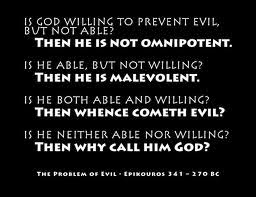
The Problem of Evil: 

Either: 

a) God is able to prevent evil, but is unwilling (and thus not omnibenevolent), or 

b) God is willing to prevent evil, but unable (thus not omnipotent),  

Therefore: 

The existence of evil is evidence against God’s existence.

Groothuis dispenses with 5 false answers to this problem: atheism, a finite god, a god who is not good, nonexistent evil, and karma/reincarnation.

In order for evil to be a problem, it can’t just be an illusion, as various pantheistic religions believe it is. There must be objective evil–which requires that there must be objective goodness…for evil cannot exist without something to pervert. Various pantheistic religions make the moral judgment that “Being concerned with right and wrong is a ‘sickness of the mind'” — it refutes itself in saying that such a moral judgment is itself sick. Atheism can point to nothing in reality that is always as it should be. Neither a finite god, nor a god who is not good, is as god should be (omnipotent, omnibenevolent). Religions that believe in karma and reincarnation deny the reality of the self–but then, if that’s true, there are no enduring individual selves to reincarnate, no selves for karma to act on…and an impersonal system like karma cannot evaluate or govern.

By contrast, the Christian view grounds goodness in God’s unchanging love-despite-adversity, accounts for evil with human free will to depart from God’s image in us (whether or not we evolved), and redeems the wreck we are in with Jesus’ death and resurrection, and the promise of a new heavens and new earth.

The section on free will: I disagree that libertarian freedom contradicts God’s sovereignty–and counter that a compatibilist view of “freedom” (genuine agency is compatible with the determination of the agents actions by factors outside of the agent) contradicts the possibility of human responsibility. See Geisler’s moderate-Calvinist resolution in “Chosen But Free.”

The Christian view defends God’s allowance of evil– “A good God will eliminate evil as far as he can without either losing a greater good or bringing about a greater evil.” (Plantinga, p. 631 of Groothuis) One biblical example is that Joseph’s brothers sold him into slavery, but God meant it for good (Genesis 50:20). There are no gratuitous (pointless) evils. The ultimate example of good triumphing over/through evil, is Jesus’ death and resurrection. The idea of “redemption” will set everything right in the end.

I want to end with a quote from C.S. Lewis, mentioned in Keller’s “The Reason for God” — “They say of some temporal suffering, ‘No future bliss can make up for it,’ not knowing that Heaven, once attained, will work backwards and turn even that agony into a glory.” (34) Also see the Dostoevsky quote that precedes it in that chapter by Keller.

Book Discussion Index 
Posted in Apologetics, Evil as Privation of Good, Groothuis' 'Christian Apologetics', Predestination, Problem of Evil & Hell, Reviews and Interviews | Leave a comment

Defining the good: The Golden Rule

http://www.pflaum.com

IN DESPERATE NEED OF EDITING/UPDATING, DON’T JUDGE!

A major argument for God’s existence is that, if there is no God, there is no “true” good, because truth is that which corresponds to reality, to real being. A common counter-argument heard from atheists, agnostics, and skeptics is that this does not account for the definition of moral goodness. If God is the source of goodness, does he define what it means to be good via his commands (hence, it is fiction, not truth), or is it a standard he himself follows (hence, he is not the highest absolute)? In other words, theists cannot define goodness just by grounding it in God’s nature. True, but we don’t claim to.

When we do attempt to define goodness (a separate issue from its grounding), the skeptic’s counter-argument becomes that our definition of goodness would be true whether or not God exists. For example, a successful argument in favor of the Golden Rule means that the Golden Rule is true on its own two feet and does not need to be grounded in God. However—if God does not exist, to what is the Golden Rule true? What being in reality does it describe? So we need both—we need moral truth to be grounded in real being, and we need to know what it means to be good. Those more experienced in philosophy might recognize this is Plato’s “justified true belief,” Hume’s “is ought distinction,” and the resolution to Euthyphro’s dilemma.
Many apologists I come across claim that we don’t need to define goodness, but many skeptics view this as a cop-out. Therefore, this essay, rather than centered on grounding goodness, is centered on defining it (while also insisting it is not true unless grounded in real being). The Golden Rule will be stated out front, referred to throughout, and finally defended.

“In everything, therefore, treat people the same way you want them to treat you, for this is the Law and the Prophets.” (Jesus, Matthew 7:12)
Made up laws, or laws that are true to nothing, are sandcastles for the tide. Nihilists admirably claim this is why there is no moral truth—because there is nothing in reality to which it can be true. But, if the Golden Rule is true to nothing, why do we find it in every major culture throughout history? This seems to indicate a universal hunger for true meaning and goodness. But to what is it true?—what in reality does it describe? Does it have rival theories in Ethics? Indeed, it does…
We are going to survey how the major ethical theories measure up to eachother when they answer questions like “What should our character be?” “What should we do as far as our conduct or duty is concerned?” and, “What is the ultimate end or consequence?” –all as pertains to the Other/self. So many theories are some attempt at improving the Golden Rule, which might come up in many chapters of an introductory Ethics text, but ironically never gets its own. This time, we’re going to give it its own section at the end. But first, let’s see how all the other major theories work out.
Greek Virtue Theory – Character
Greek virtue theory answers the questions of Ethics by emphasizing a virtuous (rational) character. Happiness is an important consequence only achieved if we fulfill the real purpose for our character, built when our conduct is according to the Golden Mean between a vice of deficiency and a vice of extremism.  Virtue ethics considers character to be more fundamental than conduct, because, in Aristotle’s words, “We are what we repeatedly do. Excellence, then, is not an act, but a habit.”
Plato’s virtue theory, with its producers, warriors, and rulers, is racist, classist, etcetera, thinking that certain types of humans are essentially different from others and therefore have different essential moral obligations and rights.
Aristotle improved on Plato by proposing that what humans do best (men, in particular), is reason, or contemplation. Moral virtue involves reasoning out the Golden Mean on a consistent, character-building basis. For example, the Golden Mean between destructive criticism and deficient criticism is constructive criticism.
One might get things right on accident using the Golden Mean, but there is the potential to get things wrong, because reason is emphasized over love. Making a rational character the highest virtue leaves the Other out of our moral considerations. Although we should behave rationally in our dealings with the Other, “reasoning well” (like being powerful) does not even require an Other (even one’s self) to be in existence. A mindless computer programmed to make decisions according to the Golden Mean would be considered virtuous.
The ancient Chinese philosopher, Confucius, also came up with the mean, the middle state of moderation, but unlike Aristotle, Confucius expressed a version of the Golden Rule. “For Confucius the superior man is one who shuns pride and strives for humility; Aristotle would have considered such a man to have insufficient self-appreciation.” (507) But there is nothing in reality to which Aristotle’s virtue theory can always be true—there is nothing in reality it always describes.
However, here’s something my introductory Ethics text failed to mention: Though you won’t find the Golden Rule in Aristotle, you can find the Golden Rule in ancient Greece. And perhaps when Socrates talks about “the god” (Apology, 3b, 14c)—that is the being to which the Golden Rule corresponds?
Atheist Existentialism – Character Revisited
In atheist existentialism the questions of Ethics are somewhat answered by emphasizing an authentic character, valuing that we take responsibility for our choices, and considering important the consequence of responsible freedom.  The answer to the question isn’t as important as experiencing it as true or creating it by choice.  Soren Kierkegaard, the Christian father of existentialism, is an essentialist, finding authenticity in freely choosing, despite adversity, the human responsibility to love (Golden Rule), whereas Jean-Paul Sartre, the father of atheist existentialism, is a voluntarist rejecting discovered purpose and finding authenticity in freely creating how we think humans should be. “In choosing myself, I choose man.” But this is just a restating of the Golden Rule…which we are free to choose responsibly.
Kant’s Categorical Imperative – Conduct
Whereas the Greeks thought they discovered moral value in developing one’s character according to a built-in purpose, Immanuel Kant, though valuing a virtuous disposition (a good will), thought he discovered the answer to the questions of Ethics in the categorical imperative:  “Always act so that you can will that your maxim can become a universal law.”
Important is the consequence of everyone’s moral sense being respected, but to determine whether or not our intentions are to do the right thing, we do not have to wait and see how the consequences pan out. We simply “determine whether we could imagine others doing to us what we intend to do to them. In other words, Kant proposes a variant of the Golden Rule. … (It) draws on the same fundamental realization that I called a spark of moral genius in the Golden Rule: It sees self and others as fundamentally similar.” (224-225) We share the same rationality and the same moral sense by virtue of being human beings, and so the rules are the same for all of us.
A common, though not universal, interpretation of Kant is that he “had harsh words for the old Golden Rule. He thought it was just a simplistic version of his own categorical imperative and that it could even be turned into a travesty. If you don’t want to help others, just claim you don’t want or need help from them!” (224-225) However, instead of viewing the GR as “more simplistic,” one could view it as “more basic” or “more essential.” Kant’s criticism is answered this way: The Golden Rule (treat the Other how you would want to be treated; love the Other as self) includes the Platinum Rule (treat the Other how they would want to be treated), considering we would want the Other to put themselves in our shoes in their interactions with us.
Ultimately, this stands or falls on what it means to be a self that wants what it ought to want. If not grounded on such a self, there is nothing in reality to which Kant’s categorical imperative can always be true—there is nothing in reality it always describes.
Relativism – Conduct Revisited
Relativism answers the questions of Ethics by requiring that we respect and be tolerant of the norms of other cultures, whether or not they agree with ours, and by logical implication, that we conform to our own cultural norms. The basic impulse driving this view is the admirable, merciful feeling that, just as we would not want another culture’s values forced upon ours, we should not force our culture’s values on other cultures. This is golden irony, for this is the Golden Rule incorrectly applied, suggesting again that the Golden Rule is more basic than any of its rivals.
There is much to be said for respecting and preserving cultural diversity. However, to claim such respect as essential, transcending culture, is to contradict the impulse behind cultural relativism. Further, the tolerance of relativism is ineffective in cultures without that impulse.
And note that the absolutist view is not that we force our values on (or adopt the values of) cultures that do not share whatever values are in question, but that absolutes are discovered in and transcend every culture while maintaining the precious diversity that does not destroy common ground.
Lastly, to not hold all cultures accountable to a transcultural standard (except that of tolerance, of course) is to insult the moral autonomy of each culture’s members—their status as free persons able to discern moral truth and make moral choices. It is to claim that Hitler, Martin Luther King, Jr., and Mother Theresa are morally equivalent. It is also to exclude different cultures from the benefits of following the transcultural standard—like universal human rights.
Utilitarianism – Consequences
In utilitarianism, the questions of Ethics are answered by bringing about the consequence of the greatest happiness in the greatest number of people. Conduct is determined by the greatest happiness principle, and a happy character is valued in ideas like ataraxia and eudemonia. Jeremy Bentham’s principle of utility, or the greatest-happiness principle, is as follows: “When choosing a course of action, always pick the one that will maximize happiness and minimize unhappiness for the greatest number of people.” What Bentham did not account for is that, if only a few suffer from the consequences of the act, then the overall pleasure (the end) justifies their suffering (the means).
John Stuart Mill (Bentham’s godson) attempted to resolve this by suggesting utilitarianism is just a general policy for general situations, but others after him have come up with rule utilitarianism, which would be phrased, “Don’t do something if you can’t imagine it as a rule for everybody, because a rule not suited for everyone can have no good overall consequences.” (201) According to Rosenstand, this is another attempt to fortify the Golden Rule. This differs from Kant’s categorical imperative, because it is focused on overall consequences, whereas the cat imp is supposed to be followed even if we calculate that it will not result in the common good.
Emphasizing the “end” allows for evil means and character—there must be a standard that judges the means, the character, and the end to be right. There must also be something in existence to which this standard is always true.
Egoism – Consequences Revisited
In egoism, the questions of Ethics are answered by emphasizing good consequences for the person taking the action, considering selfishness a virtue, and finding it important to act in one’s own self-interest. Egoism is Utilitarianism zeroed in on the individual. Rather than focusing on group happiness, egoism focuses on self-happiness.
Ayn Rand’s Objectivist philosophy of rational self-interest is this in a nutshell: “the actor must always be the beneficiary of his action.” Put another way: “The rights of the self/Other end where the rights of the Other/self begin”—that’s just the Golden Rule, restated: “Respect the rights of the Other, as you would have them respect your rights.”
Egoism, however, discourages fellow-feeling and a natural concern for the Other, both essential to a cultivated moral sense. Egoists would only follow the Golden Rule to avoid conflict with the Other (if they perceive such avoidance benefits self), rather than living out the empathy implicit in the timeless, self-, other-, and culture-spanning Golden Rule. And to what is Rand’s “Objectivism” objectively, always true? What self in reality does it always describe?
The Golden Rule – Character, Conduct ‘and’ Consequences
It has been shown how the Golden Rule is a more basic and essential aspect of each major theory in Ethics. Aristotle thought every man’s virtue is built in to reality, and Socrates perhaps grounded the Golden Rule in “the god.” Sartre restated the Golden Rule when he said, “In choosing myself, I choose man.” Kant grounded his categorical imperative in fairness to everyone’s shared moral sense. The impulse of relativism simply misapplies the Golden Rule. Bentham and Mill grounded their universalized happiness principle in our shared need for happiness. Ayn Rand thought the happiness of the self is just as important as everyone else’s happiness. They were all right – we are all free and responsible to choose the best purpose; we all need to be happy, to love and be loved, despite circumstances; we all share a moral sense; and the highest virtue is only always true if it always describes something essential to reality, not just in-the-moment behavior.
The Golden Rule—love the Other as self—best accounts for the questions of Ethics:
“What should our character be?” We should be someone who always loves the Other as self.
“What should we do as far as our conduct or duty is concerned?” We should always love the Other as self.
“What is the ultimate end or consequence?” Always this: That the Other is loved as self.
“In everything, therefore, treat people the same way you want them to treat you, for this is the Law and the Prophets.” (Jesus, Matthew 7:12)
And to what being in reality does this truth correspond? Who does it describe? There is only one candidate. The Golden Rule describes that essential being (“character”), demonstrated ultimately on the cross (“conduct”) when Jesus took our moral failings on himself, and gave us his moral perfection, loving us despite circumstances—the ultimate point or consequence (“consequences”).
That’s what goodness means. If that isn’t true, there is no good.
Posted in Euthyphro Dilemma, Golden Rule, Is-Ought Fallacy, Justified True Belief | Leave a comment

Bible Study Methods

51rzXL9o+PL._SL210_I panned Rick Warren’s “Bible Study Methods” for nuggets which can be used in this Bible Narrative Project study.

The emphasis will be on observing, asking questions, interpreting and applying—recording everything in a journal, and sharing at least some of it at the Project.

Tools:  Zondervan’s NASB Study Bible.  I also have an exhaustive concordance, a Bible dictionary, lexicons, atlas, a Bible handbook and other tools.  I will also use www.biblestudytools.com for additional translations and easier-to-use lexicons, as well as commentaries, et cetera. Continue reading

Posted in Bible Narrative Project, Reviews and Interviews | Leave a comment