Christian Carnival, April 18, 2012

Welcome back to the Christian Carnival!  For those new to this gig, the Christian Carnival is a weekly collection of some of the best posts of the Christian blogosphere. It’s open to Christians of Protestant, Orthodox, and Roman Catholic convictions.  We invite submissions from bloggers and readers, and collate the submitted posts into one big round-up (or “carnival”) every Wednesday.  It is also called a carnival because it is hosted at a new blog every week–and this week, it’s my privilege!  One of the goals of this carnival is to offer our readers a broad range of Christian thought. This is a great way to make your writing more well known and perhaps pick up some regular readers.

Please kick up your feet and make yourself at home.  Don’t mind all the boxes, as I am still shaping things up in my new portfolio here.  I thought I’d break in to the freelancing scene :)  Need something written?  Have a look around!

We’ll start off with submissions, then finish up with some posts I gleaned from the web.  I am not including my own submission this time because I am still chewing on an idea for an article that talks about the difference between Hume’s is-ought distinction, which maintains a valid distinction between ontology and epistemology, and the false is-ought dichotomy, which keeps values outside the realm of truth.  One can rightly reject the false dichotomy without rejecting the is-ought distinction.  I think making clear the differences between the two will help further the dialogue in this area of philosophy and apologetics.  If you want to see my past posts on Hume’s is-ought, scroll to the “Euthyphro, Hume, Plato, Gettier” section here.  Favorite topic!

Submissions:

Displayed in the order of submission:

Continue reading

Posted in Carnival | 2 Comments

This week’s Christian Carnival is…

here.  I host it at my new on-line portfolio blog :)  I am not including my own submission this time, because I am still chewing on an idea for an article that talks about the difference between Hume’s is-ought distinction, which maintains a valid distinction between ontology and epistemology, and the false is-ought dichotomy, which keeps values outside the realm of truth.  One can rightly reject the false dichotomy without rejecting the is-ought distinction.  I think making clear the differences between the two will help further the dialogue in this area of philosophy and apologetics.  If you want to see my past posts on Hume’s is-ought, scroll to the “Euthyphro, Hume, Plato, Gettier” section here.  Favorite topic!

Posted in Carnival, Is-Ought Fallacy | Leave a comment

In the mood for some GenX poetry?

If so, check this out, nested under the Poetry & Prose page.

And feel free to share your GenX poetry in the comments :)

Posted in Poetry, Poetry and Fiction | Leave a comment

Yo quiero choco-latte! :)

Abuelita

Abuelita (Photo credit: rachel a. k.)

Choco-latte is a Mexican mocha I ‘think’ I just invented.  If nobody has it yet–why not?!!!  Sure, it could be called the Abuelita mocha, but choco-latte sounds so much more chocolattey and you don’t have to pay Abuelita to use the name.  I thought of this because it was Easter yesterday, and I always pronounce chocolate with a Mexican accent.  By the way, under no circumstances should this drink be called a shock-o-latte, except perhaps on Halloween, sprinkled with bat and pumpkin marshmallows or other coffee-appropriate candies in black and orange.

Update:  After scavenging Google, I found a place called Java Hut with a Mexican mocha.  I think choco-latte is more catchy, although Google shows there is an actual shop with that name.  And I bet they don’t use Abuelita syrup!

Posted in Inventions | 1 Comment

Is there no truth, are all beliefs true, or is there only one truth?

cropped-contradict01This is something to consider in relationship to these objections to the objective truth of Christianity:

1) Claiming that Christianity is “the” truth steps on other people’s toes.

2) Science doesn’t even know the answers, and yet you claim to.

3) Like saying chocolate is your favorite icecream, faith equals opinion.

I jotted down those three objections during a round table discussion at a Reasonable Faith chapter meeting back in January and am finally getting around to including them in this post.

These are the options regarding objective truth:

No truth: The idea that it is true that there is no truth is self-contradictory. If there is no truth, the statement “there is no truth” cannot be true, either.

All true: “To deem all beliefs equally true is sheer nonsense for the simple reason that to deny that statement would also, then, be true,” (4, Zacharias, “Jesus Among Other Gods”). So, if you deem all beliefs true, then you deem true even the belief that “Not all beliefs are true.”

One truth: That is what we are left with, and what we ought to do our best to seek until we find it (or until it finds us).

Students of logic:  Regarding the square of opposition… The options are some/all/no. In my post, one=some, but the some is only one, because 1) there is only one reality to which all true beliefs may correspond, so that 2) the points where various conflicting and distinct worldviews agree and are true, correspond to one reality. If one takes away all the false, conflicting beliefs from every worldview, only one true worldview can be left.

In reply to the above objections: We can seek truth without trying to offend people, and if we avoid that pursuit in order to please sensitive people, we need to work on our boundary issues. Sometimes science does get it right, which can be seen in the progress it has made, and we can get it right by examining the historical evidence for the resurrection and the arguments for God’s existence from natural theology. And, lastly, genuine faith equals trust and is never blind (See Genuine faith is never blind).

Posted in Apologetics Toolbox | Leave a comment

Problem: If God is good and all-powerful, why does he not prevent evil, suffering and hell?

tumblr_m2y99iXTVp1r8bkolo1_500-300x217My thoughts on the solution:

1. Unconditional love is impossible if suffering and evil are impossible. God, like a good father, allows us to learn from our mistakes, rather than dysfunctionally protecting us from them by a) preventing us from making them, or b) preventing us from experiencing the consequences. If all suffering were made impossible, we would never learn what it means to love and be loved unconditionally.  It would be worse to make a world where unconditional love is impossible, than to allow all evil and suffering.  Love covers over a multitude of things.  Better off are those who love and lose, than those who never love at all.  Love is worth it.  That’s what Jesus died to show.
2. Similar to 1, Heaven (ultimate love) is impossible if it is not a choice.  If there is no alternative choice–hell–then heaven is not a choice, it is a prison.  “On the question of a loving God sending people to hell, Keller writes that God gives people free choice in the matter. ‘In short, hell is simply one’s freely chosen identity apart from God on a trajectory into infinity’ (p.78). In other words, those who end up in hell chose that destination by rejecting God.” (Penguin) Heaven wouldn’t be heaven if we had no choice but to be there.
3. If there is no God making the idea of “good” true to reality, there is no “problem” of evil, suffering, or hell. That one senses a problem is a clue to there being a God–an always good being to which the idea of “good” is true.  Without a real “good” there is no real departure from good, and thus no problem of evil.  “Paraphrasing C.S. Lewis, the author states: ‘… modern objections to God are based on a sense of fair-play and justice. People, we believe, ought not to suffer, be excluded, die of hunger or oppression. But the evolutionary mechanism of natural selection depends on death, destruction, and violence of the strong against the weak – these things are all perfectly natural. On what basis, then, does the atheist judge the natural world to be horribly wrong, unfair, and unjust’? (p.26)” (Penguin).  The naturalist has their own “problem of evil” to answer, since the only being to which the idea of “good” can be real is God.
Posted in Apologetics, Apologetics Toolbox, Problem of Evil & Hell | 4 Comments

Walk to the Cross (Easter Prep), pt.2: External/Internal Evidence

Back in February I posted part one of a lecture series on the Gospels by Tim McGrew entitled “Who Wrote the Gospels?”  Then, mid-March I posted Professor McGrew’s answer to my question, “Did Christians ‘reinterpret’ Old Testament passages to be prophecies fulfilled in Jesus, or did Jews always interpret those passages to be messianic?”  That was part one of this “Walk to the Cross” series in preparation for Easter.

For part two, here is the rest of Dr. McGrew’s series on the Gospels:

You can find links for the PowerPoint slides and handout at Brian Auten’s site, here:

Dr. McGrew writes via email, “Needless to say, we’re just scratching the surface of the evidence here. But sometimes it is better to make a start than to do nothing at all.”

So in the coming week that remains before we remember the resurrection, I hope you will make time to brew a pot of choice coffee, sit down under an old quilt and drink in this lecture series, and sift through the historical evidence of fulfilled messianic prophecies.

It will greatly enrich our celebration of Easter if we know that we are celebrating the REALITY of God’s demonstration in time and space that he loves (and forgives) us no matter what–even his own willing death.  No greater love has any man than that.

Posted in Apologetics, Apologetics Toolbox, Tim McGrew | Leave a comment

Groothuis’ "Christian Apologetics" ch.4: The Christian Worldview

“Thus from a Christian perspective, we perennially face the dual temptation either to demote ourselves below what we truly are (despair) or to promote ourselves above our true status (hubris).  All in all, humans are unique among the living.” p. 86 (Groothuis’ Christian Apologetics)

“The Christian view of humanity exalts neither the immaterial at the expense of the material (as in idealism, pantheism, gnosticism) nor the material at the expense of the immaterial (as in physicalism).” p. 86-87

“…redemption must originate from beyond the royal ruins of the self…” p. 88

(discussion index)

Posted in Against Gnosticism, Apologetics, Groothuis' 'Christian Apologetics', Reviews and Interviews | 2 Comments

True Reason apologists not welcome at Reason Rally of atheists

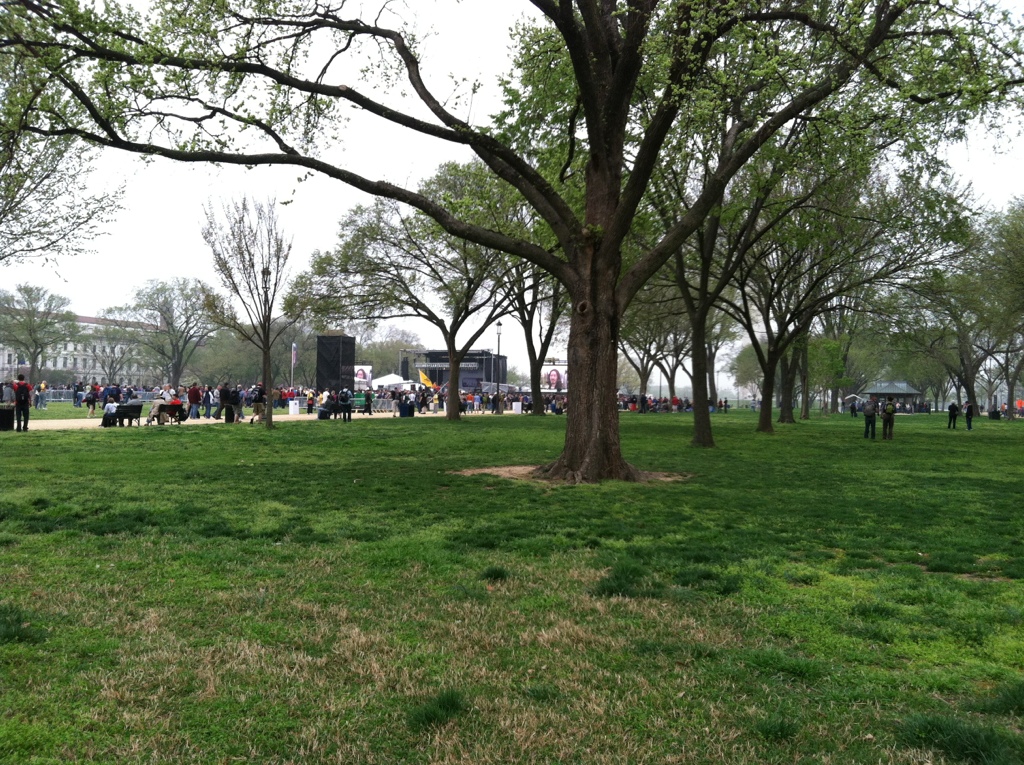
Tom Gilson’s morning view of rally
The Reason Rally of atheists and skeptics is gathering today upon the National Mall in Washington, D.C. to celebrate a common lack of belief in any particular faith and to demarginalize as a collective voice. But today is not so much about good reasoning as it is about:

…drawing attention to our movement. This is about getting media attention. This is about getting all those people not attending the rally (or who don’t even know there are so many other atheists out there) to notice us… —FriendlyAtheist

Invitations to reasoned debate and dialogue from Christian apologists of the True Reason collaboration have been abruptly declined, whereas an invitation to the rally was graciously extended to Fred Phelp’s infamous Westboro Baptist Church, attracting objectionsfrom bloggers of the Christian Apologetics Alliance and Ratio Christi. It seems Reason Rally organizers so highly esteem publicity that they will invite it even when it runs completely counter to reason.

Peer review is completely lacking in refusing to encourage dialogue with those critical of the atheist worldview and trained in reasoned debate. Rather, the rally organizers create an atmosphere of mutual ridicule, inviting Westboro Baptist.

Edited by Tom Gilson and Carson Weitnauer, the book side of the True Reason response includes contributions from William Lane Craig and Sean McDowell and discusses the “Explanatory Emptiness of Naturalism”, how evolution and God’s existence do not conflict, “Historical Evidences of the Gospels”, the problem of evil, slavery, “Did God Command the Genocide of the Canaanites?” and how the New Atheist movement’s persuasive techniques rely more on rhetoric and appeal to emotion than reason.

Posted in Apologetics, News | 1 Comment

David Silverman of American Atheists: Reason Rally not about dialogue

Reposting from In Defense of the Christian Faith:

With the secular Reason Rally only a few days away, I am featuring a guest post today from Tom Gilson titled, “REASON RALLY ORGANIZER TO REASONING CHRISTIANS: WE WANT NO DIALOGUE.” Tom is a leader in the True Reason initiative to take Christian apologists down to the Reason Rally for respectful dialogue should anyone there be interested. I have received a few comments from atheists expressing their concern that the True Reason initiative is nothing more than an attempt to disturb — or proselytize, as it is stated in the article below — atheists. This is not true, and I encourage anyone wondering about that, to read the article below, to peruse the True Reason website where the mission is clearly stated, and to take a look at Tom’s site at Thinking Christian for more.

————–
On March 12 I wrote an email to David Silverman, president of American Atheists. It was a message from the leader of one organization to another, on behalf of both our organizations.
I introduced myself as a leader of the True Reason initiative, which I described to him as “bringing Christians to the Reason Rally for respectful dialogue with atheists there.” I also mentioned that I was involved in producing the True Reason ebook. I proposed that we co-sponsor a debate between Richard Dawkins and William Lane Craig, While Dr. Dawkins was in the U.S. Mr. Silverman wrote back the following day. You can read the full text of both our emails on the True Reason Media page.
On that site you can also find a link to an invitation that the National Atheist Party had sent to the infamous Westboro Baptist hate group. The contents of that invitation stand in stand in sharp contrast to Mr. Silverman’s letter to me. On or before March 6, the National Atheist Party had told Westboro Baptist,
I am writing you today to invite you to a very special event…. Surely you would not want to miss history being made…. As an official Reason Rally sponsor, the National Atheist Party will be manning an information booth from which to promote our organization. Stop by and socialize if you have time…. Come on out and join the fun! We hope to see you there.
That message was sent to a hate group whose tactics and beliefs are rejected by the vast majority of Christians as much as by atheists or anyone else — a group that few would seriously expect to enhance reasoned dialogue between Christians and non-Christians.
A week later, the day after I sent him my message, Mr. Silverman wrote back to us, a group that has made strong commitments to quiet, respectful, non-disruptive, non-pushy, person-to-person conversations at this event. He said in part,
Make no mistake – you are not welcomed guests at the rally. We are not going to DC for ‘dialogue’ with people who believe ridiculous things – we are going to have fun with other like-minded people. Those who proselytize or interfere with our legal and well-deserved enjoyment will be escorted to the 1st Amendment pen by security, which will be plentiful, where you can stand with the Westborough [sic] Baptists and shout yourselves hoarse.
Spreading out among the crowd is not a substitute for a permit. Indeed, I will be meeting with the Parks Commission on Thursday to discuss how to handle your infiltrative permitless counter-protest.
You can read the entire text at the link given above.
A few observations:
1. The Reason Rally is being held on the National Mall in Washington, D.C., which is public land under the jurisdiction of the National Park Service. Everyone has equal right of access there.
2. Everything we are planning to do there is entirely permissible under Park regulations and the First Amendment. Nothing we are planning to do requires a permit, because we are explicitly not going to the Reason Rally to mount a counter-protest, but to engage in reasoned dialogue. To “proselytize” (his word, not ours) by way of quiet, respectful dialogue is perfectly legal; it is not grounds for being escorted away.
3. Mr. Silverman has nevertheless apparently interpreted our plans — respectful, person-to-person dialogue — as constituting interference and/or proselytizing, such as would lead to our being ejected to the “1st Amendment pen.” Now suppose some other Christian were there engaging in quiet, non-disruptive conversation with a rally attendee. Would Mr. Silverman say, “Are you with True Reason? Oh, you’re not? Then fine. Please continue.” That would not be consistent with the content of his message. From this it appears to me it is not True Reason that is unwelcome, it is what Silverman describes as “interfering” and “proselytizing,” or what others would call normal interactions between two persons who respectfully hold differing opinions. Thus Mr. Silverman’s warning quite believably applies to any Christian who might come to this public event on the National Mall.
4. Nothing in our history or documents gives any indication that we are going there to hold a counter-protest. There is another group being welcomed there, however, that has a well-known history of picketing and protesting.
5. Mr. Silverman’s statement, “We are not going to DC for ‘dialogue’ with people who believe ridiculous things,” is in one sense understandable in light of the purpose of the Reason Rally: it just isn’t what the Rally is for. It echoes, however, a much more broad and inclusive statement he recently made to CNN News. After being prompted with the question, “It sounds like you’re looking for a conversation…,” he answered, “Well they dismiss our [beliefs], and we dismiss theirs, and frankly we’re not looking for a conversation.” Reasoned dialogue between people who treat one another reasonably is nowhere in view here.
6. Virtually all of the Reason Rally’s sponsoring organizations emphasize howreasoned and reasoning they and their beliefs are. They consistently accuse religious believers of being opposed to reason. But through the National Atheist Party they are welcoming a group that is known primarily for hateful slogans and signs, while at the same time another organizer is threatening, with loaded language (“shout yourselves hoarse,” “infiltrative permitless”), to have security evict us from the primary event grounds, even though we are planning to come just for the purpose of promoting reason and dialogue. How reasonable is that? How does it promote reason?
We invite the Reason Rally organizers to a higher standard – to be reasonable in their dealings with others, and to be unafraid of reasoning with those who respectfully disagree with the secular position.
P.S. Needless to say, he declined the opportunity for a reasoned debate between Craig and Dawkins.
Posted in Apologetics, News | Leave a comment