Predestination and Free Will

This thread updates the old “determinism and free will” thread.

Predestination and Free Will

I start off asking a question for the purpose of introducing concepts in its answer: freedom and determinism: compatible or incompatible? Ultimately, though, the question is: predestination and free will… either/or… or both/and? It will be shown that determinism and predestination are different concepts – this is a key difference between this thread and the old thread.

Freedom and determinism: compatible or incompatible?

Defining freedom:

Incompatibilist freedom: “there are no conditions prior to an action that determine that action,” (p. 195, Intro. to Philo.).
Compatibilist freedom: “there can be conditions prior to an action sufficient to determine that action, and yet that action can be free,” (p. 195, ibid.).

Defining determinism:

Determinism: “theories about universal causation and total predictability … the belief that all events are governed by laws,” (pp. 194-195, ibid.). “By ‘determinists’ here we mean those who deny that in moral decisions we are free to do other than we do. A determinist, as opposed to a self-determinist, believes that all moral acts are not caused by ourselves but are caused by someone (or something) else,” (p. 31, Chosen But Free; CBF).

Different views:

The Two-Level Theory (reasons are not causes) “maintains that beliefs in determinism and free will are in some sense independent. … Reasons are essentially different from causes,” (204, Intro. to Philo.). I’m not really interested in going into this.

Hard Determinism (no free will) “applies to what we may call the physiological states and changes in our body such as height, weight, growth, pulse rate, and so forth, as well as to our purposive deliberative behavior. …If the hard determinist account of action is true, it is difficult to see how anyone can be responsible for his actions. The only basis of either praise or blame is to be found in its consequences. … One imagines that he deliberates, but that is exactly what it is, an imagination. … The hard determinist denies that any alternative action is causally possible. Every action is necessary,” (198, Intro. to Philo.).

Theological determinism – “the view that God ordains every event and situation; man does not have the capacity to choose or influence his own ultimate destiny,” (205, ibid).

Soft Determinism (compatibilist) claims “(1) determinism is true, and therefore events including human behavior, voluntary or otherwise, arise from antecedent conditions, making alternative kinds of behavior impossible; (2) voluntary behavior, however, is free to the degree that it is not performed under external compulsion; and (3) in the absence of external constraint the causes of voluntary actions may be traced to certain states, events, or conditions within the agent, namely his will or volitions, choices, decisions and/or desires,” (199, ibid). “Soft determinists assert that all that is necessary (to consider the will ‘free’) is that we have reasons, we decide, and we carry out decisions without external compulsion,” (201, ibid) (they deny contra-causal power).

Jonathan Edwards’ divine determinism — “Jonathan Edwards ‘solved’ the problem of predestination and free will by claiming that (1) free will is doing what we desire; (2) but God gives us the desire to do good,” (23, CBF). This does not solve the problem because it does not account for evil desires, which God cannot give.

R.C. Sproul — “In spite of the fact that his mentor, Jonathan Edwards, rejects the view of human freedom called self-determination, R.C. Sproul speaks of free will as ‘self-determination’ … but Sproul simply means it is not determined (caused) by anything external to itself. It is determined by things internal to itself, namely, by its nature. This is not what is meant in this discussion by a ‘self-determined action,’ which is one freely caused by the self (the I) without either external or internal constraint,” (21, CBF).

Simple Indeterminism (no determinism) contends that uncaused events are our free acts, not governed by any law, scientific or otherwise. “Some defenders … invoke Heisenberg’s principle of uncertainty … the basis for the quantum theory in physics,” (201-201, Intro. to Philo.). However, “if we should conceive of a decision as utterly without any cause (this would in all strictness be the indeterministic presupposition) then the act would be entirely a matter of chance, for chance is identical with the absence of a cause; there is no other opposite of causality,” (393, Schlick*).

Libertarianism (self-determinism) asserts “that our free actions are neither caused by another (as in determinism) nor are they uncaused (as in indeterminism). Rather, they are self-caused. Hence, the view is sometimes called self-determinism because of the theory of personal agency. / A human being (person or self… even Hume presupposes the real existence of an ‘I’ or entity behind his impressions which gives unity to them) is sometimes, although admittedly not always, a self-determining being. We are, in other words, sometimes the cause of our own behavior (not causing our self, but causing our behavior). The libertarian holds that for an action to be free it must be caused by the agent who performs it, and it must be done in such a way that no antecedent conditions are sufficient for the performance of that act. If an action is both free and rational, the action must be done for a reason, although the reason is not the action’s cause. This means that we could always have done otherwise. At least two possibilities were live options. / This account of freedom is the only one which does justice to the deeply-ingrained intuition that we do have contra-causal power. Second, this view alone makes any sense of the activity of deliberation. All the positions examined to this point, so it is argued, really do not properly account for human deliberation,” (202-203, Intro. to Philo.).

***

Predestination and free will… either/or… or both/and?

Geisler & Feinberg’s discussion on libertarianism (self-determinism) in “Intro. to Philo.” does not address the reality that “…our free actions are determined from the standpoint of God’s foreknowledge,” (45) as Geisler does in “Chosen But Free”. Chosen But Free compares extreme Calvinism, which sacrifices free will to save predestination, extreme Arminianism, which sacrifices predestination to save free will, and the preferred moderate Calvinism, which shows free will is compatible with predestination. In “Intro. to Philo” it is said that “libertarianism holds that determinism and freedom are incompatible,” (202). This is because there is a difference between the concept of determinism mentioned above, and the way the universe is actually determined (predestination).

Defining predestination compatible with free will:

“Whatever God foreknows must come to pass (i.e., is predetermined). … By ‘determined’ here we do not mean that the act is directly caused by God. It was caused by human free choice (which is a self-determined act). By ‘determined’ it is meant that the inevitability of the event was fixed in advance since God knew infallibly that it would come to pass. Of course, God predetermined that it would be a self-determined action. God was only the remote and primary remote cause. Human freedom was the immediate and secondary cause,” (44, CBF). Predestination “implies that God has actually determined (rather than simply saw) in advance the destiny of creatures,” (wikipedia). Consider that “God not only created all things, He also upholds all things. Hebrews declares that God is ‘sustaining all things by His powerful word’ (Heb. 1:3). Paul adds, ‘He is before all things, and in Him all things hold together’ (Col. 1:17). John informs us that God not only brought all things into existence but He keeps them in existence. Both are true for ‘they were created and have their being’ from God (Rev. 4:11). There is ‘one Lord, Jesus Christ, through whom all things came and through whom we live’ (1 Cor. 8:6; cf. Rom. 11:36). Hebrews asserts ‘it was fitting that God, for whom and through whom everything exists, should make the author of their salvation perfect through suffering’ (Heb. 2:10),” (12, CBF).

“First, it is possible that God knows from eternity that an event that is future to us would one day occur (and then be true). In this case, it would not be true in advance before it occurred, but it would be true that God knew in advance that it would one day occur and then be actually true.

“Second, … God … is eternal, that is, beyond time … Hence, nothing is future to God. If God is beyond time, then all time is spread before Him in one eternal now. He sees the way a man on the top of the hill sees the whole train at once, while the man in the tunnel below sees only one car going by at a time, noticing neither the one already past nor the one yet to come. God is not standing on one day of the calendar of time, looking back at the days past and forward to the days to come. Rather, He is looking down on the whole calendar, seeing all the days at once (cf. 2 Tim. 1:9; Titus 1:2),” (110-111, CBF).

Questions in Wikipedia’s predestination article answered:

1. “Is God’s predetermining decision based solely on a knowledge of His own will, or does it also include a knowledge of whatever will happen?” (wiki)

Both. God’s predetermination is in accord (1 Peter 1:2) with His foreknowledge. If based solely on His will, this is ‘voluntarism’ which “affirms something is right simply because God willed it, rather than God willing it because it is right in accordance with His own unchangeable nature (a view called essentialism). If voluntarism is accurate, then there is no moral problem with irresistible grace on the unwilling, limited atonement, or even double-predestination. If, on the other hand, God’s will is not ultimately arbitrary, then extreme Calvinism collapses,” (244). The alternative to voluntarism is essentialism, which “contends that God wills it because it is right. … There are two basic forms of essentialism: either God is bound to will things in accordance to some standard outside Himself (as in Plato’s Good) or else by the standard inside Himself (namely, His own nature). The latter is held by Christian essentialists,” (247, CBF). On the other hand — “if God’s choice to save was based on those who choose Him (‘whatever will happen,’ wiki), then it would not be based on divine grace but would be based on human decisions,” (51, CBF) (Romans 9:16). He does not base His choice on who He foresees will receive His gift (Arminianism) – but He knows in advance who will receive His salvation (persuasive, but not coercive) because He is beyond time. For more on this, go here:

http://jesuschristsonofgodsavior.blogspot.com/2008/01/god-wills-it-right-because-he-is-good.html

2. “How particular is God’s prior decision: is it concerned with particular persons and events, or is it limited to broad categories of people and things?” (wiki)

Both. He is intimately familiar with every detail. However, His sovereignty does not prevent free choice. Even if you have the power to force your child to behave a certain way, you can still step back and allow your child to make her own decision. The same is true in the case of God’s power and our decisions.

3. “How free is God in effecting His part in the eventual outcome? Is God bound or limited by conditions external to His own will, willingly or not, in order that what has been determined will come to pass?” (wiki)

God is free because this is all determined from beyond time (from His perspective, there is no “in order that (it) will come to pass” – it has already happened). God is bound to will according to His own nature. This sounds like determinism (above) but it isn’t, because He incorporates our free choices from beyond time. We, made in God’s image, are co-creator creations.

Furthermore, the same sort of considerations apply to the freedom of man’s will.

1. “Assuming that an individual had no choice in who, when and where to come into being: How are the choices of existence determined by what he is?” (wiki)

“Don’t my background, training, and environment affect what I do? Yes, they do, but they do not force me to do it. They affect my actions, but they do not effect (i.e., cause) them. They influence but do not control my actions,” (26, 27, CBF). This includes predisposed or biological inclinations or character traits. I think this is important because I used to be the sort of determinist who would say that knowledge does not increase freedom as far as free will is concerned – everything we come to know determines how we will think, feel, behave, etcetera, differently, from that point on. I no longer deny free will, and the most essential person we can ever come to know who will lead us to increased freedom, on so many levels, is Jesus.

2. “Assuming that not all possible choices are available to him: How capable is the individual to desire all choices available, in order to choose from among them?” (wiki)

Only God is omniscient of all possible choices, and therefore only God is omnipotent (completely free). But one does not need complete freedom in order to exercise freedom; one need only two options, not all options, in order to make a choice. Granted, only one choice will be made, and from God’s perspective, the alternatives were never actual. Also, the closer our walk with God, the freer our will.

3. “How capable is an individual to put into effect what he desires?” (wiki)

This (like the previous questions) has nothing to do with whether or not he has free will, but it does point out there is a continuum of freedom. Not being able to perform what you ‘will’ (or ‘will’ all possible choices) does not negate the fact that you are freely willing. I disagree with a few philosophers that it isn’t “willed” unless it is “acted out”. That there is an obstacle does not negate the fact that if it were removed, I could then perform the action according to my free will that was free before and regardless of the performance of the action.

“Chosen But Free” (Geisler) goes into verses of the Bible to show how extreme Calvinists, extreme Arminians and moderate Calvinists interpret them. If you are curious about a particular passage, just ask. The book also goes into TULIP – the five points of Calvinism, and compares extreme and moderate Calvinism according to those five points. I can go into them if you like. I highly recommend you purchase the book, as well as “Introduction to Philosophy: A Christian Perspective” by Geisler and Feinberg.

*Moritz Schlick, “Freedom and Responsibility.” [reprinted in The Philosophical Quest: A Cross-Cultural Reader, McGraw Hill, 2000]. It is interesting to note that all the articles on this issue in the reader were of the soft-determinist “goin’ with the flow” variety – basically, I’m free if I like whatever thought/feeling/action I’m involved in (though I’m not causing it… I’m just riding the kind waves of determinism). They pretty much deny the reality of personal responsibility, deny the crashing waves are caused by our own splashing around…

I also said in the old thread that I wanted to answer the problem of evil, as it pertains to God’s eternal omniscience and omnipotence.

This quote is taken from pages 329-330 of Introduction to Philosophy: A Christian Perspective (Geisler, Feinberg)

b. the second argument for dualism

The second argument for dualism is more of an argument against non-dualism (especially theism). The dualist says that the theist cannot escape the following conclusion:
(1) God is the author of everything that exists.
(2) Evil is something that exists.
(3) Therefore, God is the author of evil.

Since theists affirm God’s sovereignty and creative power over all that exists, they cannot deny premise 1. Likewise, since theists do not, like pantheists, deny the reality of evil, they cannot deny premise 2. But this means theists seem stuck with an unwanted conclusion, since it makes God directly responsible for creating evil.

Theists respond to both premises. First, God is the author of some things only indirectly. For example, God created freedom, but He does not perform acts of evil Himself or through man’s free choice. To state it another way, God does not create evil directly or essentially but only incidentally. God is directly responsible only for the fact of freedom, not for all the acts of freedom. Of course, God did create the possibility of evil when He made men free. But it is free creatures who bring about the actuality of evil. God is indirectly responsible for evil in that He made evil possible. But the possibility of evil is actually a good—it is necessary for human freedom. The power of free choice is a good power; the fact that men abuse freedom does not make freedom bad. Men abuse everything, including the water and air in their environment. But this obviously does not mean that water and air are bad.

Many theists also object to the second premise. Evil is not a “thing” (or substance). Evil is a privation, or absence of good. Evil exists in another entity (as rust exists in a car or rot exists in a tree), but does not exist in itself. Nothing can be totally evil (in a metaphysical sense). One cannot have a totally rusted car or a totally moth-eaten garment. For if it were completely destroyed, then it would not exist at all. The Christian points to Scripture which says everything God made was “good” (Gen. 1:31); even today “every creature of God is good” (1 Tim. 4:11), and “nothing is unclean in itself” (Rom. 14:14). To be sure, the Bible teaches that men are totally depraved in a moral sense, since sin has extended to the whole man, including his mind and will (Rom. 3; Eph. 2). But total depravity is to be taken in an extensive sense (affecting the whole man), not in an intensive sense (destroying the very essence of man).

When the theist says that evil is no “thing” (substance) he is not saying evil is “nothing” (that is, unreal). Evil is a real privation. Blindness is real—it is the real privation of sight. Likewise it is real to be maimed—it is a genuine lack of limb or sense organ.

Evil is not mere absence, however. Arms and eyes are absent in stones, but we would not say that stones are deprived of arms and eyes. A privation is more than an absence; it is an absence of some form or perfection that should be there (by its very nature).

Relevant article:  Does free will conflict with sovereignty?
Posted in Divine Essentialism, Predestination | 8 Comments

Can God do the meaninglessly impossible? *yawn*

Can God make a rock so heavy He can’t lift it?

It’s about logical paradox. When something is a paradox, it loses meaning.

God cannot make a rock so heavy He cannot lift it, because that is a meaningless statement.

God cannot defy logic. He is still, however, all-powerful.

God doesn’t defy logic. God is rational by nature. To be all-powerful means to have the ability to perform all that is possible (logically meaningful) to perform. Therefore He cannot do things which are logically meaningless, like create something that is logically impossible — a rock He can’t lift… or do something that defies His perfect nature — like lie (with malicious intent). (Keeping the future from us is not a malicious lie.)

Ultimately it is not an exercise of power, but of weakness, to do things which defy God’s perfect nature.

God is still free when His nature is rational. To explain, I will quote from Geisler and Feinberg’s “Intro. to Philo. / A Christian Perspective”

“Essentialists contend that God’s nature is the ultimate norm in accordance with which His will cooperates. …God wills what is essentially good without there being some ultimate standard beyond Himself. The ultimate norm for all good flows from the will of God but only in accordance with the nature of God. Thus God is neither arbitrary nor less than ultimate,” (323).

God’s nature is good and rational, and He wills in accordance with His nature — which is not beyond Himself.

This means there is no such thing as a rock He can’t lift (it is impossible for such a rock to exist) — and He can’t create a thing that is impossible to exist, because it has no meaning.

For all the same reasons, He cannot create a situation where He can lie maliciously, nor can He create a God greater than Himself. It is impossible for Him to change His own rational, good nature… to do that would be to defy His nature. He is the only truly free being because of His nature — to defy His nature (impossible for God) equates to bondage and weakness, not freedom and strength.

http://www.str.org/site/News2?page=NewsArticle&id=5160
http://www.godandscience.org/apologetics/rock.html

Here’s something I hadn’t mentioned yet… from my “Intro to Philo. / A Christian perspective” book by Geisler and Feinberg….

Other theists explain that the problem begins with the use of a double negative: “If God cannot make a stone that He cannot lift, then He is not omnipotent.” If we were to put this into logical notation, however, the statement would read: “Any stone which God can make, He can lift.”
p. 274

The question, “Can God make a rock so big He can’t lift it,” is not asking “is there omnipotence” — but, instead, is asking “what is the nature of omnipotence?” — it is not asking “Is God ominipotent?” or “Is omnipotence possible?” — it is asking, “does being omnipotent mean you can even contradict your own omnipotence?” And the answer is: no — that is not what omnipotence means. Omnipotence applies to the real world, and things that are meaningless, contradictory, and paradoxical are not part of the real world.

“A rock so big God can’t lift it” — think about that all by itself. It contradicts His omnipotence and is therefore a meaningless figment of the imagination. A rock so big God can’t lift it is a logical impossibility. That is why people answer “God cannot do the impossible” — it is shorthand.

There is a verse that says “With God, all things are possible,” — but He is not talking about logical impossibilities — He is talking about reality. Creating a rock so big God can’t lift it is not an “anything” it is a “nothing.”

While we’re on the note of omnipotence despite not exercising it — in Jesus we see true omnipotence. He could have brought swift justice to His accusers, but He sacrificed His life for them instead (and rose again, ’cause He’s God).

Posted in Apologetics | 1 Comment

Mystery in the Bible

Supernatural truths are divinely introduced via revelation from God, and so are referred to as ‘mysteries’ – as they are not “self-evident” (natural) truths (Rom 1:20; 2:14-15). Here is a collection of Zondervan NASB Study Bible notes on verses which contain the word “mystery” or “mysteries”. A nice supplement to this thread is the faith thread I will post in a minute.

Matthew 13:10-17 (read it) NASB note: Jesus speaks in parables because of the spiritual dullness of the people.

Mark 4:11-12 (read it) NASB note: In the NT “mystery” refers to something God has revealed to His people. The mystery (that which was previously unknown) is proclaimed to all, but only those who have faith understand. In this context the mystery seems to be that the kingdom of God had drawn near in the coming of Jesus Christ. / Jesus likens His preaching in parables to the ministry of Isaiah, which, while it gained some disciples (Is. 8:16), was also to expose the hardhearted resistance of the many to God’s warning and appeal.

Luke 8:10 (read it) NASB note: “mysteries of the kingdom of God.” Truths that can only be known by revelation from God (Eph 3:2-5; 1 Pet 1:10-12). “that seeing they may not see.” This quotation from Isaiah (6:9) does not express a desire that some would not understand, but simply states the sad truth that those who are not willing to receive Jesus’ message will find the truth hidden from them. Their ultimate fate is implied in the fuller quotation in Matt 13:14-15.

Romans 11:25 (read it) NASB note: “mystery.” The so-called mystery religions of Paul’s day used the Greek word (mysterion) in the sense of something that was to be revealed only to the initiated. Paul himself, however, used it to refer to something formerly hidden or obscure but no revealed by God for all to know and understand (see 16:25; 1 Cor. 2:7; 4:1; 13:2; 14:2; 15:51; Eph 1:9; 3:3-4, 9; 5:32; 6:19; Col. 1:26-27; 2:2; 4:3; 2 Thess 2:7; 1 Tim 3:9,16). The word is used of (1) the incarnation (1 Tim 3:16; see note there), (2) the death of Christ (1 Cor 2:7, “God’s wisdom is a mystery”), (3) God’s purpose to sum up all things in Christ (Eph 1:9) and especially to include both Jews and Gentiles in the NT church (Eph 3:3-6), (4) the change that will take place at the resurrection (1 Cor 15:51), and (5) the plan of God by which both Jew and Gentile, after a period of disobedience by both, will by His mercy be included in His kingdom (v. 25).

Ephesians 3:3 (read it) NASB note: Here the word “mystery” has the special meaning of the private, wise plan of God, which in Ephesians relates primarily to the unification of believing Jews and Gentiles in the new body, the church (see v.6). It may be thought of as a secret that is temporarily hidden, but more than that, it is a plan God is actively working out and revealing stage by stage (cf. 1:9-10; Rev. 10:7).

Colossians 1:26 (read it) NASB note: This word (mystery) was a popular, pagan religious term, used in the mystery religions to refer to secret information available only to an exclusive group of people. Paul changes that meaning radically by always combining it with words such as “manifested” (here), “made known” (Eph 1:9), “bring to light” (Eph 3:9) and “revelation” (Rom 16:25). The Christian mystery is not secret knowledge for a few. It is a revelation of divine truths—once hidden but now openly proclaimed.

1 Corinthians 2:14 is apparently ued to support the idea that unregenerate persons cannot even understand the Gospel or any spiritual truths of Scripture. Geisler responds:

This interpretation, however, fails to take not that the word “receiveth” (Greek: dekomai) means “to welcome.” It simply affirms that while he does perceive the truth (Rom. 1:20), he does not receive it. There is no welcome in his heart for what he knows in his head. He has the truth, but he is holding it down or suppressing it (Rom. 1:18). It makes no sense to say that an unsaved person cannot understand the gospel before he is saved. On the contrary, the entire New Testament implies that he cannot be saved unless he understands and believes in the gospel. (pp. 61-62, Chosen but Free)

Posted in Against Gnosticism | Leave a comment

Glimpse of Eternity

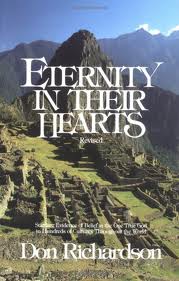
UnknownThis post gives a glimpse of “Eternity in Their Hearts” by Don Richardson, who is recognized for his anthropological and linguistic work among the Sawi people of Irian Jaya.

Edward B. Tyler’s theory that monotheism evolved has been refuted for a long time.  The theory goes like this:  Belief in the soul emerged from pondering dreams, etc.; spiritism/animism emerged when they applied the belief of a soul to other entities; the stratification of classes in developed societies suggested an aristocracy of “gods” ruling over run-of-the-mill souls and spirits; and the monarchies suggested monotheism.  Andrew Lang, Tylor’s favorite pupil, found out about the refutations from the work of A.W. Howitt, Mrs. Langloh Parker, and others, and published “The Making of Religion” in 1898. He was virtually ostracized and ignored. Schmidt’s “The Origin of the Concept of God” by 1955 had over 4,000 pages of evidence, but Tyler’s theory is still perpetuated to this day by people who either are uninformed or ignore the refuting evidence.
Nicias of Athens, “the city glutted with gods,” because it takes an infinite number of “gods” to fill an infinite God’s shoes, asked the Creton hero/poet/prophet Epiminides to help them end their plague, because none of their gods would end it. In the very beginning of the morning, Epiminides put out a flock of hungry sheep and sacrificed the ones who laid down instead of grazed, and the plague ceased. The alters were dedicated to “agnosto theo,” the unknown god. Zeus used to be a valid word for God, but it gradually was corrupted, and so was substituted with the Greek word “Theos” (“agnosto theo”). Paul of the New Testament affirms that their unknown god is God (Acts 17:16-34). Plato speaks of one of Epiminides’ fulfilled prophecies, and Paul refers to Epiminides as a prophet when he quotes his poetry in Titus 1:12-13.
Pachacuti was an Incan king from A.D. 1438-1471. He was so committed to sun (Inti) worship that he rebuilt Inti’s temple at Cuzco. He later began to question his god’s credentials. If Inti were truly God, no mere created thing could truly dim his light. Pachacuti remembered what his father told him about Viracoacha, Creator of all things, an almost extinct memory of his own culture. The only trace left was one shrine to Viracoacha named Quishuarcaneha, and the memory passed on from previous generations. Worship of Inti and other gods were departures from a purer original belief system. Pachacuti put a stop to Inti-worship, but unfortunately only among the upper class, which was obliterated by Spanish conquistadors. A mini-reformation died in its infancy.
“Eternity in Their Hearts” gives many examples of peoples who had very biblical customs (you’ll have to read the book for more details), and many examples of peoples who believed first in a Supreme Being, some who remained faithful, never converting to false religions:
(1) The Santal of India, believe in Thakur (genuine) Jui (god). A Santal elder named Kolean told of their oral tradition of creation, the fall of man, the Great Flood, the dispersion of mankind, and how they strayed away from worshipping Thakur Jui.
(2) Ethiopia’s Gedeo people believe in Magano, omnipotent Creator of all that is. One Gedeo man named Warasa Wange prayed a simple prayer asking Magano to reveal Himself to the Gedeo people and was given a prophetic vision. He saw two white-skinned strangers erecting flimsy shelters under a Sycamore (skipping detail). A voice told Warasa they would bring a message from Magano and to wait for them. He understood part of the vision (skipping detail) to mean he would stand in identification with these strangers and their message. Eight years later that prophecy was fulfilled, and Warasa establishes churches with the two missionaries.
(3) Central African Republic’s Bantu Mbaka believe in Koro (the Creator in several Bantu languages). A missionary’s son grew up listening to the Mbaka tell how Koro sent word to their forefathers that He has already sent His Son into the world to accomplish something wonderful for mankind. The forefathers turned away from the truth and they eventually forgot what it was that His Son was going to accomplish. Many generations tried to discover the truth about Koro’s Son, but could only learn that messengers would eventually come to restore that forgotten knowledge, and that the messengers would probably have white skin. The Mbaka had their version of a Levitical clan who kept this memory alive, and many Mbaka rites of passage show Judeo-Christian parallels (skipping detail).
(4) The Chinese believe in Shang Ti (may be linguistically related to the Hebrew term Shaddai, as in El Shaddai, the Almighty), the Lord of Heaven. Gradually their ideas of Shang Ti became distant, and only the emperor was allowed to worship Shang Ti. It wasn’t long before Confucianism, Taoism, and Buddhism came rushing in to fill the vacuum. The Chinese writing system has symbols that are ironically similar to the Gospel, although I personally do not think that is conclusive.
(5) The Koreans believe in Hananim, the Great One. A Tan’gun tradition states Hananim had a Son who desired to live among men.
(6) The Karen of Burma believe in Y’wa, and never converted to idolatrous Buddhism. When they were visited by an English diplomat, they thought he was the white brother they had been waiting so long for, and asked him if he had brought the lost book. This incident was mentioned in a manuscript published 32 years later. In 1816, a Muslim traveler gave the Karen a book as a gift, the Book of Common Prayer and the Psalms. They mistakenly worshipped it, waiting for the day when a teacher would come to their village and help them understand the book. 12 years later, a Karen man Ko Thah-byu got a job from the white brother, who was coincidentally translating the Bible into Burmese. The Karen’s prophets (Bukhos) of the true God taught the Karen hymns about Y’wa, repeated oral traditions of creation, the fall of man, sacrificial offerings, the return of Y’wa, the return of a king, warning against idolatry, man’s duty to love God and one’s neighbor. The Karen’s awareness of basic spiritual facts may have matched that of history’s average Jew or Christian, and may actually predate them. (There is much detail left out.) The Karen folk religion may be the purest left on earth in modern times.
(7) The Kachin of Burma believe in Karai Kasang, the Creator, also called Hpan Wa Ningsang, Glorious One Who Creates, or Che Wa Ningchang, One Who Knows. The Kachin also believed that Karai Kasang once gave their forefathers a book which they lost, and they were open to the possibility that it would one day be restored.
(8) The Lahu of Burma believe in Gui’Sha, Creator of all things, who had given their forefathers His law written on rice cakes they had to eat during a famine. They had prophets who kept the memory of Gui’Sha alive. They expected a white brother with a white book with the white laws of Gui’Sha.
(9) The Wa believe in Siyeh, the true God.
(10) The Lisu of China also believe in the true God (no name given), waiting patiently for a white brother to bring them a book of the true God written in Lisu language (they had no alphabet, let alone printed material), and they believed they would one day have their own king (they had been subject to suppressive Chinese rule for many generations.)
(11) The Shan and Palaung Peoples of Asia verbally preserved a destroyed Buddhist scripture which quotes Guatama as saying, “After me will come Phra-Ariya-Metrai (the Lord of Mercy). When he appears, my followers must all follow him.” (However, there is a separate belief that the Lord of Mercy is the fifth manifestation of Buddha, and it should be clarified that it is not truthful to say Jesus is the fifth manifestation of anybody.)
(12) The Kui of Thailand and Burma built houses of worship dedicated to the true God, in anticipation of His messenger who would bring them the lost book. No idols were placed in these places.
(13) India’s Naga believe in Chepo-Thuru, the God who sustains everything (Chakesang dialect), also called Gwang (Konyak dialect). They never represented Chepo-Thuru with idols, and they had amazingly biblical customs. One Naga tribe, the Rengma, specified that the Supreme Being gave their forefathers His words on animal skins, but dogs ate them up. The Naga culture had a prophetess in the 1600’s, Kamhimutulu. The details of her prophecy reportedly reveal remarkable conformity to Biblical principles, and to events which began to take place among the Naga at the beginning of the twentieth century.
(14) India’s Mizo believe in Pathian (Holy Father), and offered sacrifices to Him alone. They also possess traditions of a sacred book given by Pathian, lost by their forefathers.
(15) North American Indians believe in the Great Spirit, and “EITH” discusses the Sacred Four.
He has made everything beautiful in its time.
He has also set eternity in the hearts of men;
yet they cannot fathom what God has done from
beginning to end.
(Eccles. 3:11)
Posted in Apologetics, Apologetics Toolbox | Leave a comment

The motivation to do good is God.

Some who glorify evil imply that the only motivation to do good is lost when God is not in the picture. In a way this is true, because, as Jesus said, “I am the vine and you are the branches … apart from Me you can do nothing.” A universe without God a) would not exist, b) I would rather not exist at all in (I lost my motivation when I lost faith). But, the motivation, from Nietzsche’s perspective (the first dude to say that “God is dead” thing), is fear (not reverential respect, but fear of punishment) of God, of hell. However, this is not what motivates a saved Christian. What motivates a saved Christian is that God loves us no matter what (that is all He was saying by dying for us). Evil (messing things up) is such a waste of time once you “find your motivation”. There are those (secular humanists) who claim motivation without God, but… you know… I don’t know how they do it… or if they even do (maybe their view of good is skewed (sp?)?). I just know… I personally never had that motivation after I lost faith [I became selfish to the point of narcissism (sp?)], until He found me. That isn’t to say that I only ever do good since He saved me. It’s just to say that, when I do good, it isn’t motivated by fear of punishment, but by God’s love. And, when I feel bad about doing evil (sinning), it isn’t because I’m afraid of punishment, it is because I miss the closeness to God that I feel when I am living the way that makes Him smile.

God is the source of meaning (not all meaning, just the meaning that counts here). As the source, He requires nothing outside Himself. We require something outside ourself, we need God, because He is the source and we are not. More to the point, He made us that way, so that we could be loved; could love (because He’s Love).

Why can’t we be our own source of meaning (love)? May as well ask why we can’t stop needing love. I used to find it really odd… that everything seems right in the world if that “special somebody” is around to pass the time… I used to think it was weird that we couldn’t get along fine all by our lonesome… strange that we needed others and couldn’t get that need met inside ourself…. why it hurts so much when that need is not met… so much that we can become numb to pain in self-defense. This is a powerful need. It is how it is… and it is that way for a reason… not by chance.

Posted in Divine Essentialism, Golden Rule | Leave a comment

Science Experiment with Faith

I wonder…could you do an experiment… see how easy/hard it is to “walk the walk” of a Christian (not the hypocritical Christian, but your best idea of the Christian who genuinely loves and follows Christ), depending on God to help you through it…? If so, I want you to read my “faith vs. works” thread first if you try that.

And/or why not do an experiment and pray for a month (or longer) and see what happens? Don’t just ask for stuff…. talk to Him about everything…. vent all your angry questions to Him… and, if you have time, write it down… that way you’ll have evidence when your prayers are answered.

This is an experiment, so in your hypothesis you can outline that your preconceived notions include that there is nothing out there to hear your prayers — but if there were, it would have x, y, z, etcetera, qualities (also according to your preconceived notions). Once the experiment is done, go back and outline where you were (potentially) right and where you were wrong.

Hey… it may just be the strangest thing you’ve ever done. Could be an adventure. Conducive to creativity and all that.

Posted in Apologetics | Leave a comment

Biblical criticism and interpretation.

From Zondervan’s Handbook to the Bible, 1999:
‘The text and the message’, pp. 58-59
Excerpt from ‘Studying the Gospels’, pp. 546-547

The text and the message
Craig Bartholomew

Academic study of the Bible (‘biblical criticism’) has been dominated by a number of different emphases, each in turning coming to the fore.

The first is a historical emphasis. The historical-critical method, developed in Germany in the 19th century, was taken up by scholars in Britain and the United States early in the 20th century.

This method was critical, in the sense that it read and evaluated the biblical text from the perspective of the modern worldview. It was historical, in the sense that it used the historical tools that emerged out of modern philosophy of history. It was also historical in its concern, not so much with the text in its present form as with the history of the text and the events it referred to.

The main types of analysis of biblical texts that emerged out of this approach were:
*textual criticism, concerned with the establishment of the most reliable Hebrew and Greek texts of the Old and New Testaments
*source criticism, concerned with the sources underlying the text
*form criticism, concerned with the form or genre of small units of text and the origin of their genre in the societal life of Israel
*traditional criticism, concerned with the origin and development of biblical themes in the life of Israel
*redaction criticism (from the German word for editor: redactor), concerned with the way in which the text has been edited into its final shape.

A serious weakness of the historical-critical method is its failure to focus on the books of the Bible in their present form.

Not surprisingly, in the 1970s, a literary emphasis developed in response to this failure. This new emphasis focused on the biblical books as literary texts and explored them from this angle. The narrative shape of much of the Bible received fresh attention and questions such as the role of the narrator, the shape of the plot and the portrayal and development of characters were explored.

By the late 1970s some radical new developments were taking place in literary theory. Movements such as ‘post-structuralism’ and ‘deconstruction’ raised questions such as, ‘Do texts have meanings that we can discover, or do readers construct those meanings, so that there are as many meanings for a text as there are readers?’

Because of the literary emphasis in biblical studies it was inevitable that these new movements in the theory of literature would soon have an effect. And in the last few years these new questions have been applied to the Bible.

Because they represent a reaction to modern theories these new approaches are often known as postmodernism. Postmodernism has raised complex questions about texts, authors, readers, and the world, suggesting that texts do not have single meanings and that their meaning largely depends upon the reader/s.

Under the general category of postmodernism it has become commonplace for scholars to made deconstructionist, feminist, and other readings from biblical texts. A deconstructionist reading will, for example, look for places in a text where there are tensions between the overall message and what a small section of the text may be saying. In this way deconstruction exposes contradictions that it looks for and expects to find in all texts. A feminist reading will examine how women are or are not portrayed in biblical texts.

The effect of postmodernism on biblical studies has been to undermine the dominant historical criticism, leaving no one main method in its place. The impression often given nowadays is of a smorgasbord of interpretive approaches which we can choose from and enjoy, simply as a matter of personal preference. In the broader scholarly community there is no agreement about how to read the Bible or how to move forward in biblical studies.

Biblical interpretation is in crisis!

Most recently, there are signs of a theological emphasis coming to the fore, with some scholars arguing that biblical studies require a Christian theory of interpretation. This means our approach to the Bible should be rooted in a biblical understanding of the world, and that we ought to read the Bible above all to hear what God is saying to us through it.

Two points in particular should be noted about this history of different emphases:
*The Christian story or view of the world relates to the whole of life: so a biblical theory of interpretation ought to be shaped by the Christian story. In this sense the theological emphasis is right.
*We need an integrated approach to biblical interpretation. The historical, the literary and the theological are all important aspects of biblical texts. A proper understanding of the Bible means being alert to all these, and how they relate to one another—drawing on their different insights, and integrating them within a Christian theory of interpretation.

In my opinion this is best developed by taking what may be called a communication model and understanding the biblical text in terms of:

SENDER
MESSAGE
RECEIVER

If Scripture is primarily God’s Word to us, that should be the framework within which we read it.

However, we hear God’s Word through the message of the original sender and it is here that the hard interpretive work has to be done.

A communication model of biblical interpretation will focus attention on the text in its final form, employing all its energies to help us understand the message

Analysis of the sources of the text is an important element in this process. The biblical texts were written in very different times and cultures from today and knowledge of Hebrew, Aramaic, Greek and associated languages, knowledge of the cultural context in which the text was written, and so on, are vital elements in interpretation.

The examination of sources must, however, be subsidiary to helping us understand the message of the text. And study of sources must be related to understanding the text as we have it.

Knowledge of the context also plays an important role in assessing the type of the text we are dealing with—whether it is wisdom, narrative or prophecy, for example. But this too must help us focus on the particular text and its individual structure.

The rest of the Bible is also an important part of the context of each book: exploration of this, too, must help in explaining the message of the individual book.

The aim of a communication model of interpretation is to hear the message of each book of the Bible in the context of the whole of Scripture. If we understand aspects of the history of a text and something about its literary shape but fail to hear the message, our interpretation will be faulty. Our efforts at interpretation must aim to discern the message of the text, first to its original hearers and then to readers today.

There is, rightly, a growing recognition of the role of the reader/s in interpretation. It is recognized that readers bring their own views with them in the reading process. A key question is whether or not there are right views to bring.

In my opinion there are! Scripture is most appropriately read out of a deep conviction that it is God’s Word, and readers best approach it in this way. That does not mean that there are no difficult issues in interpretation: clearly there are. But analysis of the Bible out of a biblical view of the world will allow the real problems to emerge, without creating problems where none exist.

“For many decades Old Testament scholarship has been largely preoccupied with looking through the text to what may or may not lie behind it. Scholars have come to the text as a window…

Exciting things are happening, however. Since the mid-1970s…many books have appeared which have approached the text not as a window but as a picture. They have been concerned to look at the text, at what it says and how it says it. They have encouraged…an engagement with it, an enjoyment of it. The exercise of interpretation they have promoted…has brought the imagination into play, and the emotions… It has asked readers to pay attention to the text.

One great advantage of the approach is that it does not demand an enormous amount of background knowledge before we begin. The ‘ordinary’ reader can have a go.” –Trevor Dennis

— pp. 58-59, from Zondervan’s Handbook to the Bible, 1999.

If you’re ready to “have a go” at interpretation – perhaps the Inductive Bible Study Method will help get you started: http://www.godsquad.com/discipleship/inductive.htm If you want to try out the method, compare John 20:19 and Acts 2:14, and answer this question: what explains the change in Jesus’ disciples, from being full of fear, to being full of boldness? Here’s more on biblical criticism… and then something on interpretation specifically…

Different kinds of literary criticism
Richard A. Burridge

Increasingly today a wide range of literary-critical methods are being used to help our understanding of the Gospels.

So ‘compositions criticism’ considers how each evangelist arranges his material—for instance, Matthew’s five great blocks of Jesus’ teaching (chapters 5-7, 10, 13, 18, 23-25) or Luke’s geographical arrangement of Galilee (4-9:50), the journey south (9:51-19:27), and Jerusalem (19:28-24:53).

‘Narrative criticism’ studies how the whole story works, with its plot, characters, tension, irony, motifs and patters.

Structuralist approaches analyze the structure of episodes to see how they actually work, as well as the deeper structure of the whole book.

‘Rhetorical criticism’ considers the use by the evangelists of techniques in ancient oratory to persuade their readers of the truth about Jesus.

Approaches like these, together, show how this most exciting area of literary study of the Gospels reveals the richness of each evangelist’s account.

Who were the Gospels written for?

All books are written for a particular audience or readership. Since not everyone could read in those times, ancient books were made known through public readings, at a dinner party or other gathering.

The Gospels would have been read aloud, in worship or other groups, more than they were read privately by individuals.

‘Sociological analyses’ describe the social or educational level of each Gospel’s intended audience, and reconstruct the kind of church Matthew was writing for, or the ‘Johannine community’ suggested by the argument with ‘the Jews’ and the synagogue in the fourth Gospel. This can become circular—reconstructing the community in the light of the text and interpreting the text in the light of the reconstructed community!

Recently, attention has moved away from the communities to the kind of reader or listener implied within each Gospel, with ‘reader-response criticism[b]’ looking at how each Gospel achieves its particular effect on people.

Dare we ‘criticize’ the Gospels?

Some people are worried by all these different ‘criticisms’ being applied to the Gospels.

Christians believe the Bible to be inspired by the Holy Spirit, as the Word of God. Are these approaches not about the words of human beings? Yes, they are. But God has communicated His Word through inspiring human beings to write and compose, to read and pass on these stories—and He can also inspire the humble biblical scholar trying to understand them!

The Gospels are not interpreted as magic books floating down from heaven, nor should we expect them to conform to modern notions of reporting and writing. Criticism need not be negative; rather, the use of these critical tools helps us understand more fully the depths and riches of these books, how God inspired the first Christians to tell the story of Jesus in their day as we seek to do the same today.
–excerpt from ‘Studying the Gospels’, pp. 546-547, Zondervan’s Handbook to the Bible, 1999.

Two good sites which handle biblical criticism and apologetics:
http://www.tektonics.org
http://www.christian-thinktank.com

Spiritual Meaning
Gerald L. Bray

exerpt of “Interpreting the Bible down the ages”
pp.55-56 Zondervan’s Handbook to the Bible (1999)

There have always been those who have thought that the Bible is not a straightforward message from God, but a hidden riddle which has to be deciphered, usually in some highly complex and mysterious way.

A secret code of numbers? For example, in Hebrew and Greek each letter also stands for a number, and so theories developed according to which the Bible was a secret numerical code.

Numerology, as this is called, was very popular in certain Jewish circles, and it has resurfaced from time to time among Christians, although nowadays no reputable scholar or theologian takes it seriously.

Allegory? Around the time of Jesus, Philo of Alexandria (died AD 50) developed the belief that the Old Testament was in large measure an allegory of divine things. Allegory is a literary form in which one thing stands for another, even though there is no real connection between the two.

It became very popular as a way of interpreting the Song of Solomon, which many Christians regard as a picture of the relationship between Christ and His bride the church, or between Christ and the individual believer.

As a method of interpretation, allegory came into the Christian church through Clement of Alexandria (died about AD 215), who took it over from Philo. Clement’s pupil Origen (about 185-254) developed it into a systematic form of biblical interpretation.

According to Origen there were three levels of meaning in Scripture: the literal, the moral and the spiritual. These paralleled the three ‘parts’ of a human being: body, soul, and spirit. Later on, the 4th-century monk John Cassian added another spiritual sense, the ‘anagogical’, which is similar to the spiritual but concentrates on the future life of the Christian in heaven.

Allegory was very popular in the Middle Ages, especially among monks, though serious scholars did their best to keep it under control. However, it seemed to offer a very attractive way of interpreting the Old Testament, which no longer had to be taken literally. The events it describes—the slaying of the Amalekites, for example—were not to be understood as models for Christian behavior but rather as signs, pointing to the fact that we have put sin to death in our lives.

People who adopted this approach often accused Jews of being ‘literalits’ in their reading of the Old Testament, which was supposed to be why they failed to see Jesus in it.

At its best, allegory was a means of finding references to the Saviour in places which at first sight looked highly unlikely (as in the example of the Song of Solomon), and of applying obscure biblical passages to everyday life.

After the Reformation, allegory died out among academic interpreters, but it remained popular in other places. Many hymns used it. In ‘Guide me O thou great Jehovah’, for example, the wilderness journey of the people of Israel stands for the Christian life. This is a favorite allegorical theme going back to ancient times. Negro spirituals, in which the River Jordan stands for death, the Promised Land for heaven, and so on, make great use of allegory. In the 19th century, especially, preachers loved to use allegory.

Different levels of meaning In recent years, increasing attention among scholars to the literary genres used in the Bible has made many people aware of different levels of meaning within the text, and this in turn has given the ancient spiritual interpretation a new lease of life.

Much allegorical interpretation is crude or obviously wrong, but it does at least make us aware that there may be more to the meainging of a passage than meets the eye.

Some modern theories have much in common with allegory, and many attempts to make the Bible ‘relevant’ to women, to people in the developing world, and to other contemporary concerns must obviously go beyond what the actual words of the text say.

Those who study the Bible do not have to choose between the two main types of interpretation: they can borrow ideas from both of them. But it is best to determind the straightforward literary-historical interpretation first.

Christians believe that the Old Testament covenant between God and His people find its fulfillment, and therefore its true meaning, in Christ. That has to be born in mind when we try to apply a particular Old Testament passage to the present day.

Has the coming of Christ altered the conditions in which a particular Old Testament text was originally applicable? If so, the chances are that it must be used differently today. For example, what the Old Testament says about the ancient Temple sacrifices (which are no longer carried out) can throw light on the meaning of Christ’s death on the cross, as a sacrifice on our behalf.

Even in the New Testament, it is important to distinguish what the text teaches as an abiding theological principle from what it simply records as historical fact (the two are not identical). For instance, Christians are called to follow the example—to ‘imitate’—both Christ and the apostle Paul. That means sharing their attitudes and beliefs, and living in a way they would approve—not taking up carpentry or tent-making!

The Bible is the most important book in the history of Western civilization. It has been taken up in many cultures and communities, influencing faith and practice. It is crucial that it be read in a way which appreciates the different kinds of writing it contains.

These are excellent resources to use if you want to dig in to the Word.

I don’t necessarily agree with all the Precept upon Precept interpretations… for example, in Hebrews 6 (falling away). But… if you use the inductive method, you’ll agree where it’s most important.

Crosswalk has a bible search by word or verse, dictionaries, lexicons, multiple translations, etcetera.

http://www.preceptaustin.org/
http://bible.crosswalk.com/

An excellent way to make sure your assertions hold water and aren’t just pulled out of thin air…

Posted in Apologetics | Leave a comment

If you were God, how would you make yourself known?

If I had never heard about God before, and suddenly I started wondering why anything exists, and it occurred to me that perhaps there is a being behind it all… and that perhaps this being interacts with beings like me… I would look for evidence of this interaction. I would think, “If I were a being behind all existence and I interacted with beings that exist to a lesser degree than me… beings curious about me… how would I go about interacting with them… how would I feed their curiosity (that I no doubt gave them)?” I thank God that I don’t have to look far for evidence of His interaction. I just grew up around it and so it was nothing special to me. Instead of accepting it, or asking God to show me further… I just walked away. Now I know… Ask… seek… knock. Don’t get lost.

Besides that… if you are God, how do you convince someone that you aren’t just their imagination, in a way that prevents them from going absolutely nuts? Maybe going nuts is an unavoidable part of it, and is why He doesn’t just make Himself known to everybody all at once (until the end)? Maybe also it is merciful on His part, because if God revealed Himsef to you, you might think “Uh oh, my time’s up… I better straighten my act up,” and you might be forced to give up some precious sin you were surviving on. It is interesting to note how the OT prophets reacted to revelations from God… fainting… being terrified… etc.. I can definitely see God’s keeping Himself on the down-low being a lot about mercy and patience.

But I also see that He has revealed Himself throughout the course of history, greatly effecting it in the process.

Some who claim they are agnostic or atheists say their reason for this is they have no evidence of God’s interaction or existence. The responsibility to examine evidence rests on the individual. Is the evidence the authors of the Bible had available in order to convince others that God’s Word is true… any less reliable than the evidence we have available to us? What is the ‘statute of limitations’ (prob’ly wrong example) on such evidence being valid? How long after the ‘events’ does the evidence expire? What are the rules for that in the case of, say… secular history (calling it ‘secular’ sounds weird, considering God is sovereign over all of history, but anyway).

Something to think about — God can’t demonstrate His dying on the cross and rising from the dead like some sort of play that has multiple showings and goes on tour… He can only do it once, for all audiences… or it loses meaning. But, even the people who witnessed it, didn’t have a clue what was coming, what was going on while it was happening. We are in a privileged position. We don’t have to be the ones recorded in the gospels not having a clue what Jesus was talking about when He foretold His own death and how long He would be dead before He rose again… the ones all surprised to see Him alive and well again. Hopefully we are not the ones all surprised and clueless when He returns as King.

Posted in Apologetics | 2 Comments

Is it a weakness for God to have feelings?

How I know He has feelings is because He saved me. Nobody without feelings saves anybody.

He showed us how to live in union with Him (happy) by giving us the law, and He gave us a way to make things right with Him (the old sacrificial system, symbolizing the consequences of living apart from God, who is the source of true life) because keeping the law (perfection) is only possible for God (who is perfect), the old way foreshadowing and culminating in Jesus’ perfect sacrifice… the Message showing us He loves us no matter what. This love makes possible the closest friendship possible, one you can’t even come close to imagining before you actually experience it.

That’s just the emotion of love. There’s more, though they all spring from love.

And He’s still omnipotent… even with emotions… something to think about. How is it a contradiction to have emotions and yet be omnipotent? How can emotions be a weakness for God? They might be a weakness for beings as frail as we humans, but… that’s the point… for when we are weak (and not in denial about it)… that’s when we are open to allowing God’s strength to help us… then we are strong.

“However, God does not have intent. For God to have intent, it would have to have intentions towards something. God’s motivation towards that something would have to arise from something which it lacks. God is not deficient of anything, being absolutely infinite; therefore, God has no intent.”
– DeSpinozist

Here’s a few things to think about…

“God’s attention does not pass from thought to thought, for His knowledge embraces everything in a single spiritual co-intuition. For if God is simple, then His thoughts are not sequential but simultaneous. He does not know things inferentially but intuitively. On the contrary, if God is not simple, then He could think in temporal succession. And, as some have shown, if God is temporal, then He is also spatial. Indeed, such a God would even be material (which is contrary to Scripture, e.g., John 4:24). And if God is limited to the space/time world, then He could think no faster than the speed of light. Thus He would not even be able to know the whole universe at a given moment, to say nothing of having infallible knowledge of the future,”

(pp. 52-53, Geisler, “Chosen But Free”).

God does not will from a lack. All that He wills is already fulfilled from His perspective (beyond time). If He did not love, it would contradict His nature. He does not love from a lack, but from His perfection… and we are in turn to love likewise…

Some ask whether we love because the person is inherently lovable or deserving of or needful of love – or whether we love because we’ve got love to give. There is selfish giving (which isn’t really giving) and there is other-focused, selfless giving. Sometimes we do what we call “love” not out of ‘having love to give’ but out of a deficit (read Plato’s Symposium). Other times, the best times, we love because God gives us His love, and we’ve got plenty left over to share. A good analogy is the well of creativity. Some seem to have bottomless wells, others’ dry up easily. God’s well of creativity and love is infinite and one-and-the-same, and we draw from it when we walk with Him. His power (love, creativity) is perfected in our weakness (deficit) (2 Cor 12:9).

See my Lapis Lazuli thread, and this interesting article:

http://www.spurgeon.org/~phil/articles/impassib.htm

Posted in Apologetics | Leave a comment

Satan is not actually "Lucifer"

You won’t find anywhere in the Bible where it says Lucifer tempted Eve to eat the forbidden fruit. There was a serpent/dragon in Genesis, and Satan is referred to as a serpent/dragon elsewhere in the Bible besides Genesis… like in Revelation 20:2 “And he laid hold of the dragon, the serpent of old, who is the devil and Satan, and bound him for a thousand years” — saying “serpent of old” is referring to the tempting of Eve.

Although I’ve heard people try to say it because of the “morning star” connection (explained below) — Jesus is not Lucifer. Not even Satan is Lucifer, as far as the Bible is concerned.

Although even today many call Satan “Lucifer” due to interpreting poetic language in a way it was not meant — Lucifer is not one of Satan’s names (in the Bible), but instead is translated “star of the morning” in Isaiah 14:12 and refers to the king of Babylon (v4), a type (prefiguration) of the “beast” (antichrist) who will lead the Babylon of the last days (info from Zondervan’s NASB study bible notes). The phrase “star of the morning” is not synonymous with “Satan” but is figurative language of the king’s high position (see Num 24:17; Rev 2:18-29; 22:16).

In Luke 10:18, Jesus does not use the word “Lucifer” and He is not referring to a time in the past, but to His present. His comment comes after the disciples mention even the demons are subject to them. It would be silly to consider Lucifer an actual star that can fall out of the sky — this is not what Jesus meant. And He certainly wasn’t referring to Himself.

Ezekiel 28 is referring to either the city of Tyre as a ruler, or to Ethbaal II, the king then ruling Tyre. Much of the chapter is using poetic, not literal, language.

Posted in Apologetics | 4 Comments