Is-ought fallacy and knowledge as justified, true belief

The is-ought fallacy (Hume) is a real fallacy, and is why knowledge is justified, true belief (Plato). In order to be knowledge, a belief must both be justified by the evidence, and true by
correspondence. If we consider justified a belief that only corresponds, we commit the is-ought fallacy. If we consider a belief true merely due to evidence in favor of it, we commit the ought-is fallacy.

Related to moral truth–if a justified (answering the question of Ethics–“How and why should we be or behave with the Other and self?”) moral standard doesn’t describe anything in reality, to consider it “true” commits the ought-is fallacy. If we take something from reality and call it moral truth, neglecting to consider whether it is justified (answering the question of Ethics), we commit the is-ought fallacy. In order for there to be moral truth, it must both correspond to (a) real being, and it must be justified (answering the question of Ethics). Its correspondence is not its justification (is=/=ought), and its justification is not its correspondence (ought=/=is).

http://www.theswordandthesacrificephilosophy.blogspot.com/

Posted in Is-Ought Fallacy, Justified True Belief | Leave a comment

Philosophers’ Carnival 115

I had the priviledge of hosting a “Moral Landscape” edition of Philosophers’ Carnival here.

Posted in Carnival, Sam Harris | Leave a comment

The New, New Theism


Edited the fourth option on my scale 2/17/11.

THE NEW, NEW THEISM (a bit of satire)
followed by three versions of Dawkins’ belief scale, the final version being mine

The theism of the New, New Theism is not a belief, but a lack of belief–a lack of belief in a world with no God–a lack of belief in the nonexistence of God–because, there is just
no evidence for the belief that there is no God. All the evidence (who? we dunno who…it couldn’t be atheists, because they don’t believe anything…) use to support the nonexistence of God is in fact irrational gibberish invented by spin doctors and regurgitated by the unthinking masses. Their strongest evidence–the argument from evil–contradicts itself when you consider that if there is not always a real good (God) to which moral truth always corresponds, then there is no real evil (and thus no real argument from evil). And it is answered by the reality that if God, like an evil dictator, did not allow us to choose evil, the choice of Golden Rule love-despite-circumstances would be impossible–and he promises a happy ending for all those who choose it (or, at least, do not reject it). Therefore, going with our intuition that there is a real good, we favor a theistic conclusion (there is no faith involved in this, but somehow, we are not quite certain, either), but really we just lack belief in the nonexistence of God. We don’t really believe anything.

Take and share this Facebook belief scale poll!

[ The above was previously posted on Rational Skepticism and Camels with Hammers. ]

*****

Belief scale from Richard Dawkins’ “The God Delusion” p. 73:

1. Strong theist. 100 per cent probability of God. In the words of C.G. Jung, ‘I do not believe, I know.’

2. Very high probability but short of 100 per cent. De facto theist. ‘I cannot know for certain, but I strongly believe in God and live my life on the assumption that he is there.’

3. Higher than 50 per cent but not very high. Technically agnostic but leaning towards theism. ‘I am very uncertain, but I am inclined to believe in God.’

4. Exactly 50 per cent. Completely impartial agnostic. ‘God’s existence and non-existence are equi-probable.’

5. Lower than 50 per cent but not very low. Technically agnostic but leaning towards atheism. ‘I don’t know whether God exists but I’m inclined to be skeptical.’

6. Very low probability, but short of zero. De facto atheist. ‘I cannot know for certain but I think God is very improbable, and I live my life on the assumption that he is not there.’

7. Strong atheist. ‘I know there is no God, with the same conviction as Jung “knows” there is one.’

*****

Version of Dawkins’ belief scale from http://christophersisk.com/dawkins-belief-scale-images:

1. Strong Theist: I do not question the existence of God, I KNOW he exists.
2. De-facto Theist: I cannot know for certain but I strongly believe in God and I live my life on the assumption that he is there.
3. Weak Theist: I am very uncertain, but I am inclined to believe in God.
4. Pure Agnostic: God’s existence and non-existence are exactly equiprobable.
5. Weak Atheist: I do not know whether God exists but I’m inclined to be skeptical.
6. De-facto Atheist: I cannot know for certain but I think God is very improbable and I live my life under the assumption that he is not there.
7. Strong Atheist: I am 100% sure that there is no God.

*****

My version of Dawkins’ belief scale:
Take and share this Facebook belief scale poll!

1. Omniscient Theist. 100% God, 0% no God. God’s existence is proven beyond a shadow of a doubt so that the believer is a knower with absolute certainty.  Since absolute certainty is only possible for the omniscient, this amounts to “I know, therefore I AM.”

2. Strong Theist. 99-75% God, 24-1% no God. The believer believes the evidence for God’s existence far outweighs the evidence against it, and so believes s/he knows God exists. Lacking certainty, this is a position of faith (s/he is strongly pistic). S/he is only “gnostic” if God exists—if God does not exist, s/he misinterpreted the evidence.

3. Weak Theist. 74-51% God, 49-25% no God. The believer believes the evidence for God’s existence somewhat outweighs the evidence against it, and so believes God might exist. Lacking certainty, this is a position of faith (s/he is weakly pistic). S/he is only “gnostic” if God exists. If God does not exist, s/he misinterpreted the evidence.

4. Pure Agnostic/Apistic. 50% God, 50% no God***. The believer believes the evidence for God’s existence is as strong/weak as the evidence against it, and so claims to not know or believe that God does or does not exist. S/he lacks the belief of theists, and s/he lacks the belief of atheists, and so s/he is neither—s/he is apistic (having no faith, one way or the other). Since s/he makes no knowledge/belief claim, s/he cannot be gnostic, whether or not God exists. The evidence or her interpretation of it is not telling a true story, because God either exists, or he does not.  [ It could be that any claim to be agnostic/apistic after one has examined the evidence is a claim made in bad faith, a choosing not to choose (Sartre), because either there is evidence of a demonstration of love from a good God (the only sort worthy of the title), or there isn’t going to be any. ]

5. Weak Atheist. 49-25% God, 74-51% no God. The believer believes the evidence against God’s existence somewhat outweighs the evidence for it, and so believes God might not exist. Lacking certainty, this is a position of faith (s/he is weakly pistic). S/he is only “gnostic” if God does not exist. If God does exist, s/he misinterpreted the evidence.

6. Strong Atheist. 24-1% God, 99-75% no God. The believer believes the evidence against God’s existence far outweighs the evidence for it, and so believes s/he knows God does not exist. Lacking certainty, this is a position of faith (s/he is strongly pistic). S/he is only “gnostic” if God does not exist. If God does exist, s/he misinterpreted the evidence.

7. Omniscient Atheist. 0% God, 100% no God. God’s existence is disproven beyond a shadow of a doubt so that the believer is a knower with absolute certainty.  Since only the omniscient can have absolute certainty, this option on the scale is contradictory, as it amounts to saying “I know, therefore I AM not.”

[ ***Note: since 100 and 0 are reserved for the polls, 50/50 ‘could’ be changed to 49/49 (requiring the other 49’s in the scale to go down to 48, and the 51’s up to 52), but that would just look weird. 50/50 symbolizes “equiprobable” moreso than 49/49, and one does not even need to know the exact number to know whether they are a weak/strong atheist/theist or agnostic. ]

Great discussion of this found here on Facebook’s Philosophers + Philosophy.

Also see: Replacing Agnosticism with Apisticism

Posted in Apisticism, Faith, Golden Rule, Richard Dawkins | 5 Comments

Norris’ "Epistemology" Postscript, II

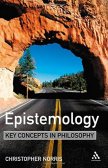
Book Discussion of Christopher Norris’ “Epistemology: Key Concepts in Philosophy”

Concluding Scientific-Realist Postscript –

Section II.


After restating some things said in section I, Norris states that he has tried to represent opposing positions fairly, without caricature. The issue has been around so long, that everyone has a legitimate point to make, although not all of their points are legitimate—but the legitimate points make unlikely any philosophical knock-down argument (last section).

No matter how many examples of progress piled up by the realist; despite the reality that such progress would be a miracle “if not the assumption that most of its theories were true and that most of its referring (e.g., natural-kind) terms picked out real-world objects, structures and properties thereof”—the anti-realist can always retort with the argument from error (last section), and the realist can (again, last section) point out this thesis as self-refuting, relying on realist cardinal distinctions between truth and falsehood or scientifically justified and unjustified belief. So, realism wins on metaphysical (or logico-semantic) grounds, as well as on epistemological grounds, as “best providing both a generalized account of the relationship between truth, knowledge and belief and a means of explaining just how that relationship is exemplified by various well-documented episodes of scientific theory-change.”

The resolution to the science wars (between science and some in the ‘cultural left’) is 1) “encouraging respect for the real achievements of the natural sciences—the fact that they have discovered (not ‘constructed’ or ‘invented’) a great many truths about the physical world” and 2) “offering a sense of the historical or socio-cultural contexts in which scientific work actually gets done”. 1 is referring to the context of justification (and reminds me of my thinking on moral truth—that it is either created/constructed, discovered, or nonexistent), 2 is referring to the context of discovery.

The strong sociologist is inconsistently and unnecessarily suspicious of every other science but sociology (despite “building in a principle of ‘reflexivity’, which treats their own claims as equally subject to socio-cultural analysis”). The ‘science-studies’ or ‘strong’-sociological rubric does not distinguish between those two contexts, replacing them with the notion of ‘parity of esteem’, requiring that “we treat all theories…as products of socio-cultural class-interest or some clearly marked ideological parti pris” (whatever parti pris means…I think I catch the meaning of the sentence, though). This is seen in Shapin and Schaffer (Leviathan and the Air-Pump) urging us to see that both Hobbes and Boyle were subject to class-based interests and pressures. But this fails to explain “why so much of modern science—including technological applications—should have turned out to vindicate the truth of Boyle’s theory and to make no sense on the Hobbesian account. This is the idea of inference to the best, most adequate or rational explanation, an approach that is mostly rejected or ignored by the ‘strong’ sociologist but which has a fair claim to account most convincingly (i.e., with least need of miracles or ‘cosmic coincidence’) for our knowledge of the growth of scientific knowledge.” Shapin and Schaffer also work on a kind of ‘reverse-prejudice’ principle—agreeing with Hobbes’ “proto-Foucauldian conception of knowledge as produced in and through the operations of social power”—rather than treating Hobbes and Boyle both with impartial parity—disagreeing with Boyle’s more realist leanings. They are not really being impartial, just as sceptics are not really not deciding—they are deciding not to decide.

The concept of impartial parity, erasing the distinction between context of discovery and context of justification, of social explanations going all the way down, can be seen in:
–Kuhnian paradigm-relativism
–post-structuralist ideas about language and representation
–Foucault’s ‘genealogies’ of power/knowledge
–postmodernist sceptical take on outmoded truth, progress and critique

Why was Lavoisier right “about the role of oxygen in the process of combustion while Priestley was wrong about the role of ‘phlogiston’ or ‘dephlogistated air’”? Impartial parity won’t even admit one was right and one was wrong. Impartial parity won’t admit this was a discovery—not a “random paradigm change, cultural mutation, or Foucauldian ‘epistemological break’.” “For to seriously doubt that Boyle was justified (as against Hobbes) when he affirmed the possibility of a vacuum is to undercut the grounds for rational belief in a whole vast range of subsequent developments and causal-explanatory theories.” For example:
–the entire science of modern aerodynamics and also subatomic particle physics
–“the latter received its first impetus from the observation of cathode-ray (electron) emission in a vacuum tube”

And (again) if the strong sociologist counters with the argument from error, they are (again) affirming a realist premise, since “they rely on the assumption that some past theories were true (or scientifically warranted) despite the weight of received opinion at the time.”

The right way to approach this is to explain “what it was about the orthodox science of the day that made it perfectly possible for Priestley, an intelligent scientist-philosopher, to credit the existence of phlogiston…in a way that preserves the distinction between scientific truth and falsehood.”

Norris uses the dubious and perhaps benign example of Paul Feyerabend’s recommendation to Catholics against recanting their original position against Galileo—to talk about how epistemology and philosophy of science “have a useful role in science education” as concerns debates about science remaining value-neutral or, on the other hand, socially responsible. There are less benign examples, but Norris doesn’t mention them. He just ends on the note that a critical realist conception is “the discipline whose range of normative, explanatory and critical resources render it best equipped to address those issues.” This is a conclusion without any premises. Until using something like my moral truth litmus, critical realism is flying blind—nothing ‘unethical’.

Next step: review all previous section summaries and see where I stand.

Posted in Norris' Epistemology, Reviews and Interviews | Leave a comment

Norris’ "Epistemology" Postscript, I

Book Discussion of Christopher Norris’ “Epistemology: Key Concepts in Philosophy”

Concluding Scientific-Realist Postscript –

Section I.

First-off, I can’t help thinking of Kierkegaard’s “Concluding Unscientific Postscript” when reading the title of this chapter, but Norris never overtly names him.

Norris basically begins this chapter the way he began the book, noting that he did what he could in the space permitted.

He boils epistemology down to the various positions regarding “the basic issue between realism and skepticism concerning the existence of an ‘external’ (objective or mind-independent) world that is not just a construct out of our various sense-data, conceptual schemes, paradigms, language-games, discourses, cultural life-forms or whatever.”

He says there is no philosophical answer to the skeptic which would prove to them the existence of the external world—he dismisses G.E. Moore’s pointing at his other hand, and Wittgenstein’s claim that skeptical doubts can be “laid to rest merely by observing that they have no place in our communally sanctioned language-games or life-forms and must therefore be counted strictly unintelligible.” To the skeptic, realism and anti-realism alike are just habits of thought which cannot guarantee their own veridical status.

The realist will ask whether the skeptical conclusion has “more rational warrant than appeals to the self-evidence of progress in various tried and tested fields of everyday experiential and applied scientific knowledge.” Norris’ use of self-evidence here is eyebrow-raising, especially since he goes on to say that “our theories or working hypotheses are…by no means secure against any prospect of future revision or rejection.” I always took self-evident to mean something like ‘certain’ or ‘unquestionable’. If it is subject to future revision, how is it self-evident? Maybe he is not saying appeals to progress are appeals to self-evident progress—maybe he is saying they are not, but skeptics apparently expect folks to believe the sceptical position is self-evident? Anyway, Norris says the “burden of proof falls squarely on those who would reject the case for convergent realism, or for scientific method as our best guarantee that most of our theories or working hypotheses are on the right track, even though (as the realist will readily concede) by no means secure against any prospect of future revision or rejection.”

The sceptic will respond with the “argument from error”—that so many past-accepted theories have got it wrong, and so many of our current theories will eventually be shown to be wrong, and so therefore nothing can be trusted. But in order to make that argument, the sceptic must rely on a realist premise: “that we now have adequate scientific reason to count those earlier theories false” or inadequate.
Examples:
1. Phlogiston and the luminiferous ether are out for different reasons:
a. phlogiston never referred to anything, and was replaced by Lavoisier’s oxygen-based theory of combustion
b. the luminiferous ether referred to what is now more adequately called the electro-magnetic field
2. Aristotle’s concept of bodies falling to find their ‘natural place’ is replaced by gravity
3. Mass, molecule, atom and electron–all have undergone some rethinking.

–Paradigm relativists would say all the theories make equally good sense.
–Kuhn would say they are all (even theories like 1b and 3) talking about something completely different.
–Convergent realism (our hero) puts up “a strong case…for the partial conservation of certain theories that have not…relinquished any claim to describe or explain the physical phenomena concerned.” This is referring to theories 1b and 3, “where the range of descriptive or identifying criteria has likewise been subject to large-scale revision but where these terms can nonetheless be taken as referring to the self-same entities.”

Norris says this sort of engagement in concrete examples is “the best starting-point for discussion, rather than high-level abstract debates about the ‘problem of knowledge’ or the ‘existence of an external world’.” The sceptic may consider the whole engagement to be circular, but not without “renouncing any claim to provide an intelligible account of our everyday experience as well as our knowledge of the growth of scientific knowledge.”

Norris connects this whole discussion to the issue of how to change human existence for the better through applied scientific knowledge.
1. Wittgenstein view: “there is no appeal to values of truth, rationality or ethical and social justice beyond those that play a meaningful role in the language-game or life-form concerned.”
2. Dummett: “denies the existence of objective, recognition-transcendent truth-values for statements of the so-called ‘disputed class’, i.e., those for which we possess no means of ascertainment or decisive proof”—including “standards of objective moral good or natural justice”.
3. Rorty: “ideas about the good life…(are) a product of our various language-games, metaphors or preferred ‘final vocabularies’. … all that is required is a switch to some alternative ‘description’ whereby the problems can be made to disappear (or the solutions to emerge) through a kind of verbal alchemy.”
a. This is kind of like Kuhn’s paradigm-shift.
b. This is a reaction to “theological ways of thinking” which “make ‘Nature’ do duty for God” but Norris replies that redescribing reality is playing God, and offers false hope.
c. Christian fundamentalist, creationist, ‘pro-life’ (anti-abortion) and other such conservative fronts…can readily exploit the ‘strong’-descriptivist line.
Note: I’m a Christian, I believe in evolution, and I believe in a God-describing GR.

Posted in Norris' Epistemology, Reviews and Interviews | Leave a comment

Norris’ "Epistemology" Ch5, VI

Book Discussion of Christopher Norris’ “Epistemology: Key Concepts in Philosophy”

Chapter 5: Making for Truth: Some Problems with Virtue-Based Epistemology –

Section VI.

Grand finale for this chapter. One more chapter after this, with only two sections in it.

Marie McGinn notes there is an “intuitive disanalogy between ethics and epistemology”. I’ll say. How do you determine if you’ve got moral truth, if you insist that epistemology must follow the true moral rules/virtues? This is something my co-member in the philosophy club, Grant Crawford, caught when Jonathan Homrighausen was doing a presentation on virtue-based epistemology.

Norris quotes McGinn and says she is contesting Hookway’s requirement of a self-evidential ‘immediate’ experience. This does not critique at all my discussion of “the hunger” (or “the question”) for true meaning evident in every culture in history, because this hunger is not self-evidential proof that there is true meaning. “The question” does halt a vicious regress, since we don’t need rules for the application of rules (etc.), we just need the answer to the question, and a realization that the answer may not correspond to anything, despite all clues to the contrary. The hunger, the question, is in the context of discovery, and does not trespass into the context of justification, except to say that any theory which does not answer the question, cannot pass as moral truth.

It seems Hookway does not speak for all virtue theorists, but McGinn’s critique applies to them, as well. Although “distinctively virtue-based theories…involve no such dubious appeal to ‘immediate’ states of mind that by very definition cannot be assessed on cognitive or rational-evaluative terms … it could also be held … the virtues adduced, whatever their precise specification, are likewise construed as taking epistemic priority over any of the more traditional (objectivist) criteria for what constitutes veridical knowledge…” That sets virtue theory apart from more traditional approaches which allow for the motivating influence of certain traits so long as they are confined to the epistemological “context of discovery” and not the “context of justification”—into which virtue theory does trespass.

Although Norris doesn’t put it in these exact words, what I gleaned is that virtue-based epistemology replaces the vicious regress of “rules for the application of rules” with a vicious circle. Like I said earlier, How do you determine if you’ve got moral truth, if you insist that epistemology must follow the true moral rules/virtues? It is circular reasoning—to insist that you use moral truth to justify any endeavor into truth, including moral truth. So the virtues are left with no justificatory warrant.

Even if the virtue-realist specifies that the virtues are realist virtues (like “the disposition to believe that truth is independent of any disposition”), they are still placing emphasis on an attitude or disposition, and therefore contradict realist virtues, which may truly only apply to the context of discovery, not the context of justification.

So virtue theory does no better than RD theory in its attempt to resolve the dilemma between realism and anti-realism, since it clearly takes an anti-realist bias toward truth that is epistemically constrained (“best judgment”-dependent), rather than verification-transcendent.

It also fails to explain how virtuous thinkers could ever have managed to get things wrong. It fails to grasp that truth can come apart from “the standing consensus of best judgment at some given stage in the progress of inquiry to date. …the chief source of disagreement concerning virtue-based epistemologies is what some would regard as their overcommitment to a practice-based (Aristotelian) approach that pins its faith to those epistemic virtues which currently enjoy widespread acceptance, and which thus tends to preclude—or downplay—the possibility of holding them to critical account. Whence the danger…of a slide toward the kind of Wittgenstein-influenced communitarian thinking whereby it simply cannot make sense to question or criticize the values and beliefs embodied in some given practice, language-game or communal ‘form of life’.” Indeed, Lorraine Code has linked virtue-epistemology with a ‘socialized’ conception of knowledge as well as a feminist epistemology, a communalist way of thinking which is at conflict with her insistence on certain ground rules.

There is a “tendency for such arguments to oscillate between a basically Aristotelian conception of those virtues which defines them chiefly with reference to the various knowledge-conducive practices wherein they play a salient role and a more Kantian (deontological) approach that treats them as subject to certain ‘internal’ checks and constraints. This latter requirement is most often introduced—as for instance by Sosa and Greco—by way of strengthening the normative component of virtue-based theories and marking their difference from straightforward reliabilist (Goldman-type) accounts.”

Norris’ own view (of course) is that these problems arise when virtue-theory trespasses into the context of justification, rather than confining itself to the context of discovery. When it stays in the context of discovery, it is superior to the “cultural-relativist or ‘strong’-sociological view whereby the distinction between truth and falsehood amounts to no more than that between beliefs which enjoy a high measure of social or peer-group acceptability and beliefs which (by common assent) lack any such status.” However, when it trespasses into the context of justification, it is at risk of sliding back into just that communalist way of thinking. It will not concede to “the realist’s cardinal point that the objective truth-value of certain propositions may (now or forever) elude our best powers of epistemic discernment just as knowledge—by very definition—transcends any possible specification in terms of currently accepted best belief.”

To equate truth with best belief, again, merely replaces the vicious regress with the vicious circle. Best to restrict the virtues to the context of discovery, where they will not fall prey to “sceptical, relativist or anti-realist fortune.”

Well done, Norris. Well done.

Posted in Norris' Epistemology, Reviews and Interviews | Leave a comment

Norris’ "Epistemology" Ch5, V

Book Discussion of Christopher Norris’ “Epistemology: Key Concepts in Philosophy”

Chapter 5: Making for Truth: Some Problems with Virtue-Based Epistemology –

Section V.

Ok, so, apparently “foundationalist” means coherentist, and “anti-foundationalist” means pragmatist. Sosa claims they are a dead-end dispute to how to solve the problems that came up after Quine beat down logical empiricism—but virtue theory clearly inherits the same old dilemmas.

The most crucial dilemma is “the problem as to just what an epistemic virtue should be taken to involve if not—at its most basic—the realist acceptance that truth might always elude our best, most reliable or virtuous means of ascertainment. It is here (as I argued in Chapter 4) that the advocates of response-dependence lean strongly in an anti-realist direction despite their overt professions of even-handedness, and here also that McDowell draws the line against any alethic (objectivist) theory of truth that would place it outside and beyond the realm of jointly operative human ‘receptivity’ and ‘spontaneity’.” Virtue theorists claim to shift the emphasis from “justificatory warrant” to “disposition”—but this puts them in the RD, or anti-realist, camp, since “it equates truth with the best opinion or optimized judgement among those presumptively qualified to know on account of just these imputed qualities.” Not only is virtue theory vulnerable to the counter-argument of the realist about epistemology—it is vulnerable to the counter-argument of the realist about ethics, who is a consequentialist.

The virtue theorist will reply that “caution, self criticism, acceptance of the non-finality of knowledge as we have it—…between them ensure an adequate respect for the standing possibility that truth might elude our present best truth-seeking endeavors. Yet these character traits, no matter how admirable, are still specified in such a way as to reverse the realist order of priority between truth…and truthfulness.”

Yes, virtue theory is better than outright communalist theories and Kripkensteineism, but it must resort to them in order to explain what counts “as an adequate definition of this or that epistemic virtue”—since they refuse to take one side of the dilemma between “a causal-reliabilist approach devoid of normative values, and a deontological approach devoid of credible epistemic warrant.” To avoid communalism and Kripkensteinism, the virtue theorist can:
1. Strengthen the internalist requirement (to responsibly apply standards like “rationality, consistency, intellectual caution and care to avoid erroneous results”).
2. Fall back on reliabilist position which makes room for virtue-talk to deal with lack of normativity.

Those two options (deontological or internalist, versus reliabilist externalist) cannot be reconciled and tend to pull in opposite directions. (However…my paper does reconcile doing and being…hmm…deontology says DO the standards and you will become them…virtue says BE the standards and you will do them…both are right. How are either of them any more/less general than the other? Norris seems to be saying they both suck compared to consequentialism…hmm…interesting.)

Anyway, the irreconcilability between externalist and internalist arguments is apparent “in Sosa’s early suggestion that the intellectual virtues could be held analogous to reliably knowledge-conducive perceptual faculties such as good eyesight, acute hearing or tactile sensitivity” because those things are mostly modular or encapsulated—they mostly run on automatic—and higher-level reasoning does not (Fodor and other modularists have scaled down their claims that higher-level reasoning is also modular or purely computational, being more global). Sosa’s claim does not account for the interpretive processing that is part of perception, making it different than passive sensory uptake…though Quine (and his successors) would naturalize the interpretive processing (the ‘torrential output’ of scientific theories and hypotheses). Wittgenstein and Kuhn also put in that we see through the lens of our background information—to the point that is impossible to distinguish between veridical and delusory appearances. All the motorists and passerby’s in Barn-Façade County have it right, by this account (though, here, Norris refers to an example by Norwood Hanson). So this screws up Sosa’s analogy. The alternative to the Quinean or Wittgensteinian path is the Fodorian path of the modularity of higher thinking, so that it is conducive to knowledge not subject to interpretation. So…what to make of interpretation? Hence, Fodor’s stepping away from massive modularity. Modularity does not account for abduction—or inference to the best explanation.

So—since the virtues of higher thinking cannot be held analogues to automatic processes, that “threatens to deprive those virtues of the normative (ethically oriented) character which they must be taken to possess if they are to count as such in any but a loose or misapplied sense of the term,” – not exactly sure why. So, Sosa has developed two requirements: reliable beliefs, and evaluating those beliefs and their acquirement for their virtue. This pushes him into internalist territory, when he is supposed to “cut out that false disjunction between causally reliable sources of knowledge and ethically responsible ways of construing the best evidence to hand.”

John Greco says he does this when he “argues that the normative deficit of Goldman-type reliabilist theories can best be got over by introducing the further requirement that, in order to possess ‘positive epistemic status’, a subject’s virtues must include their willingness to take responsibility for whatever they advance in the way of purportedly veridical statements.” This harkens back to McDowell’s “responsible freedom” and doesn’t resolve what should count as an epistemic virtue and why it should count. It is in a tug of war between “truth” and “truthfulness” (in short).

Truthfulness matters, but sometimes, despite being truthful, we can fail to get at the truth. Virtue theorists can make the virtues infallibly truth-tracking (realist), but therefore “trivially circular and devoid of substantive (perceptual-cognitive or epistemic) content.” Or—they can define what traits count as virtuous—restricting truth to human response.

Posted in Norris' Epistemology, Reviews and Interviews | Leave a comment

Norris’ "Epistemology" Ch5, IV

Book Discussion of Christopher Norris’ “Epistemology: Key Concepts in Philosophy”

Chapter 5: Making for Truth: Some Problems with Virtue-Based Epistemology –

Section IV.

Virtue-based epistemology “has partly grown out of, and partly emerged as a reaction against, the kinds of reliabilist argument put forward by philosophers and cognitive theorists like Alvin Goldman.” They feel the way around the old quandaries, including Gettier’s, “is to adopt a basically causal account whereby knowledge is taken to consist in beliefs arrived at through a process of cognitive enquiry which puts the knower reliably in touch with his or her information sources. This is clearly an externalist approach in so far as it aims to cut out any normative appeal to whatever is supposed to go on ‘in the minds’ of properly equipped, duly qualified or intellectually responsible seekers-after-truth. …in marked opposition to any version of the hitherto dominant theory, from Plato to Kant and beyond, that would supply epistemology with a normative dimension.” They just stand in a ‘direct causal relation to their various sources of evidence’.

Virtue theorists like reliabilists’ anti-deontological approach, but dislike the causal theory of knowledge “that left no room for any but a notional (reductionist and under-specified) account of those normative values which had to play a role in the assessment of our various epistemic practices.” So Goldman’s approach is open to the same objections as Quine’s hard-line physicalist programme. Goldman answers with “process reliabilism” which he suggests can be regarded as a virtue-oriented approach.

But there are problems with reconciling causal theory and virtue theory—like the fact/value distinction. McDowell replies with his Kantian “responsible freedom” (spontaneity tempered by receptivity)…but Norris says this still falls back on the old dualism.

Virtue-theorists like Ernest Sosa, who start from a reliabilist position but became dissatisfied with its lack of normative component, claim to end the dispute between foundationalists and anti-foundationalists. Sosa compares animal knowledge and human knowledge to show that what is considered reliable for an animal, is not considered reliable for humans. There is more to human knowledge, and that “more” is the distinctly human epistemic virtues, internalist constraints.

On the animal-human comparison, McDowell thinks of spontaneity as the human element exempting us from and structuring the ‘receptivity’ element we share with ordinary animals. Spontaneity is specialized receptivity. But this contradicts McDowell’s earlier de-transcendentalizing or naturalized reading of Kant.

Sosa’s argument therefore has the same problem, and so they are both on a seesaw.

Posted in Norris' Epistemology, Reviews and Interviews | Leave a comment

Norris’ "Epistemology" Ch5, III

Book Discussion of Christopher Norris’ “Epistemology: Key Concepts in Philosophy”

Chapter 5: Making for Truth: Some Problems with Virtue-Based Epistemology –

Section III.


Can a virtue-based epistemology, unlike McDowell’s efforts, “(1) make good the normativity-deficit, and (2) avoid all the usual forms of set-piece sceptical challenge?”

One such challenge is the Gettier-type counter-examples, mentioned briefly in the first section. He challenged Plato’s definition of knowledge as “justified true belief”. His (Gettier’s) point “is that people can hold beliefs which are indeed justified and true, but which for various reasons intuitively strike us as not meeting the requirements for genuine knowledge.” One critique of this is that Gettier skewed things by holding beliefs to be justified by the evidence, though the evidence is oblique, off the point, or actively misleading.

Another critique is a ‘reliabilist’ theory “which requires that knowledge be adequately grounded in some causal nexus or concatenated chain of sensory-perceptual (or strong testimonial) evidence that puts knowers reliably in touch with whatever they claim to know.” But, reliabilist theory is vulnerable to counter-instances as the motorist driving through Barn-Façade County.
1. The motorist knows the local hobby of painting images of barns and considers the current image to be one such image, when it is really a barn. The uninformed passerby would know more than he, with reliable information. Strike one against reliabilist theory.
2. The motorist doesn’t know the local hobby and assumes every image of a barn is really a barn. So, when he encounters the genuine image encountered by the first motorist, instead of saying it is a false barn, he says it is a real barn…but he is lacking the information of the original motorist, and got it wrong with every other image. He didn’t get it right based on his information’s reliability. Strike two against the reliabilist theory.
3. According to Brandom, if the hobby is peculiar to Barn-Façade County and practiced rarely in its state, then we would say the second motorist does know (“truly and justifiably believe on good, epistemically reliable or trustworthy grounds) that this is a real barn. I don’t know how this follows.
4. According to Brandom, if the hobby has a U.S.-wide following of which the motorist was unaware, then we wouldn’t consider his belief to be knowledge.

So…does that knock down Plato’s definition of knowledge as being justified true belief? Virtue-based epistemology attempts a better effort than reliabilist theory to maintain that definition.

Norris mentions this goes back to Kant bridging the gap between “sensuous intuitions and concepts of understanding…via ‘judgment’, to a supersensible faculty of pure reason that provides us with the practical ‘orientation’ in the absence of which our epistemic endeavors would lack any sense of directive or coordinating purpose.” A lot I don’t understand. Norris sees the problem here as being ‘kindred’ to “the problem that arises with Kantian ethics, that is, the problem of explaining just how the categorical imperative and maxims of practical reason may be thought to apply – or provide any guidance – in matters of complex, real-world, humanly situated ethical choice.” Norris says there is reason to doubt an epistemology which is ethics-first or virtue-based, because it courts the same objections.

Virtue-epistemology would counter that it avoids “the kinds of problem that result from adopting such an abstract, formal or deontological approach.” From what Norris goes on to say, it sounds like their main objection w/ Kantian ethics is that 1) the categorical imperative is too general, 2) it is removed from moral feeling or intuition, despite his talk of a “good will” or “virtuous disposition”.

But, according to communitarians, without that ‘rule’—we are left “within some received tradition or communal life-form”.

MacIntyre, says Norris, has swung from considering it “an ethico-political imperative to challenge the prevailing ‘self-images of the age’ to a conservative doctrine that equates virtue with conformity to this or that communal narrative whereby moral agents can make coherent and satisfying sense of their lives.”

‘Liberal’ communitarians (like Walzer), says Norris, “find more room for social criticism as an exercise of independent thought and moral judgment while denying that such criticism could have the least force if it didn’t appeal to a certain range of widely shared values and beliefs.”

There is a debate between those (like Williams) who think ethics can maintain a critical edge w/o Kantian moralism, and those (usually disciples of Wittgenstein) who “reject the very notion that judgement can be exercised from a standpoint outside the various language-games or life-forms that provide the criteria for any valid (communally warranted) belief.”

Communitarians and virtue-theorists are united on one point: “it makes no sense—in epistemological or ethical terms—to adopt a position whereby truth in such matters might sometimes be thought to elude even the best-placed, most fully informed or epistemically virtuous enquirers. Communitarians focus on shared (community-wide) belief, whereas virtue-theorists focus on “distinctive qualities—like attentiveness, caution, open-mindedness or the courage to resist peer-group pressure—that more aptly apply to individual thinkers in particular epistemic contexts.”

So, virtue-theorists claim to avoid the problems resulting from Kant and from communitarians, “by locating the norms of good epistemic practice in just those attributes that serve to mark out competent, good-faith, expert, perceptive and well-motivated enquirers.” But, Norris says, just like Wright’s or McDowell’s Kantian version of the response-dependence argument, virtue-theory “fails to explain how the quest for knowledge can take its bearings from the regulative notion of objective, verification-transcendent truth (and hence avoid a Dummett-type anti-realist upshot).” They all fail in “meeting the realist’s basic objection, i.e., that truth can always come apart from ‘best judgment’ since even the most virtuous, intellectually disciplined and truth-oriented forms of enquiry may still (for whatever reason) fall far short of their aim.”

Positive point of virtue-based approach: “Offers a useful corrective to full-fledged communitarian theories” (Kripkenstein). “It offers a means of blocking the Kripkensteinian regress by maintaining that reasoners can think for themselves and apply certain standards…which are not just those of ‘agreement in judgment’ among members of some given community.”

Posted in Norris' Epistemology, Reviews and Interviews | Leave a comment

Norris’ "Epistemology" Ch5, II

Book Discussion of Christopher Norris’ “Epistemology: Key Concepts in Philosophy”

Chapter 5: Making for Truth: Some Problems with Virtue-Based Epistemology –

Section II.
Note: physicalist is apparently synonymous with ‘thoroughly naturalized’.

This section is going to mainly focus on how McDowell’s revision of Kant attempts to replace the normativity lost by Hume, then Quine, ironically because of Kant. It’s very weird how Kant helped, involving discussion of judgement and imagination and how they work to bring sensuous intuitions under concepts of understanding. I remember reading about some of this when I was reading Schopenhauer, but that was years ago, and I don’t remember any talk of imagination (which is supposedly blind, something “of which we are scarcely ever conscious,” so must not be what I think of when I think of imagination…which is something I use on purpose…I ‘imagine’ on purpose…but…perhaps it is the part of the mind that runs on automatic when we’re dreaming? I dunno).

McDowell is supposed to resolve this by “setting empirical constraints on the exercise of spontaneity while nonetheless allowing the mind sufficient scope for its active role in the process of judgement.” This was covered in chapter four, section four, The empirical constraints of receptivity are “responsible” and the exercise of spontaneity (the active role in the process of judgment) is “freedom”. Put them together, and you’ve got “responsible freedom” because the spontaneous is anchored within the receptive (which “respects Kant’s demand that reason should acknowledge certain necessary constraints on its proper sphere of jurisdiction—i.e., that it should not encroach on the domain of cognitive understanding where intuitions are ‘brought under’ adequate concepts—since otherwise it would become nothing more than a kind of speculative free-for-all or ‘frictionless spinning in the void’.”
The “question of how to wrest a space for ‘responsible freedom’ in judgement—a space where reason can exercise its powers with due regard to empirical constraints—is one that has continued to vex philosophy in the mainstream analytic line of descent even where that tradition has expressly renounced any Kantian conception of knowledge as vested in certain a priori (transcendentally deducible) intuitions, concepts and categories.”
–ignored by logical empiricist claim “that enquiry could perfectly well proceed through the bringing of first-order empirical observations under higher-level (e.g., deductive-nomological) modes of reasoning whose validity was self-evident.
–Quine’s attack on the ‘two dogmas’ “of logical empiricism set out to demolish this residual Kantian dichotomy while leaving a third dogma in place, that is, the idea that epistemology could be ‘naturalized’”…
–Davidson pointed out “Quine’s adherence to yet another covert dogma, i.e., his notion of empirical data as open to as many divergent interpretations as there existed ontological schemes or frameworks under which those data might be subsumed.” So, the “old dualism” of scheme and world is still there. Davidson tries to give up the dualism in that he tries to “reestablish unmediated touch with the familiar objects whose antics make our sentences and opinions true or false,” – throwing out normativity.
–McDowell seeks to restore normativity by countering Quine’s thoroughly naturalized theory of knowledge.
–Rorty (with “presumptive Davidsonian warrant”) claimed “we can be as hard-headedly ‘realist’ as we like about (say) the causal impact of incoming photons on Galileo’s eyeball while still maintaining that all such physical events are under some optional description or other. In which case, according to Rorty, the issue is strictly undecidable as between Galileo’s ‘observing’ the moons of Jupiter and thereby ‘shattering the crystalline spheres once and for all’ and his opponents’ taking those ‘same’ observations as merely introducing a further complication in the old Ptolemaic-Aristotelian astronomy.” Interpretation effectively goes “all the way down”.

But apparently McDowell keeps trekking right along with his attempt to detranscendentalized Kant without losing the normativity. Apparently—a detranscendentalized Kant is not a thoroughly naturalized Kant. I’m having trouble with that one. However…go back up and read how McDowell attempted to do this. But, in his attempt, he fails to explain how our knowledge “can be responsive to certain ideas of reason which must themselves be taken to inform (or to orient) every act of cognitive judgment but whose sphere of jurisdiction lies altogether outside and beyond the cognitive domain.” He avoids any appeal to Kant’s noumenal realm which would elude our grasp. His approach “seems to fight shy of explicitly endorsing … that reality must be located inside the conceptual sphere.”

Can a virtue-based epistemology do any better? Read on…

Posted in Norris' Epistemology, Reviews and Interviews | Leave a comment