My first Wikipedia article: Graded absolutism

Edit…
Graded absolutism

From Wikipedia, the free encyclopedia
Jump to: navigation, search

Graded absolutism is a theory of moral absolutism which resolves the objection to absolutism that in moral conflicts we are obligated to opposites. Moral absolutism is the ethical view that certain actions are absolutely right or wrong regardless of other contexts such as their consequences or the intentions behind them. Graded absolutism is moral absolutism but adds that a moral absolute, like “Do not kill,” can be greater or lesser than another moral absolute, like “Do not lie”. Graded absolutism, also called contextual absolutism or the greater good view, is an alternative to the third alternative view and the lesser evil view, both discussed below, regarding moral conflict resolution.


According to graded absolutism, in moral conflicts, the dilemma is not that we are obligated to opposites, because greater absolutes are not opposites of lesser absolutes, and evil is not the opposite of good but is instead the privation of good. Since evil is the privation of good, only the privation of the greater good counts as evil, since whenever there is a moral conflict, we are only obligated to the greater good.  The real dilemma is that we cannot perform both conflicting absolutes at the same time. ‘Which’ absolutes are in conflict depends on the context, but which conflicting absolute is ‘greater’ does not depend on the context. That is why graded absolutism is also called ‘contextual absolutism’ but is not to be confused with situational ethics. The conflict is resolved in acting according to the greater absolute. That is why graded absolutism is also called the ‘greater good view’, but is not to be confused with utilitarianism.

Contents

[hide]

[edit] The third alternative view

This is the view that there are never any real moral conflicts [1] and that there is always a third alternative. However, if there is no real dilemma, what is the need for a third alternative? And surely moral dilemmas exist which have no real third alternative. When asked by a potential murderer the location of a would-be victim, we can either consider it more important to save the potential victim’s life—or we can consider it more important to tell the truth to the victim’s would-be murderer—we cannot do both, and there is no third alternative between them.

[edit] The lesser evil view

The lesser evil view is the view that the only way out of a moral conflict is to violate one of the moral absolutes and choose the lesser evil. For example, if we disagree with Kant‘s thoughts on the categorical imperative and say that lying is a lesser evil than helping a would-be murderer, the lesser evil view would have us lie rather than help a would-be murderer. This violates the ought implies can principle and defeats itself in obligating evil.

[edit] The greater good view

Graded absolutism, or the greater good view, is the view that there are real moral conflicts between absolutes, but rather than requiring a third alternative (as in the case of the third alternative view above) or obligating evil (as in the case of the lesser evil view above), this view obligates the greater absolute, or greater good. For example, when one saves a life rather than telling the truth to a would-be murderer, one is committing the greater good of saving life, rather than violating the lesser good of telling the truth or committing the lesser (than aiding a murderer) evil of lying. Since evil is the privation of good, only the privation of the greater good counts as evil, since whenever there is a moral conflict, we are only obligated to the greater good.

[edit] Objections

  • It is often argued that graded absolutism (the greater good view) reduces to situational ethics. However, the situation is used to determine which absolutes are in conflict, not which absolute is greater or lesser.
  • Though graded absolutism is usually associated with Christian philosopher Norman Geisler [2], some [1] argue there is no Biblical basis for it. Norman Geisler responds in “Introduction to Philosophy: A Christian Perspective” [3] that the Bible has many examples of God approving rather than condemning instances when people acknowledged the higher over the lower, like when God blessed and gave families to the Hebrew midwives who “disobeyed government and lied to the king (Exodus 1:19) in order to save the male babies,” (p. 417). He points out that “Jesus spoke of ‘greater sin’ (John 19:11), ‘greater love’ (John 15:13), ‘greatest commandment’ (Matt 5:19), and ‘weightier matters’ of the law (Matt. 23:23),” (ibid, p. 424). He asserts killing in self defense (Exodus 22:2), capital punishment (Gen. 9:6), and in a just war against aggression (Gen. 14) were all greater goods (ibid, p. 418).

[edit] Works cited

  • [1] Ethics: Knowing Right from Wrong; by Stan Reeves.
  • [2] Any Absolutes? Absolutely!; by Norman Geisler.
  • [3] “Introduction to Philosophy: A Christian Perspective” by Norman L. Geisler and Paul D. Feinberg; Baker Academic; 2nd edition (May 1, 1987); ISBN 0801038189.

[edit] Further reading

“Christian Ethics: Options and Issues” by Norman L. Geisler; Baker Academic; 2nd edition (1989); ISBN 9780801038324.

[edit] See also

Posted in Apologetics | Leave a comment

The Bibliographical Test for New Testament Historicity (guest post)

The below was taken from Gospel 101 curriculum developed by Redeemer Church, Modesto.  Click on the image to get it on its own page.


The bibliographical test seeks to determine the quantity and quality of documents, as well as how far removed they are from the time of the originals. The quantity of New Testament manuscripts is unparalleled in ancient literature. There are over 5,000 Greek manuscripts, about 8,000 Latin manuscripts, and another 1,000 manuscripts in other languages (Syriac, Coptic, etc.).

The age of the manuscripts is also excellent. Possibly the oldest manuscript is a scrap of papyrus (p52)   containing John 18:31-33, 37-38, dating from AD 125-130, no more than 40 years after John’s gospel was likely written. A non-Christian scholar, Carsten Peter Thiede even claims that he has dated a fragment of Matthew to about 60 AD. By comparing the ancient manuscripts we find that the vast majority of variations are minor elements of spelling, grammar, and style, or accidental omissions or duplications of words or phrases. Only about 400 (less than one page of an English translation) have any significant bearing on the meaning of a passage, and most are footnoted in Modern English translations. Overall, 97-99% of the New Testament can be reconstructed beyond any reasonable doubt, and no Christian doctrine is founded solely or even primarily on textually disputed passages.
The Scripture quoted in the works of the early Christian writers (most 95-150 AD) are so extensive that   virtually the entire New Testament can be reconstructed except for 11 verses, mostly from 2 and 3 John.

Critics of the accuracy of the Bible routinely claimed that it was in fact a series of fables and legends that had developed over hundreds of years because there were not enough copies of ancient manuscripts to alleviate their skepticism. Curiously, a simple shepherd boy dealt a death blow to their criticisms in 1947.   He wandered into a cave in the Middle East and discovered large pottery jars filled with leather scrolls that had been wrapped in linen cloth. Amazingly, the ancient copies of the books of the Bible were in good   condition despite their age and harsh climate because they had been well sealed for nearly 1900 years. What is now known as The Dead Sea Scrolls are made up of some 40,000 inscribed ancient fragments.  From these fragments more than 500 books have been reconstructed, including some Old Testament books such as a complete copy of Isaiah.

Simply, if someone seeks to eliminate the trustworthiness of the New Testament then to be consistent they would also have to dismiss virtually the entire canon of western literature and pull everything from Homer to Plato and Aristotle off of bookstore shelves and out of classroom discussions.

[ The above was taken from Gospel 101 curriculum developed by Redeemer Church, Modesto. ]

Posted in Apologetics, Apologetics Toolbox | Leave a comment

Good without God?

Under every billboard of the sort above, should be the following one (click to get it on its own page)…

Posted in Divine Essentialism, Euthyphro Dilemma, Evil as Privation of Good, Golden Rule, Is-Ought Fallacy, Natural Law and Divine Command | 2 Comments

WLC’s case for the resurrection

This is an attempt to give a brief case for the evidence of Jesus’ resurrection, gleaned from Dr. William Lane Craig’s “Reasonable Faith” and “On Guard”.   I tinkered w/ it only a bit.  One example is that I took from other areas to strengthen the point that the Apparent Death hypothesis is very much contrived, even without the conspiracy twist.

Why focus on the resurrection? The “hope that is within us” stands on the reality of Jesus’ resurrection. His resurrection authenticates his claims to be the royal Messiah, Son of God in a unique sense, the Danielic Son of Man. It authenticates all of his teachings and prophesies. Without the resurrection, there is no Gospel, no good news. The traditional apologetic, used during the Deist controversy, involved showing that the Gospels are authentic (internal, external evidence), the text is pure and the Gospels are reliable (apostles neither deceivers nor deceived). Whereas the traditional apologetic dealt only with the “Lord, liar or lunatic” trilemma, the current apologetic deals with a fourth possibility: “legend”. We will formulate an argument by inference to the best explanation
(which I recognize fondly as a critical realist method, from studying Christopher Norris’ “Epistemology”).

Historical scholars insist that, like other scientists, the historian can only study events occurring in the physical universe. Step 1 directly below does not deal with the miraculous and so counters Bart Ehrman. Step 2 directly below considers the resurrection a bodily event (and so counters Dale Allison) in space and time (and so counters John Meier). [Speaking of the miraculous, the thought might occur to you, whenever it is mentioned that even critical scholars accept the historicity of crucial sayings or events, “Why then do they not believe in the resurrection?” One main answer is the “problem of miracles”. We will not deal with that here, as it is discussed here and elsewhere.] Dr. Craig lays out the two-step process for an historical argument for the resurrection of Jesus:

STEP ONE: “to establish the facts which will serve as historical evidence”

STEP TWO: “to argue that the hypothesis of Jesus’ resurrection is the best or most probable explanation of those facts”

“Step (1) will involve an investigation of the historicity of events such as the discovery of Jesus’ empty tomb; step (2) will assess the comparative merits of rival hypotheses offered as explanations of the facts established in step (1),” (p. 350, Dr. Craig, Reasonable Faith).

CRITERIA FOR STEP ONE:

Some criteria for showing (positively) the authenticity of a particular Biblical saying or event, rather than a whole document:

(these are mentioned in different orders on pages 292, 298 and 395 of Dr. Craig’s Reasonable Faith)

1: Dissimilarity. Dissimilarity to antecedent Jewish or subsequent Christian thought-forms. Dissimilarity to pagan thought-forms. Also referred to as “Context and expectation” on p. 396, RF.

2: Multiple attestation. Multiple/independent attestation (especially if early).
–[ historians think they’ve hit historical pay dirt when they’ve got two independent accounts of the same event ]

3: Semitic traces. Linguistic Semitisms.

4: traces of Palestinian milieu (see 6)

5: Embarrassment. Retention of embarrassing material.

6: Historical congruence. Coherence w/ other authentic, external material.  Also see 4.

7: Effect. Effect(s) which point to the saying(s)/event(s) as the cause.

8: Principles of embellishment. No (legend-making) embellishments.

9: Coherence. Coherence with other internal sayings/events (internal congruence).

Look for the titles of these criteria throughout step one and step two.

CRITERIA FOR STEP TWO:

McCullagh’s criteria (p. 371 of Dr. Craig’s Reasonable Faith) for justifying historical hypotheses:

1. The hypothesis, together with other true statements, must imply further statements describing present, observable data (literary evidence of NT).

2. The hypothesis must have greater explanatory ‘scope’ than rival hypotheses. It will explain more of the evidence.

3. The hypothesis must have greater explanatory ‘power’ than rival hypotheses. It will make the evidence more probable.

4. Hypothesis must be more plausible. It will fit better with true background beliefs.

5. Hypothesis must be less ad hoc or contrived (“won’t require adopting as many new beliefs that have no independent evidence” (Dr. Craig, On Guard, p. 244).

6. Hypothesis must be disconfirmed by fewer accepted beliefs. It won’t conflict with as many accepted beliefs.

7. Hypothesis must significantly exceed rivals in fulfilling 2 through 6.

First we will do Step (1) on each of three evidences (directly below), then step (2) on each of the rival hypotheses which attempt to explain those three evidences, concluding with the Bodily Resurrection hypothesis. All of this takes place (a bit differently) on pages 360-399 of Dr. Craig’s “Reasonable Faith” and pages 219-264 of his “On Guard”.

STEP ONE: “to establish the facts which will serve as historical evidence”

–The Empty Tomb
(Rival Hypotheses: Conspiracy, Apparent Death, Wrong Tomb, Displaced Body, Bodily Resurrection)

— Postmortem Appearances
(Rival Hypotheses: Hallucination, Bodily Resurrection)

— Origin of Christian Faith
(Rival Hypotheses: Antecedent Influences, Hallucination, Bodily Resurrection)

Coherence. The above three facts cohere interestingly “with eachother; for example, the coherence between Jesus’ physical resurrection appearances, Paul’s teaching on the nature of the resurrected body, and the empty tomb,” (Dr. Craig, RF, p. 396).

“Don’t be misled by unbelievers who want to quibble about inconsistencies in the circumstantial details of the gospel accounts. Our case for Jesus’ resurrection doesn’t depend on such details. All four gospels agree that: Jesus of Nazareth was crucified in Jerusalem by Roman authority during the Passover Feast, having been arrested and convicted on charges of blasphemy by the Jewish Sanhedrin and then slandered before the governor Pilate on charges of treason. He died within several hours and was buried Friday afternoon by Joseph of Arimethea in a tomb, which was shut with stone. Certain female followers of Jesus, including Mary Magdalene, having observed his interment, visited his tomb early on Sunday morning, only to find it empty. Thereafter, Jesus appeared alive from the dead to the disciples, including Peter, who then became proclaimers of the message of his resurrection. … Historians expect to find inconsistencies even in the most reliable sources. No historian simply throws out a source because it has inconsistencies. Otherwise we’d have to be skeptical about all secular historical narratives that also contain such inconsistencies, which is wholly unreasonable. Moreover, in this case the inconsistencies aren’t even within a single source; they’re between two independent sources. But obviously, it doesn’t follow from an inconsistency between two independent sources that both sources are wrong. At worst, one is wrong if they can’t be harmonized.” (Dr. Craig, On Guard, p. 243).

–The Empty Tomb

1. The historical reliability of the story of Jesus’ burial supports the empty tomb.

a. The burial’s historicity is important because:

i. The disciples would not have preached resurrection if the tomb was occupied

ii. The disciples’ critics would have investigated to make sure the tomb was empty
–wanted to squelch budding Christian movement: hired Saul to persecute

iii. Belief in Jesus’ resurrection flourished in the very city in which he was crucified

iv. The Jewish authorities would have exhumed the body to try to prove Jesus was dead

b. Evidence for the burial:

i. Multiple attestation. Multiply attested in extremely early, independent sources

–Mark, probably via eyewitnesses, within 7 years of resurrection (in a tomb, by Joseph of Arimathea)

–1 Cor 15:3-5, via earliest disciples, within first 5 years of resurrection (buried)

–Compare four-line formula of 1 Cor 15:3-5; Acts 13:28-31; Mark 15:37-16:7
died, buried, raised, appeared

–Jesus’ burial by Joseph also found (with non-editorial differences) in Matthew and Luke
(non-editorial thing discussed pp. 363-364)

–Jesus’ burial by Joseph also found in John and extra-biblical Gospel of Peter

–the early apostolic sermons in Acts (probably not wholly of Luke’s creation)

ii. Not likely to invent Joseph of Arimethea, a Jewish Sanhedrist (Sanhedrin voted to condemn Jesus) as the one who did right by burying Jesus in a proper tomb
Embarrassment: criterion of embarrassment.

iii. For these reasons, most NT critics concur Jesus was buried by Joseph of Arimethea in a tomb

2. The discovery of Jesus’ empty tomb is multiply attested in very early, independent sources.

a. pre-Markan source probably included and ended at the discovery of the empty tomb

i. incomplete w/o victory at the end

b. third line of four-line formula (mentioned above) is summary of empty tomb narrative

i. “he was buried” followed by “he was raised” implies empty tomb

ii. “on the third day” (since they didn’t ‘see’ the resurrection and couldn’t have known which day it occurred) is when the women found the tomb empty

c. Matthew is independent source, including the story of the guard at the tomb

d. traces of prior-tradition in non-Matthean vocabulary in his narrative

i. also, “This story has been spread among Jews till this day” (Matt. 28:15) suggests Matthew is responding to prior tradition.
Effect. (See 6 below.)

e. Luke is independent source, including the story (not in Mark) of the two disciples’ verifying the report of the women that the tomb was vacant

f. Luke’s story (e) is independently attested in John

g. apostolic sermons in Acts (2:29-32; 13:36-7)

3. Semitic traces. The phrase “the first day of the week” in Mark reflects ancient tradition.

a. speaks to the fact that the tradition is very old, predating the “on the third day” motif

4. Principles of embellishment: The Markan story is simple and lacks legendary development/embellishment.

a. “The resurrection itself is not witnessed or described, and there is no reflection on Jesus’ triumph over sin and death, no use of Christological titles, no quotation of fulfilled prophecy, no description of the Risen Lord.”

b. no reason to think the tradition ever lacked the angel.

i. If the angel was a literary figure used by Mark to explain the empty tomb, the tradition Mark takes from is even more “stark and unadorned” (cf. John 20:1-2).

c. compare to the account from the extra-biblical Gospel of Peter
“describes Jesus’ triumphant egress from the tomb as a gigantic figure whose head reaches above the clouds, supported by giant angels, followed by a talking cross, heralded by a voice from heaven, and all witnessed by a Roman guard, the Jewish leaders, and a multitude of spectators! This is how real legends look: they are colored by theological and apologetical developments,” (p. 367, Dr. Craig, Reasonable Faith).

5. Embarrassment. The tomb was probably discovered empty by women (discussed further in the book: considered unreliable in court, occupied low rung on Jewish social ladder—disciples wouldn’t have invented this).

a. “Secret Gospel of Mark” tradition was fraud by Morton Smith.

b. If you’re going to “make up” that the women witnessed it, why not make up that the men had ‘not’ fled too far away (a “fiction of the critics”) and were the first witnesses?

c. If you’re going to “make up” that the women witnessed it (and didn’t tell anybody) to explain “why the fact of Jesus’ empty tomb had remained unknown until the writing of his Gospel” why not leave out the part where Jesus commands the women to tell the disciples they will see Jesus?

i. for thirty years nobody asks the women what happened after the women left the cross (btw, this includes that the women saw where he was laid, relevant to Wrong Tomb hypothesis: Mark 15:42-47)?

ii. for thirty years, even after the resurrection appearances, the women just keep silent?

6. Effect. The earliest Jewish polemic (“disciples stole body”) presupposes the empty tomb.

a. Matthew 28:11-15. A stolen body leaves an (undenied) empty tomb.

b. Skeptics regard “the guard” as an apologetic legend.

i. fact: aimed at widespread Jewish allegation that the disciples had stolen Jesus’ body

7. “According to Jacob Kremer, a New Testament critic who has specialized in the study of the resurrection: ‘By far most scholars hold firmly to the reliability of the biblical statements about the empty tomb.’ In fact, in a survey of over 2,200 publications on the resurrection in English, French, and German since 1975, Gary Habermas found that 75 percent of scholars accepted the historicity of the discovery of Jesus’ empty tomb. The evidence is so compelling that even a number of Jewish scholars, such as Pinchas Lapida and Geza Vermes, have declared themselves convinced on the basis of the evidence that Jesus’ tomb was found empty,” (Dr. Craig, On Guard, p. 230).

(Rival Hypotheses: Conspiracy, Apparent Death, Wrong Tomb, Displaced Body, Bodily Resurrection)

–Postmortem Appearances

1. Paul’s list of eyewitnesses to Jesus’ resurrection appearances guarantees that such appearances occurred. I Cor 15:3-8. Old Jerusalem-Christian tradition quoted by Paul.

a. Appearance to Peter. I Cor 15:3-8. Old Jerusalem-Christian tradition quoted by Paul.

i. Paul (Gal 1:18) two weeks with Peter in Jerusalem three years after Paul’s conversion

ii. Multiple attestation: mentioned in another old Christian tradition found in Luke 24:34

iii. As a result, even the most skeptical NT critics agree Peter saw an appearance of Jesus alive after death.

b. Appearance to the Twelve (best attested). I Cor 15:3-8. Old Jerusalem-Christian tradition quoted by Paul.

i. Paul had contact with them (less Judas—“The Twelve” was a formal title).

ii. Multiple attestation: independent stories in Luke 24:36-42 and John 20:19-20
–Jesus shows his wounds and eats to show he was raised physically and is Jesus

c. Appearance to five hundred brethren. I Cor 15:3-8. Old Jerusalem-Christian tradition quoted by Paul.

i. Paul had personal contact with them, since he knew some of them had died.

ii. He mentions most are still alive because their witness adds weight to what he is saying—they can be questioned

iii. Paul couldn’t have gotten away w/ saying these things if they weren’t true

iv. It is probably not mentioned in the Gospels because it took place in Galilee, and the Gospels focus their attention on the appearances in Jerusalem

v. Was this the appearance predicted by the angel in the pre-Markan passion story and described by Matthew (28:16-17)?

d. Appearance to James (Jesus’ younger brother). I Cor 15:3-8. Old Jerusalem-Christian tradition quoted by Paul.

i. Was a skeptic during Jesus’ lifetime (Mark 3:21, 31-35; John 7:1-10).
Embarrassment: criterion of embarrassment

ii. After resurrection, Jesus’ brothers are among the fellowship in the upper room (Acts 1:14)

iii. In Acts 12 Peter says “Report this to James.”

iv. In Gal 1:19 James is an apostle.

v. In Gal 2:9, James is one of the three ‘pillars’ of the church.

vi. In Acts 21:18, James is the sole head of the church and council of elders.

vii. Historical congruence. Josephus (Antiquities of the Jews, 20.200) says he is stoned to death illegally by the Sanhedrin after A.D. 60 for his faith

viii. His brothers, too, became believers active in the church (1 Cor 9:5)

ix. If crucified, would have confirmed Jesus’ brothers’ doubts, unless they saw the resurrected Jesus

x. Effect. NT critic Hans Grass admits conversion of James one of surest proofs of resurrection

e. Appearance to “all the apostles.” Multiple attestation. Acts 1:21-22; I Cor 15:3-8. Old Jerusalem-Christian tradition quoted by Paul.

i. Paul had personal contact with them.

f. Appearance to Saul of Tarsus. Acts 9:1-9 (later told again twice, referred to in Paul’s letters). I Cor 15:3-8. Multiple attestation.

i. Effect. “This event changed Saul’s whole life. He was a rabbi, a Pharisee, a respected Jewish leader. He hated the Christian heresy and was doing everything in his power to stamp it out. He was even responsible for the execution of Christian believers. Then suddenly he gave up everything. He left his position as a respected Jewish leader and became a Christian missionary: he entered a life of poverty, labor, and suffering. He was whipped, beaten, stoned and left for dead, shipwrecked three times, in constant danger, deprivation, and anxiety. Finally, he made the ultimate sacrifice and was martyred for his faith at Rome. And it was all because on that day outside Damascus, he saw ‘Jesus our Lord’ (I Cor 9:1),” (p. 380, Dr. Craig, Reasonable Faith).

2. Multiple attestation. The Gospel accounts provide multiple, independent attestation of postmortem appearances of Jesus.

a. The appearance to Peter independently attested by Paul and Luke (1 Cor 15:5; Luke 24:34) and universally acknowledged by critics.

b. The appearance to the Twelve is independently attested by Paul, Luke and John (1 Cor 15:5; Luke 24:36-43; John 20:19-20) and is not in dispute (even if many critics are skeptical of the physical demonstrations that attend this appearance).

c. The appearance to the women disciples independently attested by Matthew and John (Matt 28:9-10; John 20:11-17).

i. Embarrassment: also fulfills criterion of embarrassment (see above).
–generally agreed that absence of this appearance from tradition quoted by Paul is a reflection of that embarrassment

d. appearances in Galilee independently attested by Mark, Matthew and John (Mark 16:7; Matt 28:16-17; John 21)

i. “Taken sequentially, the appearances follow the pattern of Jerusalem—Galilee—Jerusalem, matching the festival pilgrimages of the disciples as they returned to Galilee following the Passover/Feast of Unleavened Bread and traveled again to Jerusalem two months later for Pentecost,” (p. 381, Dr. Craig, Reasonable Faith).

e. NT critics Perrin, Ludemann (and others) do not dispute the disciples saw the risen Jesus. “It may be taken as historically certain that Peter and the disciples had experiences after Jesus’ death in which Jesus appeared to them as the risen Christ,” (Dr. Craig quoting Ludemann, On Guard, p. 236).

3. The resurrection appearances were physical, bodily appearances.

a. Paul implies that the appearances were physical. 1 Cor 15:42-44 (‘spiritual’ is used in same sense as it is used in 1 Cor 2:14-15)

i. as opposed to Stephen’s ‘vision’ in Acts which no one else experienced in any way

b. The Gospel accounts show the appearances were physical and bodily.

i. None of them non-physical. No trace of an earlier, non-physical oral tradition, and eye-witnesses are still about.

ii. Non-physical visions do not explain the Gospel accounts of physical resurrection, since Gentiles wanted to be rid of the body and Jews could not conceive of an ‘individual’ resurrection before the end. Dissimilarity.

iii. Not from anti-Docetic motives, since they didn’t think the resurrection was a vision, more would need to be done than Jesus’ showing his wounds, and Docetism came later than the appearance traditions.

iv. Only reason for denying bodily resurrection is philosophical (“problem of miracles”), not historical.

(Rival Hypotheses: Hallucination, Bodily Resurrection)

–Origin of Christian Faith

(Skeptical NT scholars admit earliest disciples ‘believed’ in Jesus’ resurrection.)

(Without resurrection, would not have believed Jesus is Messiah, since had no conception of Messiah who is shamefully executed as criminal. Disimmilarity.  Acts 2:32, 36.)

(Meier rejects there was a community of believers devoted to Q document who had no belief in resurrection, because only two Q communities we know of were Matthew and Luke’s churches, who both valued the passion tradition.)

(Discussion of Wright’s critique of Bultmann’s ‘exaltation’ hypothesis on p. 389.)

1. Dissimilarity. Not from Christian Influences.

a. There was no Christianity yet.

2. Dissimilarity. Not from Pagan Influences.

a. That Jesus’ resurrection is a copycat of other resurrection myths is itself a myth.

i. Many of the alleged parallels are actually apotheosis stories, disappearance stories, Emperor worship—none of them parallel to the Jewish idea of the resurrection of the dead.

ii. The ‘dying and rising gods’ did not ‘rise’ but lived in the netherworld, or went through cycles of dying and rising [Jews knew about (Ezek. 37:1-14) and found seasonal deities abhorrent], rather than one single resurrection (Mettinger).

iii. There is no trace of cults of dying and rising gods in first-century Palestine (Kittel).

3. Dissimilarity. Not from Jewish influences.

a. Jewish resurrection: Isaiah 26:19, Ezekiel 37, Daniel 12:2.

i. Occurs after the end of history (John 11:23-24, Mark 9:9-11)

ii. Does not happen to just one individual (I Cor 15:20)

b. no other example of any Jewish group (century before or century after) claiming their executed leader had died and been raised from the dead and really was the Messiah after all

c. If the disciples had merely had hallucinations (which would only have involved visions of Jesus, since they had no concept of individual, mid-history resurrection—Dissimilarity), they would not have concluded he had been raised bodily from the dead. At most, they would have concluded he had been translated or assumed into heaven.
(Discussion of Wright’s critique of Bultmann’s ‘exaltation’ hypothesis on p. 389.)

(Rival Hypotheses: Conspiracy, Apparent Death, Wrong Tomb, Displaced Body, Bodily Resurrection)

STEP TWO: “to argue that the hypothesis of Jesus’ resurrection is the best or most probable explanation of those facts”

Rival Hypotheses:

Conspiracy: Disciples stole Jesus’ body, lied about postmortem appearances.

Apparent Death (a.k.a. Swoon): Jesus didn’t really die but revived in the tomb.

Wrong Tomb: The women didn’t know they went to the wrong tomb.

Displaced Body: The disciples didn’t know Joseph moved Jesus to common grave.

Hallucination: The disciples hallucinated Jesus’ resurrection appearances.

Antecedent Influences: Resurrection part of early pagan, Jewish or Christian beliefs.
–won’t be countered here, because countered above

Bodily Resurrection: Jesus was resurrected physically by God from the dead.

Now to apply McCullagh’s criteria (p. 371 of Dr. Craig’s Reasonable Faith) for justifying historical hypotheses:

1. The hypothesis, together with other true statements, must imply further statements describing present, observable data (literary evidence of NT).

“Virtually any explanation offered for the resurrection will fulfill this first criterion, since such explanations are offered to account for the New Testament witness to Jesus’ resurrection and so will imply that the literary evidence contained in the New Testament will exist as a result of the events described in the proposed hypothesis,” (RF, p. 371).

Conspiracy: See above. Gospel accounts are deliberate fabrications.

Apparent Death: See above.

Wrong Tomb: See above.

Displaced Body: See above.

Hallucination: See above.

Bodily Resurrection: “Dialectical theologians like Barth often spoke of the resurrection as a supra-historical event; but even though the cause of the resurrection is beyond history, that event nonetheless has a historical margin in the empty tomb and resurrection appearances. As J.A.T. Robinson nicely put it, there was not simply nothing to show for it; rather there was ‘nothing’ to show for it (that is, an empty tomb)! Moreover, there is the Christian faith itself to show for it. The present, observable data is chiefly in the form of historical texts which form the basis of the historian’s reconstruction of the events of Easter,” (RF, p.397).

2. The hypothesis must have greater explanatory ‘scope’ than rival hypotheses. It will explain more of the evidence.

Conspiracy: Explains empty tomb, postmortem appearances, disciples’ belief.

Apparent Death: Same as above.

Wrong Tomb: Doesn’t explain resurrection appearances.

Displaced Body: Only explains empty tomb.

Hallucination: Only explains resurrection appearances.

Bodily Resurrection: Explains empty tomb, postmortem appearances, disciples’ belief.

***Surviving hypotheses: Conspiracy, Apparent Death, Bodily Resurrection

3. The hypothesis must have greater explanatory ‘power’ than rival hypotheses. It will make the evidence more probable.

Conspiracy: Why invent the embarrassing detail that women were first witnesses to empty tomb? Principle of embellishment: Why not more theophany-type glorifying embellishments of resurrection experiences? Why isn’t Matthew’s guard there in pre-Markan tradition—and why isn’t the guard there before Saturday morning in Matthew’s story (like they are in the Gospel of Peter)? Why no appearances to Caiaphas or the Sanhedrin as Jesus predicted, branding them liars? What about the fact that the disciples’ lives were transformed and they died for their “supposed” belief?  Effect.

Apparent Death: How explain empty tomb, since a man sealed inside cannot move the stone? How did a half-dead man move the stone? Why did the appearance of a half-dead man make the disciples think he had died and then conquered death by rising again? Why did they believe he rose again (contrary to Jewish thought), instead of believing he never died? Dissimilarity.  Why couldn’t two women handle the stone (Mark 16), if a half-dead man could handle it?

Wrong Tomb: Has no explanatory power to explain postmortem appearances. It has no power to explain their belief, because they would have investigated the tomb (without getting lost) rather than believing the women (btw, the women saw where he was laid in Mark 15:42-47). Certainly the Jewish opponents would have pointed out Jesus’ body in the correct tomb.

Displaced Body: Has no power to explain the appearances or belief. Has same problems as “Wrong Tomb” hypothesis. Why didn’t Joseph and his servants correct the disciples’ error? Why do the Jews instead claim the disciples stole the body? Why is there no evidence of a dispute over the location/identity of Jesus’ corpse?

Hallucination: Only very weakly explains appearances. The diversity of the appearances and that they happened to groups and unbelievers and even enemies bursts the bounds of the psychological casebooks. A chain-reaction among the disciples does not account for people like James and Saul, who stood outside the chain. Non-physical hallucinations (“visions”) do not explain the Gospel accounts of physical resurrection, since Gentiles wanted to be rid of the body and Jews could not conceive of individual, mid-history resurrection. Dissimilarity. At the very least, they would have assumed the vision was of Jesus “from beyond the grave”. At most, they would have concluded he had been translated or assumed into heaven, like Elijah.

Bodily Resurrection: The Conspiracy and Apparent Death hypotheses, though having good explanatory scope with regard to the empty tomb, the resurrection appearances, and the origin of the Christian faith, have very poor explanatory power (above), whereas the Bodily Resurrection hypothesis makes it very probable that all the data is just as it is.

***Surviving hypothesis: Bodily Resurrection.

4. Hypothesis must be more plausible. It will fit better with true background beliefs.

Conspiracy: Unbelievable complexity of pulling off such a conspiracy, something about the supposed psychological state of the disciples, it wouldn’t have entered the Jewish disciples’ minds to make up (for others to believe) an individual, mid-history resurrection (Dissimilarity). The transformation of the disciples becomes very improbable. Effect.

Apparent Death: Roman executioners were very reliable (spear in the side, piercing heart). Jesus’ tortures ‘before’ that would have prevented him from surviving a crucifixion or entombment. Then Jesus went on to move the stone and appear to his disciples as the Risen Lord throughout Jerusalem and Galilee? Two women couldn’t handle the stone (Mark 16), but a half-dead man could handle it? The transformation of the disciples becomes very improbable. Effect.

Wrong Tomb: Implausible in light of evidence we do have, like that the site was known by both Jew and Christian, the empty tomb story is extremely early and shows no sign of theological development and reflection. Implausible for same reasons as Hallucination hypothesis.

Displaced Body: Criminal’s graveyard not far off, had adequate time for a simple burial, so Joseph would have put it there in the first place (rather than moving it later). Also, Jewish law did not permit moving the body later, except to the family tomb. Historical congruence.

Hallucination: First, Ludemann’s psychoanalysis (Peter and Paul’s guilt) implausible because based on highly disputed theories, insufficient data, evidence that Paul did not struggle from guilt complex [Romans 7 is not to be interpreted in terms of Paul’s pre-Christian experience, and Paul said “As to righteousness under the Law (I was) blameless,” (Phil 3:6)]. Second, in 1 Cor 15 Paul is saying his experience of Jesus was just as objective and real as the other apostles—he was not diluting theirs to a mere vision. Non-physical hallucinations (“visions”) do not explain the Gospel accounts of physical resurrection, since Gentiles wanted to be rid of the body and Jews could not conceive of individual, mid-history resurrection. Dissimilarity. At the very least, they would have assumed the vision was of Jesus “from beyond the grave”. At most, they would have concluded he had been translated or assumed into heaven, like Elijah.

Bodily Resurrection: “plausibility…grows exponentially as we consider it in its religio-historical context of Jesus’ unparalleled life and radical personal claims and in its philosophical context of the arguments of natural theology. Once one abandons the philosophical prejudice against the miraculous, the hypothesis that God should raise Jesus from the dead is no more implausible than its rivals, nor are they more plausible than the resurrection,” (RF, p. 397).

***Still surviving hypothesis: Bodily Resurrection.

5. Hypothesis must be less ad hoc or contrived (“won’t require adopting as many new beliefs that have no independent evidence” (Dr. Craig, On Guard, p. 244).

Conspiracy: What all the evidence points to is mere appearance. The disciples’ conspiratorial motives, ideas, and actions for which there is no shred of evidence. The moral character of the disciples was defective (not implied by already existing knowledge). Can become even more ad hoc when having to answer objections to the hypothesis (like the appearance to the 500 brethren, the women’s role in the empty tomb and appearance stories). The disciples’ lives were transformed because of and they died for their “feigned” belief.  Effect.

Apparent Death: The centurion’s lance thrust into Jesus’ side was just a superficial poke or is unhistorical detail (goes beyond existing knowledge). A half-dead man went on to single-handedly move the stone, get past the guard and appear to his disciples as the Risen Lord throughout Jerusalem and Galilee. Rather than making the disciples believe he had ‘not’ died, the appearance of a half-dead man made the disciples think he had died and then conquered death by rising again (contrary to Jewish thought). Gets even more ad hoc in its conspiratorial forms. Secret societies, secret potions, secret alliances between disciples and Sanhedrin, et cetera. It requires a biological miracle (of the gaps), that Jesus survived his tortures, crucifixion and entombment.

Wrong Tomb: Accepts some evidence (the women’s visit to the tomb, most of the angel’s words, that there ‘is’ some person saying those words, that the women react with fear and astonishment) while disregarding other equally-authentic evidence (the women noting where the body was laid, the words “He is risen!”, the person saying those words is an angel, that the women’s reaction is to the angelic confrontation).

Displaced Body: Ascribes motives and actions to Joseph for which there is no evidence. “Becomes even more contrived if we have to start inventing things like Joseph’s sudden death in order to save the hypothesis,” (Dr. Craig, On Guard, p. 254).

Hallucination: “It assumes that the disciples fled back to Galilee after Jesus’ arrest, that Peter was so obsessed with guilt that he projected a hallucination of Jesus, that the other disciples were prone to hallucinations, and that Paul had a struggle with the Jewish law and a secret attraction to Christianity,” (RF, p. 387). It requires a psychological miracle (of the gaps) in the case of the appearances to more than one person at a time, as people do not share hallucinations. It assumes that a physical resurrection was desirable to the Gentile imagination (it was not) and available to the Jewish imagination (it was not). Dissimilarity. At the very least, they would have assumed the vision was of Jesus “from beyond the grave”. At most, they would have concluded he had been translated or assumed into heaven, like Elijah.

Bodily Resurrection: Though McCullagh thought that the Resurrection hypothesis was ad hoc, it seems only to require one new supposition, unless one is already a theist with a background knowledge of the arguments of natural theology: that God exists. “Scientific hypotheses regularly include the supposition of the existence of new entities, such as quarks, strings, gravitons, black holes, and the like, without those theories being characterized as ad hoc,” (RF, p. 398). The biological miracle of Apparent Death, and the psychological miracle of Hallucination, strike one as artificial and contrived (“of the gaps”) compared to Resurrection, within the context of Jesus’ ministry and personal claims.

***Still surviving hypothesis: Bodily Resurrection.

6. Hypothesis must be disconfirmed by fewer accepted beliefs. It won’t conflict with as many accepted beliefs.

Conspiracy: Disconfirmed by knowledge that conspiracies tend to unravel, the disciples’ sincerity (died for faith), the unavailability of individual, mid-history resurrection to the Jewish imagination, et cetera. Dissimilarity.

Apparent Death: Massively disconfirmed by medical facts about the effects of scourging and crucifixion, and unanimous evidence that Jesus did not continue among his disciples after his death.

Wrong Tomb: Disconfirmed by generally accepted beliefs that Joseph buried Jesus and so could point to burial location and empty tomb tradition is very early.

Displaced Body: Disconfirmed by what we know of Jewish burial procedures for criminals. Historical congruence.

Hallucination: Disconfirmed by “the belief that Jesus received an honorable burial by Joseph of Arimethea, that Jesus’ tomb was discovered empty by women, that psychoanalysis of historical figures is not feasible, that Paul was basically content with his life under the Jewish law, and that the New Testament makes a distinction between a vision and a resurrection appearance,” (RF, p. 387). (Joseph and the women add some ‘disconfirming’ embarrassment.) Disconfirmed by the fact that individual, mid-history resurrection was inconceivable to the Jewish imagination, and undesirable to the Gentile imagination. Disconfirmation by dissimilarity.

Bodily Resurrection: “Dead men do not rise” (addressed by addressing “problem of miracles”).

***Still surviving hypothesis: Bodily Resurrection.

7. Hypothesis must significantly exceed rivals in fulfilling 2 through 6.

Conspiracy: Although it has good explanatory scope, “there are better hypotheses, such as the Hallucination Hypothesis, which do not dismiss the disciples’ belief in Jesus’ resurrection as fraudulent,” (RF, p. 373). Poor explanatory power.

Apparent Death: Although it has good explanatory scope, it is hardly a standout. Poor explanatory power.

Wrong Tomb: Nope.

Displaced Body: Nope. If the resurrection is denied, historians are left w/o explanation of the empty tomb, as scarcely any modern historian or biblical critic would hold to these hypotheses.

Hallucination: Although it has very poor explanatory scope (for starters), this is the only hypothesis entertained by skeptical scholars and so exceeds its naturalistic rivals, but not the Resurrection. “Different individuals and groups saw Jesus physically and bodily alive from the dead. Furthermore, there is no good way to explain this away psychologically,” (RF, p. 387) and individual, mid-history resurrection was not available to the Jewish imagination. Dissimilarity

Bodily Resurrection:   Given the religio-historical context and vindicating Jesus’ radical personal claims, Jesus’ resurrection explains well the empty tomb, the resurrection appearances, and the origin of the Christian faith. It has “greater explanatory scope than some rival explanations like the hallucination hypothesis or the displaced body hypothesis by explaining all three of the main facts at issue, whereas these rival hypotheses explain only one,” (Dr. Craig, On Guard, p. 259). Its explanatory power is its greatest strength. “The conspiracy hypothesis and the apparent death hypothesis, just do not convincingly account for the empty tomb, resurrection appearances, and origin of the Christian faith; on these theories the evidence (for example, the transformation of the disciples) becomes very improbable. Effect. By contrast, on the hypothesis of Jesus’ resurrection it seems extremely probable that the tomb should be empty, that the disciples should see appearances of Jesus alive, and that they should come to believe in His resurrection,” (ibid). It has been shown that the resurrection hypothesis requires only one new supposition (if one is not already a theist), whereas rival theories require many. It has been shown that the resurrection hypothesis is only disconfirmed if the problem of miracles is a real one (but this is addressed elsewhere), whereas rival theories are disconfirmed by many accepted beliefs. Once one gives up the prejudice against miracles, there is no better rival.

***Sole surviving hypothesis: Bodily Resurrection.

Remember, following where the evidence leads is not the same as trusting the person it leads to.  A ‘reasonable’ faith is not mere intellectual assent, but includes a relationship with the God who died to show us that he loves us no matter what.

Posted in Apologetics, Apologetics Toolbox, William Lane Craig | Leave a comment

Where I am at with Hume’s is-ought distinction

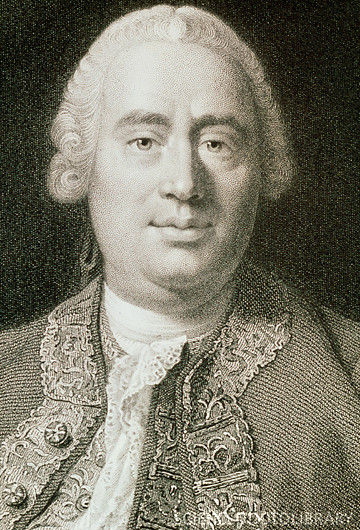
The Scottish philosopher David Hume (May 7, 1711-August 25, 1776) lays out the is-ought problem, in book III, part I, section I of his A Treatise of Human Nature (1739).  Hume says ought-statements are “entirely different” from is-statements and, in his own style, he challenges readers not to pass unthinkingly over the type of argument that switches from is-statements to ought-statements:

“In every system of morality, which I have hitherto met with, I have always remark’d, that the author proceeds for some time in the ordinary ways of reasoning, and establishes the being of a God, or makes observations concerning human affairs; when all of a sudden I am surpriz’d to find, that instead of the usual copulations of propositions, is, and is not, I meet with no proposition that is not connected with an ought, or an ought not. This change is imperceptible; but is however, of the last consequence. For as this ought, or ought not, expresses some new relation or affirmation, ’tis necessary that it shou’d be observ’d and explain’d; and at the same time that a reason should be given; for what seems altogether inconceivable, how this new relation can be a deduction from others, which are entirely different from it.”[1]


Hume is essentially asking, “given knowledge of the way the universe is, in what sense can we say it ought to be different?” (2)  It is with that in mind that he “notes that many writers make claims about what ought to be on the basis of statements about what is” (ibid).

Some turn Hume’s quote into “Hume’s Law” or “Hume’s Guillotine” (as it completely severs ‘is’ from ‘ought’):  “no ethical or indeed evaluative conclusion whatsoever may be validly inferred from any set of purely factual premises” (7) or “you cannot derive an ‘ought’ from an ‘is’”.

In short, Hume is calling attention to arguments of this form:

Premise:  This is (not) so/done.
Conclusion:  This ought (not) to be so/done.

Hume says it is “altogether inconceivable” to say any of the following three things:

1) what is good (an ought) is justified by God’s existence (an is),

2) we ought (not) to do something a certain way ‘because’ it is (not) how we have always done it or are currently doing it, or, (though Hume came before Darwin),

3) “natural selection” is how things ought to be ‘because’ it is how things are in nature.

Hume is not so much talking about whether or not those oughts are really ‘justified’.  More than that, he is talking about whether or not they are “real” or “true” in order to be known.  To put it more basically, “(Can) any moral statement be literally true, and hence potentially knowable?” (6). This is the ultimate concern in Hume’s thinking here.

It should be noted before going any further that, though Hume does acknowledge that the ought-propositions, fallaciously derived from God’s existence, come ‘after’ the writer “has established the being of a God,” Hume would not have granted that God’s existence is part of “how the universe is” (or how reality is).  He was an atheist.

Some atheists who agree the is-ought fallacy is a real fallacy will counter theists (who also agree, but use the Guillotine to attack naturalist ethical theories) simply by stating that Hume was an atheist and that the is-ought fallacy does not lead to a theistic conclusion, but actually critiques it.  Others will just deny that the is-ought fallacy is a real fallacy in order to neutralize challenges to the validity of their moral judgments which do not “mind the gap” between ‘is so’ and ‘ought to be’.

For example, challenging the fact-value distinction, Ruth Ann Putnam has argued “even the most ‘scientific’ of disciplines are affected by the ‘values’ of the men and women who research and practice the vocation” (9).  Granted, but that is something to watch out for when it comes to remaining as objective as possible, rather than an argument against the distinction.  And it does not mean they necessarily have reasoned, or that it would be okay for them to reason, from “ought” (or value) to “is” (or fact) (the reverse is-ought fallacy).  Pointing out that the distinction has been violated in the past is no argument against maintaining the distinction.

Given that the is-ought problem is fallacious, of what sort of fallacy does it consist?

Those who equate the is-ought fallacy with the fallacy named “appeal to nature” (10) consider it 1) a kind of formal, deductive “fallacy of accident” (also called destroying the exception, because evidence to the contrary is not admitted), 2) a kind of informal “appeal to tradition” which is a type of genetic fallacy, a fallacy of relevance, 3) an example of informally “begging the question” because of an unproved hidden co-premise (as in “He is a person and persons shouldn’t torture other beings” below, and any other “evaluative premise” which could take its place), or of 4) formal “circular reasoning” because the conclusion (what ought to be) is assumed in the premises (what is).  “The is-ought fallacy occurs when a conclusion expressing ‘what ought to be so’ is inferred from premises expressing only what ‘is’ so” (4).

While some think the is-ought problem completely severs is from ought and so name it Hume’s Guillotine and Hume’s Law, others interpret him as less strongly suggesting that “one cannot make the initial discovery of moral properties by inference from nonmoral premises using reason alone; rather one requires some input from sentiment” (7).  They say this can be done by simply inserting an “evaluative premise” (1).  “(Hume) seems to have thought that one can infer the latter (‘ought’ claims) from the former (‘is’ claims) only if, in addition to premises concerning plain matters of fact, one has on hand as well at least one evaluative premise” (1).  For example (4):

He is torturing the cat.
[Evaluative premise:  He is a person and persons shouldn’t torture other beings.]
So, he shouldn’t do that.

First, it should be easy to see that inserting an evaluative sentence does not mean one can then go ahead and infer an ought from an is.  That isn’t what is happening.  The ought is not inferred from an is, but from an evaluative statement which is not inferred, but merely inserted or assumed.  This leaves unexplained ‘why’ persons shouldn’t torture other beings, instead taking it as a given and going from formally arguing in a circle (without the evaluative premise), to informally begging the question (with the evaluative premise).  “The question immediately arises, ‘How might we justify these evaluative premises or principles?’” (1). One might say the question actually ‘remains’ rather than ‘immediately arises’, however, a belief’s being justified (the newly arising question) is different from a belief’s being true (Hume’s question).  Both questions are important:  the belief (premise/principle) needs to be ‘both’ justified ‘and’ true if it is to also count as moral knowledge (the ultimate concern in Hume’s thinking).

Some say that, given you cannot get an ought from an is, and applying Hume’s Fork (problem of induction), oughts rely on neither “logic and definitions, or…observation” (2) and so can be neither ‘conclusive’ (preferred by Hume’s Fork) or ‘probable’ (this is an area I would love and sorely need to study further).

Mortimer J. Adler considers the is-ought fallacy “an analogue or special form of the modal fallacy. … It is logically invalid in reasoning to infer a necessary conclusion from premises that are contingent in their modality, or to assign contingency to a conclusion that is inferred from premises that are necessary in their modality. It is similarly and just as obviously fallacious to draw an ought-conclusion from premises that consist entirely of is-statements; for the difference in logical type between descriptive and normative propositions is as great as, if not greater than, the difference in modality between two descriptive propositions” (8).  Similarly, the difference between descriptive and normative propositions is the difference between correspondence (ontology/metaphysics) and justification (epistemology).

A known belief “is” true (correspondence) and “ought” to be believed (justification).  This goes back to Plato’s “justified true belief” requirement for knowledge.  Truth is either/or, while belief can vary in degrees depending on the strength of justification.  All that is required for knowledge is that a belief be ‘both’ true ‘and’ justified (enough to be believed above 50%) by logic and definitions, observations, direct reason, intellect or intuition—whatever reasons we “ought” to believe the conclusion “is”.

To say that a belief’s being true or false makes it justified 100% or 0% (respectively) commits the is-ought fallacy, and to say that a belief’s feeling justified (say, 86%) makes it (86%) true commits the ought-is fallacy.  Although truth is 100%, justification only needs to be above 50%, and we must have them both independently of eachother in order to ‘know’.

Translating from epistemology back over to ethics, there needs to be a real ought in order for there to be moral knowledge, but 1) the real ought is not justified by its correspondence to reality—that would be saying its correspondence justifies its correspondence (begging in a circle) and 2) a particular ought is not made to correspond by its justification—that would be like saying that the act of believing made something real to believe in (also begging in a circle).  No, there must be “both” justification “and” correspondence.  If one or both is lacking (by depending on the other, or for some other reason), knowledge is lacking.

Some (anti-realists, skeptics) argue that if ‘is’ is completely severed from ‘ought’ then moral ‘truth’ (ontology, metaphysics) is completely severed from ‘justification’ (belief, epistemology) and all we can have is belief and never knowledge, because it puts truth beyond the grasp of even belief, much less knowledge.  This is false.  Unless we maintain the gap, we argue in a circle, we grasp at grasping and know nothing.  For an in-detail analysis, see (11).  As long as we mind the gap, knowledge is possible, which is evident in scientific progress.

Still, John Searle tries to derive ought from is by distinguishing between two kinds of descriptive statements:  brute facts and institutional facts.  Institutional facts are composed of ‘constitutive’ rules which create a form of activity (chess for example) that would not exist without the rules,” (5) as opposed to ‘regulative’ rules which regulate things that would exist even without the regulations (traffic code for example).  Searle says combining institutional rules (ought) and brute facts (is) will result in obligation.  “As far as institutional obligations go, we can derive them only after we first collectively contrive them.  Or, at least, that is all that Searle has shown” (5).

The attempted solutions, first of inserting an evaluative premise, second the discussion of institutional facts, appeal to “values already possessed” (2), rather than evaluating the truthfulness of those values.  Truthfulness is about correspondence.

Some (2) say that the truth of an “is” statement is defined by its correspondence to reality, whereas the truth of an “ought” statement is defined by its correspondence to right desire.  However, if we are talking about “real oughts” then that (granted) “right desire” should be part of reality, so that the truth of “ought” statements is, like the truth of “is” statements, determined by (though not justified by) its correspondence to reality.  In other words, if an ought statement is true, there is some being in reality to which it corresponds, some being which it describes, but which does not justify the ought statement, which is justified using reasons (12).

Sources reviewed in preparation for this article (some of them referenced above):

(1) http://plato.stanford.edu/entries/metaethics/

(7) http://plato.stanford.edu/entries/hume-moral/#io

(8) Comments on the “Naturalistic Fallacy” by Mortimer J. Adler, Ph.D

(9)

http://en.wikipedia.org/wiki/Fact-value-distinction

(10)

http://en.wikipedia.org/wiki/Appeal_to_nature

(11) Christopher Norris’ “Epistemology”.

http://ichthus.yuku.com/forums/71/Epistemology-Norris-Book-Discussion

(12) http://theswordandthesacrificephilosophy.blogspot.com/2010/08/appendix-g-synthesizing-golden-rule.html

Other relevant articles I have written:

God (is) the Golden Rule (ought) without offending Hume

http://ichthus77.blogspot.com/2011/04/god-is-golden-rule-ought-without.html

The Golden Rule (self=Other) and God

http://ichthus77.blogspot.com/2011/04/golden-rule-selfother-and-god.html

Hume’s is-ought, Plato’s true-justified, Euthyphro’s dilemma and Gettier’s problem

http://ichthus77.blogspot.com/2011/02/humes-is-ought-platos-true-justified.html

Replacing Agnosticism with Apisticism

http://ichthus77.blogspot.com/2010/11/replacing-agnosticism-with-apisticism.html

Is-ought fallacy and knowledge as justified-true-belief http://ichthus77.blogspot.com/2010/11/is-ought-fallacy-and-knowledge-as.html

Norris, Gettier, Euthyphro, Hume and Plato: Is knowledge justified true belief?

http://ichthus77.blogspot.com/2011/01/norris-gettier-euthyphro-hume-and-plato.html

Answering Gettier
http://ichthus77.blogspot.com/2011/01/answering-gettier.html

Natural law, divine command and Euthyphro’s dilemma resolved using Hume’s is-ought distinction:

http://ichthus77.blogspot.com/2011/03/natural-law-divine-command-and.html


***

This post also appeared on Examiner.com.

Posted in Examiner.com Articles, Is-Ought Fallacy | 2 Comments

Why does Sam Harris’ "Moral Landscape" have the word "moral" in it?

I actually have ‘two’ questions (followed by a more important ‘third’ question).

1.  Why does Sam Harris’ “Moral Landscape” have the word “moral” in it? and…
2.  Why doesn’t its sub-title say “How science can likely determine human values”?

Really, I think the title should read “The Landscape of Well-Being: How science can likely determine human well-being” rather than pretending to be a book about objective moral truth.

Here’s why:

A.  Harris: “Notice that I do not mention morality in the preceding paragraph, and perhaps I need not. I began this book by arguing that, despite a century of timidity on the part of scientists and philosophers, morality can be linked directly to facts about the happiness and suffering of conscious creatures. However, it is interesting to consider what would happen if we simply ignored this step and merely spoke about ‘well-being.’” (Landscape, p. 64).

B.  Harris:  “…if evil turned out to be as reliable a path to happiness as goodness is, my argument about the moral landscape would still stand, as would the likely utility of neuroscience for investigating it. It would no longer be an especially ‘moral’ landscape; rather it would be a continuum of well-being, upon which saints and sinners would occupy equivalent peaks,” (Landscape, p. 190).

And, here’s a third question–the most important of the three:

3.  What was the point of including the psychopath’s statement in chapter two (p. 95-96), if Harris is cool with not calling it evil (quotes A and B above)?

He goes on to say that people are not ultimately responsible for their own immoral, evil choices when he denies free will.  It is no wonder then that he is so ready to deny morality, to ‘go beyond’ good and evil in quotes A and B.  But…what is it people are not responsible for in the first sentence of this paragraph, if there is no morality, no good and evil–why go to the trouble of pointing out they are not responsible for something that doesn’t exist?  And what of this quote:

C.  Harris:  “We can choose to focus on certain facts to the exclusion of others, to emphasize the good rather than the bad, etc.  And such choices have consequences for how we view the world.  One can, for instance, view Kim Jong-il as an evil dictator; one can also view him as a man who was once the child of a dangerous psychopath.  Both statements are, to a first approximation, true.  (Obviously, when I speak about ‘freedom’ and ‘choices’ of this sort, I am not endorsing a metaphysical notion of ‘free will,’)” (p. 139).

So…is Kim Jong-il’s dictatorship ‘really’ evil or not?  Are we free to focus on ‘really’ morally good thoughts (precursors to behavior), to the exclusion of ‘really’ morally bad thoughts, or not?  What is the ‘correct’ approximation (as Harris calls it)–if thefirst one (by calling it ‘first’ and an ‘approximation’) needs improvement?  One that is more in line with quotes A and B–right, Harris?

I’ve said most of this previously, but it came up again here.  Figured I’d blog about it.

Other related blog posts:
Why Sam Harris’ “objective moral truth” hovers over an abyss…
Craig v Harris debate post mortem, audio, video and transcript
Open letter to William Lane Craig regarding April 7 debate with Sam Harris
At Coffee with the Euthyphro Dilemma

Related Examiner.com articles:
Review: Sam Harris’ “The Moral Landscape”
Harris versus Dawkins, modern day Euthyphro dilemma
Dawkins changes mind for Harris’ objective moral truth
Sam Harris’ forthcoming Moral Landscape ‘decides’ objective morality
Sam Harris claims we are not free to choose objective moral truth.

***

This post also appeared on Examiner.com.

Posted in Examiner.com Articles, Sam Harris | 2 Comments

Outside the Box: on the ‘extended mind’ hypothesis by Christopher Norris

Philosopher Christopher Norris, whose book Epistemology is discussed here on Ichthus77, has granted me permission to post the following as a guest post and enter it into the most recent Philosophers’ Carnival.  It was written a couple weeks back and is under consideration for a regular print journal, so until then I am honored to display it here.  Thankyou, Professor Norris :)

Outside the Box: on the ‘extended mind’ hypothesis

Christopher Norris

Abstract

In this essay I examine various aspects of the ‘extended mind’ (EM) thesis proposed by David Chalmers and Andy Clark. Their claim is that various items of extra-cranial equipment (ranging from notebooks to iPhones) are so closely bound up with the mental processes of those who use them that they must – on a ‘parity principle’ – count as parts or integral components of the users’ minds. Opponents of the thesis typically object that minds don’t have parts, that the devices in question are themselves products of human ingenuity, and that intentionality – the mark of the mental – cannot be attributed to notebooks or iPhones without falling into gross confusion. In response the advocates of ‘strong’ EM run a range of arguments, mostly of the slippery-slope kind, in order to press their point that there is no way to draw a firm or principled line between ‘internal’ and ‘extraneous’ modes of mental extension or cognitive enhancement.


My essay reviews the current debate, starting out from a position of broad sympathy with the EM thesis but then raising problems with it from a phenomenological as well as ethical and socio-political standpoint. I conclude that its advocates have been too much concerned with prosthetic devices of a physical or material kind and have thereby been led to under-estimate the role of human inter-personal, collective, and social exchange as a source of expanded mental powers. By way of pointing up this missing dimension of the EM argument I briefly trace a history of thought – from Spinoza to Negri and other recent theorists – which lays chief stress on the idea of ‘multitude’ as a means of breaking with the entrenched individualism of Western post-Cartesian philosophic thought.

Keywords: brain, cognitive science, epistemology, extended mind, externalism, mind, phenomenology, psychology

I
     Consider, if you will, the sheer variety of (supposedly) non-mental since extra-cranial processes and events that have gone into the making of this article. I am writing it with the aid – more than that: with what feels like the active involvement – of a computer/word-processor linked to the internet and sometimes providing me with prompts, references, links to relevant online debates, and so forth. Besides, what I write even during periods of off-line dedication to ‘the writing itself’ is inevitably shot through with a great many witting or unwitting allusions to my online reading and is also, crucially, shaped in large measure by this experience of thinking and working in tandem with a whole range of modern technologies. Indeed their influence goes far deeper than their role in merely providing us with more convenient, speedy, or well-stocked and ready-to-hand informational resources. Rather it reaches into various regions of our cognitive, intellectual, and even our affective lives in such a way as to induce a profound re-structuring of knowledge and experience alike.

To think of those technologies as extra-mental – as standing in a merely prosthetic or supplementary relation to the human mind – must in that case be a big mistake and a product of the anthropocentric or human, all-human tendency to draw a categorical line between what transpires inside and outside the skull. Once rid of that prejudice, so the argument goes, we can start getting used to this counter-intuitive yet strictly inescapable truth, namely that the mind is not intra-cranial but engaged in a constant two-way traffic with objects, events, and information-sources beyond the individual brain. Moreover this is an active reciprocity – a mutual exchange or feedback-loop with continual adjustment on both sides – that finds no place on more traditional (not just Cartesian) conceptions of the mind-world relationship. Quite simply, philosophers have got it wrong and shown themselves prey to mistaken, folk-psychological beliefs by adopting the view, in however philosophically ‘sophisticated’ a form, that mental processes and events must be thought of as transpiring in a realm quite apart from the various ‘external’ devices whereby human beings often contrive to enhance their cognitive powers. Thus the various IT resources that I have called upon in writing this essay – or throughout its period of intellectual gestation – are not just so many useful aids or handy adjuncts to processes of thought that would otherwise have gone on largely unaffected by their absence except for some limiting conditions with regard to information access and ease of textual or data processing. Rather they have become so intimately a part of the cognitive process itself – so deeply bound up with every stage in the business of data-retrieval and selection, ideational synthesis, concept-formation, inference, analogy, critical review, and so forth – that it is no longer possible to draw any clear or principled line between mental and non-mental or intra- and extra-cranial events. More precisely: any such line-drawing will amount to no more than a stipulative fiat or a last-ditch attempt to conserve some privileged space for the human (i.e., what is conceived as uniquely or distinctively human) against the perceived encroachments of modern techno-science.

Such is the ‘extended mind’ (henceforth ‘EM’) hypothesis advanced by a number of vigorous and eloquent present-day advocates, chief among them David Chalmers and Andy Clark. It was their jointly authored essay of 1998 that first set out the hypothesis in its full-strength boundary-shifting form and very quickly produced a wide range of responses for and against.[1] Most prominent among the nay-sayers were philosophers of mind and cognitive psychologists, like Jerry Fodor, whose disagreement turned on what they diagnosed as the basic error – or category-mistake – necessarily involved in any ascription of mental states, contents, capacities or powers to extra-cranial (and hence, by definition, non-mental) items.[2] For Fodor it is a truth borne out by commonsense judgement and philosophical reflection alike that mental content is ‘underived’, that is to say, sui generis, non-dependent, and in itself the sole possible source of whatever strictly derivative contents might attach to various kinds of supplementary device.[3] What sense can there be, he asks, in talking about minds as if they had parts – additional parts or the scope for such piecemeal augmentation – so that some of them (maybe through possession of an iPhone) might come to have more parts than others? Is it not the case that our recourse to – even, at times, our reliance on – devices of this sort requires both that they have already been programmed (by ourselves or others) with relevant, reliably sourced information and also that we, the end-users, should believe that information or at any rate take mental note of it. For Fodor, in short, ‘externalism needs internalism, but not vice versa [since] external representation is a sideshow; internal representation is ineliminably the main event’.[4] In this respect he stands foursquare with other thinkers, among them John Searle, who likewise regard underived content – or intentionality – as the distinguishing mark of the mental.[5]

Clearly this also sets him squarely opposed to advocates of the EM hypothesis. Their point is to challenge all such ideas of a mental domain whose locus, however problematically, is inside the human skull. On their account the predicate ‘mental’ stands in need of radical semantic surgery so as to extend its range of application not only beyond the ghost-in-the-machine of Cartesian mind/body dualism but also beyond the individual brain as it figures in the discourse of hard-line eliminativists or central-state materialists.[6] Indeed this proposal goes even further in an anti-mentalist or anti-Cartesian direction than the thoroughly integrated nexus or synthesis of mind/body that we are urged to endorse – albeit for very different reasons – by continental phenomenologists and analytic strong-naturalists alike.[7] Chalmers and Clark seek to persuade us that a great many items commonly thought of as extraneous to mind-brain are in fact so deeply intertwined with our perceptual, cognitive, intellectual, affective, and creative or imaginative experience as to constitute not merely prosthetic devices but integral components thereof. Just as mind reaches out into world through various kinds of applied technology – from the humble notepad and pencil to the iPhone or other such hi-tech marvels – so world reaches deep into mind through the active combination of that same technology with the human aptitude for adjusting to new and sometimes transformative changes in its ambient life-world. Hence the Chalmers/Clark ‘Parity Principle’, according to which: ‘[i]f, as we confront some task, a part of the world functions as a process which, if it were done in the head, we would have no hesitation in recognizing as part of the cognitive process, then that part of the world is . . . part of the cognitive’.[8] I would guess that the untypical clunkiness of this crucial sentence has its point in stressing both the knotty imbrication of mind and world and the resistance that this claim tends to generate in many – Fodor among them – by reason of its coming so sharply into conflict with a range of deep-laid intuitive beliefs.

 In his book Supersizing the Mind Clark offers numerous striking examples of past, present and future-possible developments which he considers to present a powerful challenge to defenders of the inner/outer dichotomy or suchlike (as he sees them) Cartesian residues.[9] On his account it is not enough for those of an expressly anti-Cartesian persuasion – mind/brain identity theorists or exponents of a thoroughly naturalised epistemology and philosophy of mind – to reject the charge outright. Where they still betray signs of that bad old heritage is in stopping short at an intra-bodily or ‘skin-sack’ monism which might indeed count as radical in terms of received philosophical wisdom but fails to question the other, more tenacious dualism. That is, they persist in trying to demarcate mental (even if physically embodied) processes from non-mental since extra-bodily means of cognitive enhancement. Clark’s book is largely devoted to running a series of slippery-slope arguments – some of them involving extant technologies, others more in the nature of thought-experiments – designed to show just how questionable, or downright arbitrary, that line really is. Thus his point is to provide a whole series of ‘intuition-pumps’ (in Daniel Dennett’s useful phrase) so as to wean us off accustomed ways of thought, whether philosophical or folk-psychological, according to which there just must be a difference – a humanly salient or crucial difference – between what goes on inside and outside our skulls.
II

     It is important for Clark’s argumentative purposes that this claim should extend well back into the history of cognitive enhancement techniques. Thus he makes a strong point of invoking ‘primitive’ techniques such as pen-and-paper or the sundry mnemonic devices that people have used, down through the ages, to supplement their limited resources of ‘internal’ memory or their restricted capacity for processes of ‘purely’ mental computation. (I am making this liberal use of scare-quotes, let me say, in keeping with the anti-dualist conviction that motivates the EM hypothesis, since for now I am trying to represent their case without prejudice either way.) If one thing is intrinsic to the human mind it is not the kind of delusive self-sufficiency envisaged by Descartes and his legion descendents – some of them unwitting or deeply in denial – but rather this capacity for linking up with its environment in adapative, creative, and self-transformative ways. This why Clark likes to offer a range of homely examples so as not to be accused of resting his case too heavily on the latest in current technology or on speculative glimpses of a higher-tech future like that which might be opened up by ‘cyberpunk’ silicon brain implants.

Hence his best-known fictive or thought-experimental case-study, that of Otto and Inga the two art-loving New Yorkers who decide to visit the Museum of Modern Art on 53rd Street.  While Inga relies on her memory to get there – on resources ‘internal’ to her own mind or brain with its range of unaided mnemonic powers – Otto is suffering from a mild degree of Alzheimer’s disease, and must therefore consult the directions written down in his notebook. Clark’s point is that there is no rational or principled, as opposed to adhoc or arbitrary, way of drawing a line between the two kinds of memory and the two sorts of procedure for getting from A to B. Of course the mentalist/dualist/internalist will raise all the obvious objections, such as the (presumptive) fact that Inga has direct access to her memories as opposed to Otto’s indirect access via his notebook, or that Otto has to inspect its content whereas Inga just knows – without need for any such roundabout means – how to reach MOMA by the quickest route. However Clark is breezily unimpressed by these and other counter-arguments put up by critics of the EM hypothesis. Where they always beg the question, he claims, is by taking for granted the validity of certain deep-laid yet far from self-evident folk-psychological beliefs.

Still this has failed to convince those who see nothing naively folkish about the idea that there exists a real (and not merely adhoc or gerrymandered) boundary between whatever goes on in our heads and whatever goes on in the world outside our heads. Thus Fodor fires number of sceptical ripostes back at Clark, among them the suggestion that he try this vignette: Inga asks Otto where the museum is; Otto consults his notebook and tells her. The notebook is thus part of an ‘external circuit’ that is part of Otto’s mind; and Otto’s mind (including the notebook) is part of an external circuit that is part of Inga’s mind. Now ‘part of’ is transitive: if A is part of B, and B is part of C, then A is part of C.[10]

In which case, Fodor continues, ‘it looks as though the notebook that’s part of Otto’s mind is also part of Inga’s’, with the consequence that ‘if Otto loses his notebook, Inga loses part of her mind’.[11] This sounds logical enough and would seem to knock a hole in the EM case were it not for the temporal aspect of the story which allows both circuits (Otto’s with his notebook; Otto’s mind with Inga’s) to be broken once Otto has mislaid that precious item. After all, it is quite explicitly a question in Fodor’s narrative of who knows what and when, that is to say, of knowledge acquired by both parties at a certain stage in the proceedings and then lost by one of them (due to his memory deficit) but presumably not by the other (due to her suffering under no such disadvantage). However Clark ignores this point and focuses instead on what he takes to be Fodor’s most substantive objection, namely his above-mentioned argument concerning the ‘underived’ (self-sufficient or autonomous) nature of mental content as opposed to the ‘derived’ (dependent or second-order) status of physical prostheses such as Otto’s notebook. His rejoinders regularly take the form of turning Fodor’s objections around so as to argue that any sense in which Otto’s knowledge or cognitive state can rightfully be called ‘derivative’, ‘secondary’, ‘dependent’, ‘unreliable’, ‘indirect’, ‘error-prone’, ‘fallible’, or whatever, is also – at no great stretch of counterfactual reasoning – a sense that applies equally in Inga’s case.

According to Clark, ‘both modes of storage can be seen as supporting dispositional beliefs’ – Inga’s self-accessed data bank no less than Otto’s ‘external’ guide – since Inga also needs to consult her memory, as the phrase goes, and retrieve the relevant items of information for the purpose at hand.[12] Moreover she has to have confidence in their accuracy and reliability even if that belief is so much a matter of unthinking routine commitment as scarcely to register at the level of conscious or deliberative thought. Thus Inga’s reliance on ‘unaided’ memory is not, after all, sufficient to establish a categorical or even a reasonably clear-cut distinction between her way of getting to MOMA and Otto’s reliance on his trusty aide-memoire. The latter is indispensably a part of that single integrated system that makes up Otto the absent-minded though cognitively enhanced way-finder, just as Inga’s memory functions as part of a complex system including – as a formative part of its background history – the possibility of error bound up with all recourse to the presumed self-evidence of first-person recollection. Besides, again contra Fodor, Otto’s habit of relying on his notebook is one that we should think of as having acquired the force of habit – of ‘second nature’ – and therefore as being so tightly bound up with his needs, desires, feelings, thoughts, purposes, and intentions as to constitute a quasi-automatic response fully on a par with Inga’s implicit dependence on memories laid down in her brain. And to Fodor’s objection that Otto has to make an extra effort, i.e., that of consulting his written directions Clark responds that the business of remembering – of calling things to memory – can be quite arduous and by no means always so straightforward and uncomplicated as tends to be suggested by talk of ‘underived’ (mental) as opposed to ‘derived’ (artificial or prosthetic) content.

Thus ‘[i]f one denies a dispositional belief to Otto on the grounds that he has to consult his notebook, then one should also deny a dispositional belief to a version of Inga who has to wilfully consult her memory’.[13] One has to assume that Chalmers includes the word ‘wilfully’ not by way of conceding that Inga’s and Otto’s situations are different when her memory is functioning normally, quickly, or spontaneously but rather as a first stage in getting his opponents to see that in fact the same applies in that case too. After all, it is the habitual or well-nigh ‘automatic’ character of Otto’s mnemonic practice – the fact that it forms so seamless a part of his getting around town – that qualifies the notebook as an integral component of his mental life and not a mere supplement or add-on. Here again the crucial point is that the ‘coupling’ between man and device be so close, regular, reliable and habitual as to constitute a genuine circuit or feedback-loop rather than an adhoc or every-so-often and hence less dependable resource. In such cases, according to Chalmers and Clark, there is no relevant sense in which the domain of mental processes and events can be thought to exclude those various ‘external’ items that enable the mind/brain to function more efficiently. It may yet be objected that inert items such as notebooks or notebook-entries, unlike brains, have meaning, purpose, or intentionality only through some prior investment of ‘underived’ mental content, that is, through the directions having been written down – whether by Otto himself or by a helper – with the aim of getting him to MOMA. However they respond once again that this objection misses the mark since it fails to grasp that the writing-down is just as much a product of that same ubiquitous interaction between brain, world and the various basic or advanced technologies that play a more or less prominent role in the commerce between them.    

Another staple of debate is the use of slippery-slope arguments, most often deployed by upholders of the EM hypothesis against those who defend a mentalist or ‘intra-cranialist’ position. The idea is that Fodorians will always be vulnerable to this type of reasoning since they are trying to fix a line of demarcation where no such line can justifiably be fixed, in which case there will always be a ready supply of marginal, borderline, or (for them) problematical instances. What if Otto’s notebook were replaced by a silicon brain implant programmed with the details of his best route to MOMA, along with any amount of other information as and when required? Or again, what if the device had wireless access to a data-bank reliably and regularly primed with just the sorts of details that enable Otto to find his way around and generally manage his life? And what if that provision were further enhanced at some future yet presently conceivable stage of advance by a highly sophisticated feedback system whereby to detect and respond to Otto’s informational needs through its capacity to ‘read his mind’, i.e., pick up and suitably interpret certain recognisable kinds of neural activity? Such scenarios are thought to create a large problem for internalism since they force the question of exactly where – at what point on the scale of deepening physical as well as psycho-cognitive integration with Otto’s lifeworld – the device in question might properly count as a fully-fledged extension of his mind. Clark’s wager is that the internalists will be stuck for an answer, or at least for any answer that doesn’t beg the question against the EM hypothesis. They will either resort to some shifty fallback position with distinct though disavowed Cartesian implications or else bite the bullet, deny that slippery-slope arguments of this sort possess any genuine force, and continue to maintain – as Fodor does – that underived content is the mark of the mental and that minds just ain’t outside the head.

This seems to me a striking example – one of many to be found in philosophy, perhaps for reasons endemic to that discipline – of a debate carried on with great intelligence, wit, and resourcefulness by both parties and yet without reasonable hope of a decisive outcome or, to adapt Dr. Johnson’s mordant phrase, a conclusion in which something is concluded.  Thus it exemplifies the way in which advocates of two flatly opposed positions can each bring up a range of strong and, on their own terms, convincing arguments while curiously failing to engage each other except at a level where every last move in the debate seems to be programmed in advance. Of course it might be said that this is only to be expected since, after all, the quarrel between EM-advocates and intra-cranialists is just another version – a techno-savvy update – of old controversies like those around Cartesian dualism or, what is usually somewhere in the offing, free-will versus determinism. Hence no doubt the depth of commitment on both sides but also, perhaps in consequence of that, the lack of any real prospect that either party will achieve some decisive advantage or come up with some knockdown rejoinder. Chalmers and Clark have no end of slippery-slope instances by which, as they think, to create new problems for the internalist while s/he in turn has arguments in plenty (usually involving an appeal to some aspect or analogue of intentionality) whereby, as s/he thinks, to refute the proponents of strong EM. The latter then respond that Fodor and his allies are merely betraying their residual Cartesianism by attaching such an undue weight of significance to the (supposedly) issue-settling witness of conscious, reflective, or deliberative thought.

Slippery-slope instances include the use of fingers for counting or multiplication vis-à-vis the use of electronic calculators; the Filofax vis-à-vis the iPhone; diagrams and tables of various kinds; the popular (if old-fashioned) image of the engineer always with a slide-rule attached to his [sic] belt; the scrabble player shifting letters around in an offline trial of word-constructing possibilities; and any number of kindred cases where an ‘old’ appliance finds its equivalent – at whatever technologically geared-up remove – in some present-day invention. Also very apt to their purpose is the computer game Tetris where players have to rapidly perceive various objects of this or that geometric shape as they descend from the top of the screen and build a wall at the bottom by intercepting and rotating them so as to fit the available slots or sockets.[14] Here the slippery-slope runs: (1) the game-player does all this ‘in her head’, i.e., by rotating the shapes in her mind’s eye and relying on her unaided sense of visual-spatial orientation; she can either choose to proceed as in (1) or else press a button to rotate the objects on screen (with some advantage in terms of speed); and (3), looking forward to a plausibly not-so-far-off future, the player has been fitted with a brain implant – a silicon-based neural chip – which allows her to perform the action just as quickly as did the computer in situation (2) but without pressing the button since now the operation is carried out through an act of the conjoint mind/brain along with its integral (or ‘internally’ hard-wired) shape-shifting device. Clark and Chalmers present this particular case with very little in the way of commentary or analysis, clearly regarding it as something of a clincher or knock-down argument on their side of the debate.

The second (anti-Cartesian) line of attack relates closely to this because, as Chalmers and Clark see it, the upshot of all those slippery-slope instances if pressed right through is to leave no room – no philosophically habitable space – for the appeal to conscious mind-states as a demarcation criterion. A whole range of basic mental activities, including some (like language-use) of a highly complex and sophisticated kind, are such as not only to proceed for the most part without conscious or deliberative thought but actually to require – for their normal functioning – that this should be the case. So when opponents claim that another salient difference between Otto and Inga is the liability of Otto’s notebook – like all such prostheses – to loss, damage, or sabotage the EM party promptly rejoins that Inga’s brain is liable to the same sorts of accident and, besides that, subject to episodes of distraction, drowsiness, or sleep. The intended effect of all this is to soften up opponents by steadily removing any rational ground they might have (or purport to have) for maintaining the idea of a qualitative difference between mind, intentionality or natural memory and various mind-extending devices like those instanced above. Indeed that effect is clearly visible in the writing of EM theorists where already there has developed a regular tendency to use the language of computing, networks, feedback loops, etc., when describing what would normally – folk-psychologically – dictate the choice of a mentalist or intentionalist idiom. So when Chalmers and Clark rehearse the various standard objections to the EM hypothesis they go so far as to concede the possibility that ‘Inga’s “central” processes and her memory probably have a relatively high-bandwidth link between them, compared to the low-grade connection between Otto and his notebook’.[15]

However this is a concession in which nothing much is conceded since the difference concerned – when phrased and conceived in this manner – is one that works out entirely in favour of their own central proposition. That is to say, their talk of high versus low bandwidths joins onto the nowadays familiar analogy between mind and the central processing unit of a computer so as to suggest that this whole way of thinking has a more than analogical force. What it helps to drive home is the message that memory, along with other aspects of human mental life, should be thought of in resolutely physicalist terms and hence as including any and all of those physical devices that serve to extend its cognitive powers.

III

     Another main area of debate in this context is the distinction between standing and occurrent beliefs, the latter defined as conscious or present-to-mind at some given point in time and the former – by contrast – as those of which we are not conscious or presently aware although we would acknowledge them if asked or act upon them if prompted. This distinction is seen as crucial by the anti-EM party since it arguably falls in with their case for consciousness as the source of ‘underived content’, and hence with their claim that extra-cranial devices simply cannot be integral constituents of mind unless one adopts the pan-psychist idea that everything partakes of consciousness in some, however slight degree. One can therefore understand why Chalmers should profess a certain sympathy with such ideas since the case for panpsychism can readily be stated in terms that fit in well enough with the EM hypothesis, i.e., through its likewise seeking to remove the mind/world barrier, albeit in a more far-reaching way and on no such basically physicalist grounds.[16] From the pro-EM standpoint it is just as crucial to deny that occurrent thoughts, beliefs or memories have any kind of privileged status vis-à-vis standing or dispositional mind-states. After all, the former seem maximally unlikely candidates for replacement or replication by devices outside the skull while the latter are much more readily conceived – though not by Fodor and company – as subject to this or that form of prosthetic extension. So EM advocates typically take the line that since no beliefs are wholly or purely occurrent – since they are all reliant for their power to guide or influence behaviour on a background of standing belief-dispositions – that distinction cannot serve as a basis for rejecting the EM claim.

Here again they deploy a version of the slippery-slope argument, in this case reasoning from the fact that possessors of a normally functioning Inga-type ‘internal’ memory must all the same have recourse, at whatever unconscious or preconscious level, to stored information that cannot plausibly be thought of as punctually present to mind. In short, if the mark of the mental is underived content and if underived content is possessed by occurrent but not by standing beliefs then Inga’s situation in this regard is no different from Otto’s. Or rather, their situations differ in a relative but not in a decisive way since although Inga is no doubt better placed for quick and ready access to her memories without having to consult a notebook she still has the need – conscious or not – to check out the reliability of any knowledge or guidance thus obtained against the stock of information laid down in her standing memory. Of course the opponents of EM will be routinely unimpressed by this argument, on the one hand because (according to them) it once again begs the question by denying, rather than disproving, the existence of underived content and on the other because they (Fodor at least) reject the validity of slippery-slope arguments in general. Besides, they may respond, the point about Inga’s having (like Otto) to ‘consult’ her memory is far less telling than the point that Otto has to believe in the accuracy of his notebook – has to invest it, so to speak, with a quality of credit-worthiness – in a way that necessarily involves the exercise of underived intentional or sense-bestowing powers. To which of course the EM-advocates predictably come back with the further iteration of their basic case: that quite simply there is no such thing as ‘underived content’, and hence that there is no difference – in principle if not for certain practical purposes – between Inga’s and Otto’s situations.

It should be clear by now that this dispute is of the kind – the peculiarly philosophical kind – that is very likely to run and run until boredom sets in, or until there is a switch of interest amongst members of the relevant (largely academic) community. This is not to conclude that it is a ‘merely’ academic dispute, in the sense of having nothing important or relevant to say to anyone outside the community of those with the time and incentive to pursue such matters. On the contrary: it has some large ethical and socio-political implications, as Chalmers makes clear when he remarks that if the EM hypothesis achieves wide acceptance then ‘in some cases interfering with someone’s environment will have the same moral significance as interfering with their person’.[17] Moreover, if physical devices like notebooks and iPhones can qualify as genuinely mind-extending in the strong sense proposed then all the more must this apply to those ‘significant others’ – persons with whom the individual concerned is regularly, closely or intimately in contact – who serve not only as sources of information but (at least under normal circumstances) as active and cooperative members of his or her life-world. Clark and Chalmers acknowledge this, sure enough, but tend to underplay the significance of it or treat it as a non-essential aspect of their case. They prefer to offer instances like that of one’s financial accountant or trusted waiter at a favourite restaurant rather than partners, relatives, or people more personally close-to-home. The reason for this preference is not far to seek since the EM hypothesis is primarily one having to do with processes of information-uptake and information-transfer occurring in a depersonalised context, whether that of Otto’s consulting his notebook or somebody’s consulting their accountant. Even the favourite-waiter example seems to be chosen – fully in line with standard priorities – so as to place greatest emphasis on considerations such as special expertise, reliability, habitual contact, ease of communication, and so forth.

            Thus the idea of socially (as opposed to physically or artefactually) extended cognition is one that Clark is willing to endorse – ‘no reason why not’ – but without anything like the partisan vigour that he brings to his argument for the mind-expanding power of notebooks and iPhones. Of course this is hardly surprising given his and Chalmers’ primary emphasis on the ways in which material implements and devices, rather than other minds, have a role in extending our cognitive powers. However it does tend to bias their approach in favour of that physical or techno-prosthetic dimension and thus prevent them from fully acknowledging the depth and extent of those human, social, or inter-subjective dimensions that shape so much of our mental lives. The resultant philosophy of mind is one that inclines not so much toward naturalism as understood by most of its present-day advocates but rather toward a mechanistic conception that so emphatically repudiates one aspect of Cartesian dualism, i.e., that of res cogitans or the mentalist ‘ghost in the machine’ that it ends up by granting pride of place to an all-encompassing res extensa or inertly physical realm.

            Of course the phrase ‘inertly physical’ is one that the EM theorists would reject out of hand, implying as it does the existence of an altogether distinct ‘mental’, ‘subjective’, ‘intentional’, ‘phenomenological’, or ‘underived-content’ domain where physicalism meets its ultimate limit in that which transcends any possible physicalist specification. By taking that line – so the charge-sheet runs – the anti-EM brigade are merely buying into the same old vitalist delusion, the idea of some mysterious life-force beyond reach of scientific or rational explanation, that has typified so many reactive movements of thought over the past two centuries and more. However this would be to misidentify the main point at issue in the EM debate, as distinct from the point endlessly belaboured – and to no great avail, on the evidence presented here – by parties on both sides. What really matters, I am suggesting, is not so much the question as normally posed, that is to say, internalism = mentalism + individualism versus extended mind = individual mind/brain + various physical prostheses. Rather it is a different, more searching and relevant question of the form: cognitive individualism = this or that solitary brain + various, chiefly physical prostheses versus the socially extended mind = everything belonging to the human sphere wherein there can be no more sense to the distinction between minds and brains than there is to the distinction between ‘individual’ minds/brains and their range of inter-subjectively salient inputs, contacts, or relationships. That this is not – or not primarily – the kind of question raised by EM theorists should at least give pause to anyone assessing their proposal on grounds of intuitive acceptability.

            Of course intuition need not have the last word in these matters, and should probably not be allowed too prominent a voice at any stage in the debate. After all, the progress of scientific knowledge has come about very largely despite and against the weight of (supposed) self-evidence attaching to commonsense-intuitive ideas and beliefs. That history runs from Galileo’s heliocentric hypothesis to the advent of non-Euclidean geometries (with their shock to the Kantian a priori system) and – in consequence – the relativistic conception of space and time. All the same it is far from clear that intuition should always take a back seat when it comes to philosophy of mind or to issues in epistemology which concern that very question of just how far we can or should rely on such apodictic sources. Here at least there is a case – one urged by thinkers in the phenomenological line of descent from Husserl, a tradition oddly conspicuous by its absence from EM debate – that understanding might yet be advanced by a suitably disciplined and rigorous approach to certain intuitions concerning the scope and limits of the properly (non-analogically) mental.[18]

This is not to say – far from it – that any claims in that regard should be subject to assessment on terms laid down by the Cartesian tribunal of conscious awareness or reflective self-knowledge. Indeed few ruling ideas have led to greater wastage of time, effort and ingenuity than the deep-laid philosophical conviction that knowledge must involve a conscious mind-state or some kind of privileged first-person epistemic access. Thus it will count among the most useful services rendered by advocates of strong EM if they manage to shift attention away from the ‘hard problem’ in philosophy of mind, i.e., the famously intractable but (as I have argued elsewhere) much hyped and in the end not very interesting problem of consciousness.[19] On the other hand their way of setting about that worthy task is one that raises some equally intractable problems, among them – as critics like Fodor remark – that of drawing a non-arbitrary line between what properly belongs to mind on this expansive account and what must be considered extra-mental since lacking the requisite degree of informational richness, relevance, complexity, or readiness to hand. This difficulty might best be got over, and without serious detriment to their own case, were the EM theorists a bit more receptive – or a bit less prickly – in their response to the above-cited range of counter-arguments from a broadly phenomenological standpoint. Clark and Chalmers may be right that some of those objections issue from misconceived ideas about the existence of human free-will as dependent on the absolute autonomy of mind, or from a strain of shamefaced Cartesianism that has found another refuge under cover of which to continue the campaign. Thus it now takes the form of a strain of individualism seemingly purged of such dualist residues but squarely opposed to any idea that mind might extend beyond the boundaries of this or that isolated brain, skull, or skin-sack. Such is the diagnosis routinely offered by EM theorists whenever confronted with some argument involving the phenomenological appeal to given aspects of our experiential being-in-the-world, or our placement as so many spatio-temporally located human agents with a certain, albeit at times highly qualified sense of existing within those boundaries.

            Indeed his keenness to have done with such arguments leads Clark to suggest that this whole debate might be seen as evidence that ‘the mind is itself too disunified to count as a scientific kind’, and hence to ask: ‘might the EM debate form part of a reductio of the very notion of mind in Cognitive Science?’.[20] In other words, might we not be better off abandoning not only dualism, mentalism, and skin-sack individualism but also – for this would seem to be Clark’s proposal – all those branches of cognitive science and cognitive psychology that find any room for mental or phenomenological predicates? At this stage it strikes me that the only appropriate rejoinder is one that involves babies washed away with the bathwater or noses cut off to spite faces. Where the EM theorists go wrong is by too readily saddling (perceived) opponents with a view of these issues that equates the mental with the conscious, or thought and belief with their surrogate forms – their phantom delegates – in the ‘Cartesian theatre’ of dualist imagining. Otherwise they would have less trouble in conceding that those opponents do have a point, and moreover an EM-compatible point, when they resist going so far as Chalmers and Clark with the project of barrier-dismantling, or with deconstructing categorical distinctions such as that between the mental and the mechanical. More precisely, these objectors – or the cannier among them – think it is worth hanging onto the intuitive distinction between (1) that which is most aptly characterised as belonging to the broadly intentional (i.e., belief-related, thought-involving, cognitive, rational, purposive, or generally mindful) realm and (2) that which it makes better sense to think of as belonging to a different (i.e., physical and extra-cranial) domain, at least when considered under its normal or primary range of descriptions.[21]

IV

     It is here – in contesting the mechanistic bias of much EM argument – that Fodor is able to mount his two strongest lines of attack. First, he rejects the kinds of slippery-slope reasoning often used by EM theorists since he considers them to be no more cogent or decisive when deployed in this context than in other set-piece instances like the classical sorites-type (pseudo-)dilemmas. Second, he makes the cardinal point about underived content – or intentionality – as ‘the mark of the mental’ and hence as pertaining to notebooks, maps, GPS units, iPhones, etc., only in a strictly derivative sense or else by the loosest of analogies. As we have seen, Clark and Chalmers are inclined to treat this sort of argument as yet further evidence of backsliding into thoroughly discredited Cartesian ways of thought. Yet the charge clearly lacks force if one construes ‘underived’ not in terms of individual mentality or first-person privileged epistemic access but rather with reference to that wider trans-personal or inter-subjective context in the absence of which human beings would be unable to mean, intend or signify anything whatsoever. This is not to deny the EM thesis in its other, wholly defensible form, namely that those various extra-cranial devices are indeed mind-extending, mind-expanding, and mind-enhancing in a way that changes and might potentially transform the range and scope of our mental capacities. What it does call into doubt is the far-out version of that thesis according to which the history of those developments is sufficient to obliterate the boundary between mind and the various ancillary (no matter how useful, reliable, or even indispensable) devices that have come to play a major role in the lives of many human beings.

That supplements have an odd habit of reversing the normal order of priorities – shifting the emphasis from ‘supplement = mere (strictly unnecessary) add-on or optional extra’ to ‘supplement = that which is needed in order to repair or make good some existing shortfall or deficit’ – is a point that Jacques Derrida demonstrates to brilliant effect in his book Of Grammatology.[22] However it also emerges very strikingly through straightforward reflection on the complex of meanings or logico-semantic implications inherent in these two, on the face of it downright contradictory yet closely entangled senses of the word. It seems to me that this debate around the EM hypothesis has a lot to do with what Derrida calls the ‘logic of supplementarity’ and the kinds of joint reversal-and-displacement to which certain binary distinctions may be subject through a critical account that no longer takes for granted the supposedly self-evident, logical, rational, or ‘natural’ order of priority between them. On the other hand Derrida is equally insistent – as against some other, less canny or cautious exponents of the deconstructive turn – that there is no point in carrying out this inversion of priorities unless it meets the twofold strict requirement exemplified by his own critical practice. That is to say, it must (1) be shown to follow from a rigorous analysis of the terms in question along with the complex, paradoxical, or contradictory relationship between them, and (2) succeed in revealing the strictly unwarranted (i.e., the arbitrary or ideologically motivated) ascription of superiority or dominance to one term over the other.

I cannot see that the strong-EM case meets those requirements or convincingly demands so radical an overhaul of our basic conception of mind vis-à-vis the non-mental or – as the debate is currently played out – the intra vis-à-vis the extra-cranial. Like Chalmers I do all sorts of things with my iPhone, among them downloading and listening to music, watching films, reading books and journals, accessing the internet, finding my way on bike-rides via GPS (shades of Otto and his notebook), making phone-calls once in a while, taking photos or videos, setting myself maths and logic puzzles, doing sound-recordings (of myself and others), and looking up a whole vast range of otherwise elusive information. Also like Chalmers I am sometimes tempted to think of it as something more literally mind-integral – more closely or intimately bound up with my meanings, intentions, or thought-processes – than could ever be allowed by the more moderate construal of the EM thesis here proposed. This is especially the case when it offers me some otherwise unavailable and life-enriching musical experience or provides ready access to some otherwise inaccessible information-source combined with a capacity for searching out relevant passages and self-addressed memos across all the other devices (desktop, laptop, Kindle etc.) to which my iPhone is linked. However I normally set that temptation aside by reflecting that there is still a great difference between what goes on in my head and what goes on outside it, no matter how much those various externalities may affect, extend, augment or refine my unaided powers of calculation, recollection, logical reasoning, or even – where many would surely dissent – inventive though disciplined hypothesis-construction.

Indeed there is a sense in which the slippery-slope argument beloved of EM enthusiasts can be turned right around and used to challenge their standard line of reasoning. I have been the grateful beneficiary of various electronic music media from LP to CD, Mini-Disc, MP3 and now iTunes and should acknowledge that they have contributed greatly to my mental and physical (not to say spiritual) wellbeing over the years. Still I would be confusing the issue and committing a fairly gross kind of category-mistake if I claimed that the devices in question were literally a part of my musical experience or were bound up with it in some intrinsic and response-constitutive way rather than serving as handy – marvellously handy – technological resources for delivering that experience. The same applies to the distinction between intra-cranial (mental-intentional) and extra-cranial (prosthetic) dimensions of information-processing or whatever goes into the business of cognitive uptake. If that distinction can be made to look delusory or merely naïve then this is no doubt due to the present-day dominance of naturalistic approaches in epistemology and philosophy of mind, and the consequent suspicion that any attempt to draw such a line must be in hock to residual Cartesian ways of thought.

That this objection misfires, since intentionality (or Fodor’s ‘underived content’) can perfectly well go along with a naturalized epistemology, is a case that I have presented in detail elsewhere and which finds support in a good deal of recent work in those same disciplines.[23] What emerges is something more in line with that moderate version of the EM thesis which treats extra-cranial prosthetic devices as no doubt playing all manner of informative, restorative, memory-boosting, intelligence-stretching, creativity-provoking, or other such mentally enhancing roles without for that reason demanding recognition as integral components of mind. Rejecting the lessons of phenomenology or viewing it as merely a species of ‘psychologism’ (for which read: subjectivism/relativism run amok) is one of those deep-laid articles of faith or largely unquestioned imperatives handed down by the founding fathers – Frege in particular – that typify the discourse of mainstream analytic philosophy.[24] Even thinkers who have lately questioned that imperative or sought to negotiate a renewal of ties between the two traditions – an increasing number of late – still tend to assume that Frege got it pretty much right with regard to the irrelevance of phenomenological considerations when it comes to logic and the formal sciences.[25]

It seems to me that this assumption, whether or not valid in that particular context, has exerted a distorting effect when carried over into different areas of debate like those surrounding the strong EM hypothesis. It has led philosophers like Chalmers and Clark to treat any resistance to their case in its full-strength or uncompromising form as just a throwback to quaintly subjectivist or ‘psychologistic’ modes of thought. However this is a flat misunderstanding of the opposition case and one that badly distorts the issue between these contending parties. In short, there is no reason – partisanship or prejudice aside – to suppose that a belief in the distinctness of mind from its various ancillary, prosthetic, or supplementary aids is necessarily a sign of Cartesian leanings. Nor is it to go along with those thinkers – among them followers of Wittgenstein and subscribers to Donald Davidson’s idea of ‘anomalous monism’ – who regard mind-talk and physicalist talk as each making sense in its own proper (topic-relative) sphere, and hence as incapable of coming into conflict except through some categorical confusion or failure to respect their respective scope and limits.[26] Rather it is to recognise that phenomenology can and should have its say in any discussion of these issues, and moreover that this can and should go along with the commitment to a thoroughly naturalised conception of mind and its various attributes. However – crucially – this is a phenomenology of the extended mind where that extension is primarily social or inter-subjective in character, i.e., no longer restricted to the realm of first-person apodictic thought, judgement, and experience that occupied the main focus of Husserlian phenomenological enquiry.

            Here it joins with other anti-individualist or trans-personal conceptions, many of which trace their lineage back to Spinoza’s radically heterodox thesis – developed very much in opposition to Descartes – that mind is a properly collective (or multitudinous) phenomenon which gains its power and capacity for action precisely through achieving the maximal extent of inter-active communal exchange.[27] This is why recent intellectual historians have identified Spinozism as the leading force in that largely underground ‘radical enlightenment’ that pressed its social-transformative claims far beyond anything countenanced by the purveyors of ‘official’ enlightenment values and beliefs, Kant chief among them.[28] Thus the idea of ‘multitude’ has nowadays been taken up by a number of thinkers who seek to develop a social-political ontology that would break altogether with the individualist and epistemologically oriented modes of philosophizing bequeathed by Descartes and Kant.[29] One feature of that tradition has been its periodic tendency – above all in Descartes – to combine a subjectivist-idealist appeal to the supposed self-evidence and privileged status of first-person epistemic warrant with an otherwise thoroughly mechanistic worldview, thus squeezing out any notion of mind as manifest through modes of inter-subjective, inter-personal, or ‘multitudinous’ assemblage. It seems to me that the ‘strong’ EM thesis shows a similar penchant for all things physical-mechanical and a similar tendency to downplay the role of those other, more-than-supplementary resources which pertain to mind in its trans-individual dimension.

            One need not be a Marxist – though probably it helps – to detect here a telltale symptom of the process (call it reification or commodification) that converts the products of human labour, invention, or creative ingenuity into so many items of inertly physical matter. Of course the advocates of strong EM will again protest that this charge is grossly misconceived since what they are proposing is a radical shift in just the opposite direction, that is, from conceiving notebooks, iPhones, and so forth as physical artefacts and nothing more to conceiving them as animated (so to speak) by human intentionality. Yet it is precisely Marx’s point in his writing on the uncanny ‘logic’ of commodity fetishism that this is indeed a two-way exchange of properties or attributes although one that has the predominant effect of rendering the animate inert rather than vice versa.[30] Thus, in EM terms, the mind-extending powers of extra-cranial devices are routinely extolled without taking adequate account of their dependence on the mind-expanding power of communal or collective human intelligence. This produces a reified, commodified or fetishized conception of technology which in turn leads us to think of human beings as creatures of the various (whether lo-tech or hi-tech) gizmos that are taken to constitute a large and increasingly pervasive aspect of their life-worlds. So there is, I suggest, good reason to resist the more hard-line versions of the EM thesis, or those that take literally its claim that notebooks and iPhones are integral parts of – rather than highly useful, versatile and often much relied-upon additions to – our core repertory of cognitive powers. Otherwise it is likely to result not so much in a newly expansive conception of the mental that embraces all sorts of items hitherto deemed inertly physical but rather, despite what its advocates may claim, in a shift of perception that works to precisely opposite effect.

            This likelihood increases as the EM case is pushed beyond cases having to do with memory, knowledge, reasoning, logic, calculation, and the more cognitive or formal-procedural aspects of human intelligence. After all, the whole approach finds its best, most convincing set-piece instances in technologies – whether notebooks or iPhones – that have as their primary function the more efficient marshalling of information or the better working of our rational thought-procedures. As I have said, Chalmers and Clark are by no means unaware of this challenge and indeed make a point of confronting it head-on. Thus to the questions ‘what about socially-extended cognition?’ and ‘could my mental states be partly constituted by the states of other thinkers?’ they respond that ‘in an unusually interdependent couple, it is entirely possible that one partner’s beliefs will play the same sort of role for the other as the notebook plays for Otto’.[31] This does at least take us further into the realm of significant inter-subjective or inter-personal exchange than their allusion to the kind of relationship that people have with their financially trusted accountant or the favourite waiter in their favourite restaurant. Still it doesn’t take us that much further since the interdependent-couple case is one that confines the range of relevant examples to relationships of the most intimate (hence socially exclusive) kind and thereby works to debar any reference to the collective – i.e., the socio-political or ‘multitudinous’ – dimension of human inter-dependent activity.
V

     Chalmers and Clark go on to raise the question as to what consequences flow from an acceptance of the strong EM thesis for our conception of ‘that most problematic entity, the self’.[32] The passage needs quoting at length because it brings out very clearly the effect of such thinking in terms of that wider, i.e., not only trans-individual but also properly public or non-intimate since trans-personal sphere. ‘Does the spread of cognitive processes out into the world imply some correlative leakage of the self into local surroundings?’, they ask. Yes indeed, since it is only the diehard (or shamefaced) Cartesians who would seek to shore up the citadel of the self – or personal identity – against all encroachments from ‘outside’. Thus:

Most of us already accept that the boundaries of the self outstrip the boundaries of consciousness: my dispositional beliefs, for example, constitute in some deep sense part of who I am. If so, then our previous discussion implies that these boundaries may also fall beyond the skin. The information in Otto’s notebook, for example, is a central part of his identity as a cognitive agent. What this comes to is that Otto himself is best regarded as an extended system, a coupling of biological organism and external resources. To consistently resist this conclusion, we should have to shrink the self into a mere bundle of occurrent states, severely threatening the psychological continuity of the self. Far better to take the broader view, and see agents themselves as spread-out into the world.[33]

This passage perfectly exemplifies the way that strong EM uses the bugbear of Cartesian dualism – with all its well-known problems concerning selfhood or personal identity vis-à-vis the ‘external world’ – in order to prop up its case. There are three main issues that it raises with particular force so I shall end this discussion by focussing on them and drawing the relevant conclusions with regard to the EM programme in its currently most visible and vigorous guise.

            First: if the boundaries need pushing back then it is far from clear – indeed highly doubtful – that they need pushing so as to include an ever-increasing range of technological appliances, accessories or gadgets that cannot (except on a thoroughly mechanistic worldview) lay claim to a constitutive role in the shaping of human identity. Second: if it is true that mind-world boundaries must be thought of as falling ‘outside the skin’ then getting inside other people’s skins (and allowing them to get inside ours) is more important – more crucial to overcoming that Cartesian legacy – than extending our nominal definition of ‘mind’ to include this or that item of physical paraphernalia. And third: if Otto’s notebook is deemed ‘a central part of his identity as a cognitive agent’ then this claim needs some very careful unpacking. Maybe it qualifies for such a role only in so far as we are considering his ‘identity’ in strictly ‘cognitive’ terms, that is, in line with the bias typically displayed by the advocates of strong EM. But in that case one should surely be given pause by the emphatic claim that ‘Otto himself is best regarded as an extended system, a coupling of biological organism and external resources’. For then it is hard to avoid the conclusion that selfhood and identity must be a matter of states that pertain very largely – perhaps entirely – at an infra-personal, pre-volitional, or sub-doxastic level.

            So far from preserving the ‘psychological continuity of the self’ this idea of agents as ‘spread-out into the world’ is much likelier to induce a generalised scepticism with regard to any claim for the self as playing an other than notional or place-filler role. In effect it is squeezed out – reduced to insignificance – by that direct ‘coupling of biological organism and external resources’ that Chalmers and Clark envisage as providing all that’s required in the way of explanatory content. Indeed, the very fact of their resorting to talk of ‘external’ versus ‘internal’ is enough to suggest that the ‘shrinkage’ of the self here imputed to internalists is perhaps more a feature of the EM approach and its reduction of mind to a ‘mere bundle’ of dispositional (rather than occurrent) states. At any rate if there is a genuine threat to the ‘psychological continuity of the self’ then it looms much larger from the EM direction than from any over-emphasis on phenomenological aspects of human thought and experience. Acceptance of the thesis in its strong or literal form is apt to produce an increasingly mechanised image of the mind that ignores or discounts those properties of it – chief among them its distinctive intentionality – which stand in the way of such acceptance. What most needs stressing is the basic point that a theory of mind duly heedful of the relevant distinctions need not (indeed, should not for its own philosophical good) get into conflict with a naturalised conception of mind vis-à-vis brain and its ambient physical and social world. However if attention is focused solely on physical aspects of the extended mind – thus ignoring its social or inter-personal aspects – then this is sure to produce a distorted perspective and a tendency to replicate those same vexing dualisms that the EM proponents hope to have resolved once and for all.

            At any rate there is room to doubt Clark’s and Chalmers’ claim – or to find in it a certain revealing ambiguity – when they confidently state that ‘once the hegemony of skin and skull is usurped, we may be able to see ourselves more truly as creatures of the world’.[34] In the strong version it is a thesis with some fairly discomforting overtones for those whose relationship with various items of not-so-peripheral technology may involve a mixture of dependence, fascination, and a sense that we are indeed becoming ‘creatures’ of a world – a world of all-embracing informatics – with designs on the scope and limits of our selfhood.

References
[1] David J. Chalmers and Andy Clark, ‘The Extended Mind’, in Richard Menary (ed.), The Extended Mind (Cambridge MA: MIT Press, 2010), pp. 27-42. For further discussions pro and contra the EM thesis, see especially Frederick Adams and Kenneth Aizawa, The Bounds of Cognition (Oxford: Blackwell, 2008); Lynne Rudder Baker, ‘Persons and the Extended Mind Thesis’, Zygon, Vol. 44, No. 3 (2009), pp. 642-58; Andy Clark, Natural-Born Cyborgs: minds, technologies and the future of human intelligence (Oxford: Oxford University Press, 2003), ‘Curing Cognitive Hiccups: a defence of the extended mind’, Journal of Philosophy, Vol. 104, No. 4 (2007), pp. 163-92, and ‘Intrinsic Content, Active Memory, and the Extended Mind’, Analysis, Vol. 65, No. 285 (2005), pp. 1-11; Brie Gertler and Lawrence Shapiro (eds.), Arguing About the Mind (London: Routledge, 2007); Susan Hurley (ed.), Consciousness in Action (Cambridge, MA: Harvard University Press, 1998) and ‘Vehicles, Contents, Conceptual Structure and Externalism’, Analysis, Vol. 58, No. 1 (1998), pp. 1-6; Richard Menary, Cognitive Integration: mind and cognition unbounded (London: Palgrave, 2007); Mark Rowlands, ‘Extended Cognition and the Mark of the Cognitive’, Philosophical Psychology, Vol. 22, No. 1 (2009), pp. 1-19 and ‘The Extended Mind’, Zygon, Vol. 44, No. 3 (2009), pp 628-41.
[2] Jerry Fodor, ‘Where is my Mind?’, London Review of Books, 31:3 (2009), pp. 13-15.
[3] See also Fodor Psychosemantics (Cambridge, MA: MIT Press, 1987) and The Elm and the Expert (MIT Press, 1994).
[4] Fodor, ‘Where is my Mind?’, p. 15.
[5] John R. Searle, Intentionality: an essay in the philosophy of mind (Cambridge: Cambridge University Press, 1983).
[6] For a vigorously-argued presentation of the eliminativist or central-state materialist case, see Paul M. Churchland, Scientific Realism and the Plasticity of Mind (Cambridge: Cambridge University Press, 1979).
[7] For further discussion of this possible convergence between phenomenological and naturalistic conceptions of mind, see Christopher Norris, Minding the Gap: epistemology and philosophy of science in the two traditions (Amherst, MA: University of Massachusetts Press, 2000) and Re-Thinking the Cogito: naturalism, reason and the venture of thought (London: Continuum, 2010). 
[8] Chalmers and Clark, ‘The Extended Mind’ (Note 1, above), p. 29.
[9] Andy Clark, Supersizing the Mind: embodiment, action and cognitive extension (Oxford: Oxford University Press, 2008).
[10] Fodor, ‘Where is my Mind?’, p. 13.
[11] Ibid, p. 13.
[12] Clark, Supersizing the Mind, p. 96.
[14] Chalmers and Clark, ‘The Extended Mind’, p. 27 ff.
[15] Ibid, p. 44.
[16] See especially Chalmers, The Conscious Mind: in search of a fundamental theory (Oxford: Oxford University Press, 1996).
[17] Chalmers and Clark, ‘The Extended Mind’, p. 45.
[18] See for instance Shaun Gallagher and Dan Zahavi, The Phenomenological Mind: an introduction to philosophy of mind and cognitive science (London: Routledge, 2008); Barry Smith and David Woodruff Smith (eds.), The Cambridge Companion to Husserl (Cambridge: Cambridge University Press, 1995); David Woodruff Smith, Husserl (London: Routledge, 2007); Dan Zahavi, Subjectivity and Selfhood: investigating the first-person perspective (Cambridge, MA: MIT Press, 2008).
[19] Norris, Re-Thinking the Cogito.
[20] Clark, ‘Memento’s Revenge: the extended mind, extended’, in Menary (ed.), The Extended Mind (Note 1, above), pp. 43-66; p. 65.
[21] See for instance Adams and Aizawa, The Bounds of Cognition (Note 1, above); also various contributors to Gertler and Shapiro (eds.), Arguing About the Mind and Menary (ed.), The Extended Mind  (Note 1). Among others resistant to the EM proposal, at least in its full-strength form, see also Gary Bartlett, ‘Whither Internalism? how internalists should respond to the extended-mind hypothesis’, Metaphilosophy, Vol. 39 (2008), pp. 163-84 and Robert D. Rupert, ‘Challenges to the Hypothesis of Extended Mentation’, Journal of Philosophy, Vol. 101, No. 8 (2004), pp. 389-428. For some wider though highly relevant contexts of debate, see P. Robbins and M. Aydede (eds.), The Cambridge Handbook of Situated Cognition (Cambridge: Cambridge University Press, 2009).
[22] Jacques Derrida, Of Grammatology, trans. G.C. Spivak (Baltimore, MD: Johns Hopkins University Press, 1976).
[23] Norris, Re-Thinking the Cogito.
[24] For a more detailed account, see Norris, ‘Who’s Afraid of Psychologism?: normativity, truth, and epistemic warrant’, in On Truth and Meaning: language, logic and the grounds of belief (London: Continuum, 2006), pp. 12-40.
[25] See especially Michael Dummett, Origins of Analytical Philosophy (Cambridge, MA: Harvard University Press, 1993). 
[26] See for instance Severin Schroeder (ed.), Wittgenstein and Contemporary Philosophy of Mind (Palgrave-Macmillan, 2001); also Donald Davidson, Essays on Actions and Events, 2nd ed. (Oxford: Oxford University Press, 2001).
[27] See especially Antonio Negri, The Savage Anomaly: the power of Spinoza’s metaphysics and politics, trans. Michael Hardt (Minneapolis: University of Minnesota Press, 1991); also Gilles Deleuze, Spinoza: practical philosophy, trans. Robert Hurley (San Francisco: City Lights Books, 1988) and Expressionism in Philosophy: Spinoza, trans. Martin Joughin (New York: Zone Books, 1992).
[28] Jonathan Israel, Radical Enlightenment: philosophy and the making of modernity, 1650-1750 (Oxford: Oxford University Press, 2002); see also Christopher Norris, Spinoza and the Origins of Modern Critical Theory (Oxford: Blackwell, 1991); Paul Wienpahl, The Radical Spinoza (New York: New York University Press, 1979); Yirmiyahu Yovel, Spinoza and Other Heretics, Vol. One: The Marrano of Reason, and Vol. 2, The Adventures of Immanence (Princeton, NY: Princeton University Press, 1989).
[29] See especially Michael Hardt and Antonio Negri, Empire (Cambridge, MA: Harvard University Press, 2000) and Multitude: war and democracy in the age of empire (New York: Penguin, 2004). 
[30] Karl Marx, Capital, Vol. One, A Critique of Political Economy (Harmondsworth: Penguin, 1992), Chapter One, Section Four.
[31] Chalmers and Clark, ‘The Extended Mind’, p. 41.
[32] Ibid, p. 42. 
[33] Ibid, p. 42.
[34] Ibid, p. 42.
Posted in Carnival, Norris' Epistemology, Reviews and Interviews | Leave a comment

Philosophers’ Carnival #127

Welcome to the June 27, 2011 edition of Philosophers’ Carnival.  First those blog posts which were actually submitted will be listed, followed by blog posts which were gleaned.  If you submitted a good post that was not included, please know there has been a glitch with blogcarnival.  Email me and it will be remedied.

Submitted:

epistemology

Aaron Rathbun presents Obama’s Birth Certificate and Epistemology posted at theology+culture, saying, “This post is about postfoundationalist epistemology. “Birthers” doubting Obama’s birth certificate will never have any sufficient amount of evidence to prove them otherwise, because our presuppositional commitments shape how we filter the evidence to begin with.”

Matt Flannagan presents In Defense of Reasonable Disagreement by Andrew, posted at MandM.

logic and language

Tristan Haze presents Sketch of a Way of Thinking about Modality – Part 1 posted at Sprachlogik.

metaphysics


Michael S. Pearl presents Matters of Choice and Free Will posted at The Kindly Ones, saying, “This actually relates to logic and epistemology as well.”

mind


gualtiero piccinini presents 
Was Psychosemantics a Failure? posted at Brains.

Christopher Norris presents Outside the Box:  on the ‘extended mind’ hypothesis posted at Ichthus77.

moral philosophy

Richard presents The Normativity Objection to Metaethical Naturalism posted at Philosophy, et cetera.

Greg Nirshberg presents What we miss in the free will debate posted at Cognitive Philosophy.

Matt Flannagan presents Lawful Authority and Just Wars posted at MandM.

Jeremy Pierce presents Abortion and Incurred Responsibility posted at Parableman.


Gleaned:

Physicalism by Nick Smyth on Yeah, OK, But Still, on John Danaher’s articles of the same topic.

Is there a best possible multiverse?  by Alexander Pruss on Prosblogion.

Omnipotence and failure by Kenny Pearce.

How am I not myself? by Greg Nirshberg on Joshua Knobe and Mark Pierpoint’s articles.

Examples of errors in reasoning by James W. Gray on Ethical Realism, as well as an overview of the major theories in Ethics.

The anatomy of intentional action by Dan Jones on The Philosopher In the Mirror explaining “The Knobe Effect”.

Susan Wolfe and Meaningfulness by

You can’t get an ought from an is – but Cameron’s trying to do just that by Richard J Murphy on Tax Research UK.

Moral Absolutes and the Humpty Dumpty Fallacy by Matthew O’Brien and Robert C. Koons at Public Discourse, the second article in a series of three on The Uses of Philosophy.

Doing Away with God by Ian Kluge at Common Ground on Hawking and Mlodinow’s “The Grand Design”.

Mailbag Monday:  What is the Greater Good? on Philosophy Bro.

The Language of Responsibility by JP on Philosophy Talk.

Academic ethics under competition by Thomas Rodham on The Philosopher’s Beard.

philosophical divisions by Gary Sauer-Thompson.

Equal weight and asymmetric uncertainty by Brian Weatherson on Thoughts, Arguments and Rants.

Two Problems with Kripkenstein’s Argument for Meaning Skepticism by Jason Streitfeld at Specter of Reason.

The animal you are by Paul Snowdon on The Philosophers’ Magazine.

A short introduction to the philosophy of artificial intelligence by Anderson Brown.

Distinguished woman philosopher 2011 by profbigk on Feminist Philosophers.

What do diversity and inclusion mean at Cisco systems? by Tom Gilson at Thinking Christian.

Victor Stenger responds to “Who Made God?” by Edgar Andrews

Why do people completely misunderstand the word ‘faith’? by Eric Chabot at Ratio Christi.

The problem of miracles by Max Andrews on Sententia.


That concludes this edition. Thankyou to those who submitted blog posts.  Submit your blog article to the next edition of philosophers’ carnival using our carnival submission form. Past posts and future hosts can be found on our blog carnival index page.  “Like” us and stay updated on Facebook.

Posted in Carnival, Norris' Epistemology, Reviews and Interviews | 23 Comments

Philosophers’ Carnival call for submissions

I’ll be hosting the next Philosophers’ Carnival on June 27 (submit by June 25).  Email submission if need be.
.
Some topics I’d like to see in the submissions:
  • How can an objectively true moral ‘ought’ correspond to the ‘is’ of reality?
  • Is free will scientifically possible?  Is moral responsibility possible without it?
  • Respond to this:  If the strong sociologist counters with the argument from error, they are affirming a realist premise, since “they rely on the assumption that some past theories were true (or scientifically warranted) despite the weight of received opinion at the time,” (Christopher Norris, Epistemology, Postscript II).
  • Respond to this: Admitting that false grounds are false grounds is admitting they are non-justifiers, so that Gettier’s problem examples do not involve instances of justified, true belief, and so do not challenge Plato’s justified-true-belief account of knowledge.
  • Does “God commands in accordance with his good nature” and Plato’s justified-true-belief requirement for knowledge show Euthyphro’s Dilemma to be a false one?
  • Hume’s fork:  What, if any, is the connection between Hume’s is-ought problem (is this really a problem?) and his problem of induction (is this really a problem)?  Did he see a connection?
  • Why is there something, rather than nothing?
  • Why is every major theory in Ethics compared to the Golden Rule in my Intro. to Ethics text, yet the Golden Rule is not considered as a theory in itself?  Is this common to introductory Ethics texts?
  • Why should any and/or every person care about philosophy?
  • Show how your favored theory in Ethics is superior to the others by applying each to a current event or common moral dilemma.  Top it off with the first question in this list.
  • Feel free to reply to this blog post and submit your own with other good ideas.
Posted in Carnival, Euthyphro Dilemma, Gettier Problem, Golden Rule, Is-Ought Fallacy, Justified True Belief, Natural Law and Divine Command, Norris' Epistemology, Predestination, Reviews and Interviews, Sam Harris | Leave a comment

Christian Carnival CCCLXXXIV

Welcome to what should have been the June 15, 2011 edition of christian carnival ii.

There was a glitch with blogcarnival, so Fish and Cans is rescheduling for a later date.  All apologies that this was not posted Wednesday.  All Things New is up for Wednesday the 22nd.

KAZBullet presents What I’m Thinking: Caprice/Son? posted at Bullet’s Brain, saying, “Is God a capricious God? Does He change his mind? That’s what this blog post addresses. Thanks!”

Cowboy Bob presents Opinions, Traditions or Convictions? posted at A Soldier for Jesus, saying, “Hello, I’m new here. Do I wait until I’m approved before I put the widget on the post? Thanks for your time. Hope you like it. Cowboy Bob”  Answer:  No, go ahead and slap that widget on your post.

Jeremy Pierce presents Abortion and Incurred Responsibility posted at Parableman, saying, “on sex and consenting to care for resulting children”

Kaleb presents Only the Players Get Paid posted at W2W Soul: Windows to The Woman’s Soul, saying, “If you have ever gone to a college or professional basketball or football game where the arena or stadium is sold out, you know the spectators far outnumber the players.”

Dan Lower presents Dan Reads the Catechism: Paragraph 103 and the Kneeling Argument posted at keyboard theologians, saying, “An interesting [post] about presences…”

loswl presents Scientific Accuracy in the Bible Revealed posted at INSPIKS, saying, “The Bible is not primarily a book of science, but it does contain numerous scientific facts. We laugh at some of the scientific data that was available just a few hundred years ago. If man alone were the author of the Bible, we would expect to find many such errors contained in it.”

michelle presents contentment is a choice? posted at going into all the earth….

Russ White presents Sheep and Shepherds posted at Thinking in Christ.

Dave Taylor presents The rise of the holier-than-thou post-evangelical posted at Letters from another life, saying, “It’s become trendy and fashionable in some circles not to call oneself an evangelical. Are we supposed to believe this signals improvement, or is it just another form of sanctimony?”

Josh presents Bible Verses For Encouragement: 20 Great Scripture Quotes posted at What Christians Want To Know, saying, “We all need encouragement and the Bible provides this. Check out these great encouragement Bible verses.”

Ridge Burns presents Obey Even When It Hurts posted at Ridge’s Blog.

Kaleb presents Give Me Patience—Right Now! | W2W Soul posted at W2W Soul: Windows to The Woman’s Soul, saying, “To coin a beloved phrase by Joyce Meyer: “ I’m not where I need to be but thank God I’m not where I used to be!”

Diane R presents How Socialist Movements REALLY work posted at Crossroads: Where Faith and Inquiry Meet, saying, “Today we have another group of socialist-oriented Christians that really think they can help the poor, but they will end up hurting them just like their predecessors.”

I present San Francisco Atheists interested to see Dawkins debate Craig and Central Valley location of first CAA chapter posted here at Ichthus77.

That concludes this edition.   Submit your blog article to the next edition of christian carnival ii using our carnival submission form.   Past posts and future hosts can be found on our blog carnival index page.  “Like” us and stay updated on Facebook! :)

Posted in Carnival | 1 Comment