Solve for x (good) & y (great/beautiful)

Following up on a segment of my last post, “It’s a greater ‘neutral value’ view that considers competing goods as neutral values before they are in the context of a decisive action,” from Graded Absolutism Revisited: Ordered Neutral Values, I wanted to clarify that the word greater should more properly be in the context of going above and beyond. Good is breakeven.

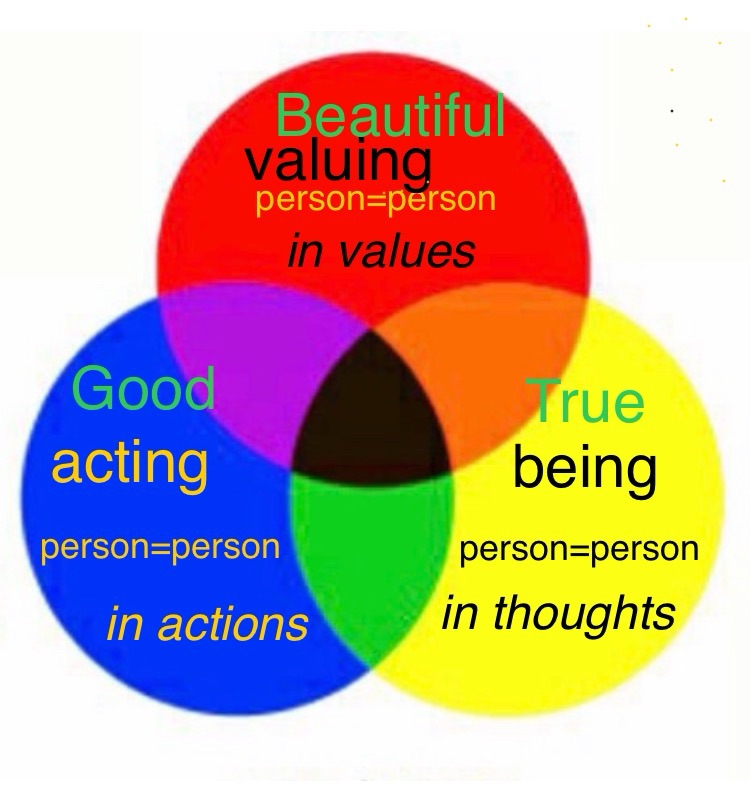
Does this image do justice to the concepts conveyed in this post? How would you have represented them?

This exercise helps clarify that.

The sets x & y…

x (a common value that is good, but bare minimum)

y (a personal preference that is both good and so beautifully extra that “against such things there is no law” unless you’re a Scrooge or a Grinch)

After you read the below, solve for x and y in the comments.

As long as your values don’t violate my consent, and my values don’t violate your consent, I think we’re good. But I think we can be better than good. We can be beautifully great when we go above and beyond for each other.

Don’t just x (a common value that is good, but bare minimum), go above & beyond into y (a personal preference that is both good and so beautifully extra that “against such things there is no law” unless you’re a Scrooge or a Grinch).

;^)

****

How Jesus solved for x & y:

x: treat others the way you want to be treated, live for & love your friends who are good & love you, tithe what you can spare, lend without interest, forgive others for things you’ve also done wrong, stop doing wrong things before correcting others about those same things, the punishment should not exceed the crime, obey your parents and those in authority, exchange greetings with your circle, fulfill your work duties, reward employees after you reward yourself, first do no harm, store up your treasures in heaven, never wander or lead others astray, be fair, be firm in your convictions, steward wealth generously, be sexually and emotionally faithful in marriage until death, follow the evidence where it leads

y: show kindness to your evil & ungrateful enemies who hate you & treat you unfairly (including God, if you are a theist ontologically but an atheist thetically…because you feel God is evil & hates you), die for (to truly live/love) your friends, give everything away to the poor, give someone twice what they ask and don’t expect it back, forgive all wrongs even if you’ve never done them, start doing generous things even if no one else is doing them, accept all wrongs against you without repaying them with anything but blessing and prayer – and invite even more, obey God even if those in authority command the opposite, invite outcasts to hang out with you, exceed expectations at work, reward employees before you reward yourself, heal someone even if you didn’t harm them, quietly invest God-given gifts in the public square without seeking recognition, return home when you wander and welcome/lead back those who will return, be the servant of all, put all your presuppositions to the test with the innocent openness of a child, prioritize eternal gifts that increase without passing away, make yourself incapable of marriage, believe in the answer to the deepest question in everyone even in your lowest/highest moment

(No such thing as an exhaustive list in either case.)

To put it another way:

x: treat others the way you want to be treated

y: show kindness to your evil & ungrateful enemies who hate you & treat you unfairly (including God, if you are a theist ontologically but an atheist thetically…because you feel God is evil & hates you)

x: exchange greetings with your circle

y: invite outcasts to hang out with you

x: live for & love your friends who are good & love you

y: die for (to truly live/love) your friends

x: tithe what you can spare

y: give everything away to the poor

x: lend without interest

y: give someone twice what they ask and don’t expect it back

x: forgive others for things you’ve also done wrong

y: forgive all wrongs whether or not you were personally affected and even if you’ve never done them

x: stop doing wrong things before correcting others about those same things

y: start doing generous things even if no one else is doing them

x: the punishment should not exceed the crime

y: accept all wrongs against you without repaying them with anything but blessing and prayer – and invite even more

x: obey your parents and those in authority

y: obey God even if those in authority command the opposite

x: fulfill your work duties

y: exceed expectations at work

x: reward employees after you reward yourself

y: reward employees before you reward yourself

x: first do no harm

y: heal someone even if you didn’t harm them

x: store up your treasures in heaven

y: quietly invest God-given gifts in the public square without seeking recognition

x: never wander or lead others astray

y: return home when you wander and welcome/lead back those who will return

x: be fair

y: be the servant of all

x: be firm in your convictions

y: put all your presuppositions to the test with the innocent openness of a child

x: steward wealth generously

y: prioritize eternal gifts that increase without passing away

x: be sexually and emotionally faithful in marriage until death

y: make yourself incapable of marriage

x: follow the evidence where it leads

y: believe in the answer to the deepest question in everyone even in your lowest/highest moment

***

Your turn:

How would YOU answer which examples/members belong in categories/sets x & y if category/set z is Agent Z (this time it can be you instead of Jesus) and NOT a Scrooge or a Grinch?

Posted in Apologetics, Divine Essentialism, Ethics & Metaethics, Golden Rule, Harmonic Triads | Leave a comment

Graded Absolutism Revisited: Ordered Neutral Values

Generations of people who survived childhood are evidence of a mother’s nurturing and a father’s protection—or some other caregivers who stood in their places. At the animal level it involves following a program of parental empathy. At the intentional level it involves prioritizing what begins as the neutral-good value of parental empathy, whether expressed in nurturing or protecting behavior that must taper off when offspring near adulthood.

But I would like to add to my thoughts about neutral goods.

They might more properly be called morally neutral values. It helps clear up a confusion between goods (some of which we don’t value) and values (which are not morally good or bad, or rightly/wrongly ordered, until decided upon in a given context).

Vices are when you get used to fulfilling neutral wants (things everybody wants, so for that reason are commonly labelled absolutes—or personal preferences) in a way that violates the golden rule. Virtues are when you get used to fulfilling neutral wants in a way that conforms to the golden rule (either by following the natural program, or intentionally not resisting it, or intentionally ordering your competing wants around the golden rule). To pare down to the neutral want, carve away the part that violates (or conforms to) the golden rule. That is why empathy is such a great example (got it from C.S. Lewis)—and why you have to consider character and passions separately.

This leads to a different sort of greater good view (got *that* from Norm Geisler) because it’s not a greater “good” view. It’s a greater “neutral value” view that considers competing goods as neutral values before they are in the context of a decisive action.

It was born April 6, 2015 (at least… that’s when I discovered it with my mind) during a conversation I had with my oldest son, Ethan, about how telling the truth, saving a life, lying, and killing are–in and of themselves, and all things being equal–morally neutral. The context determines which one follows the golden rule. For example, you would not tell the truth about someone’s location to someone who wants to murder them. Instead, you would save their life by withholding that information. Saving their life is more important (greater) than telling the truth in that context. And in that context, telling the truth would be evil. 

Isn’t it interesting that there can be no greater, lesser, or neutral values unless there is the good (golden rule) to order them by? And isn’t it interesting that the good has nothing to determine to be greater, lesser, or neutral if there are no competing neutral values? And the greatest of these is love (golden rule love stands above all the values—it is the value of values). So in that sense, God “exists” his essence (eternal value/love) in both being (character) and action (conduct)—and because they all need each other to be whole/One, they are all three ontologically primary (triunity).

Posted in Apologetics, Divine Essentialism, Ethics & Metaethics, Golden Rule, Harmonic Triads, Is-Ought Fallacy | 1 Comment

Rules: Descriptive, Prescriptive, and Purposive

Sparked by a “separation of church and state” discussion with my youngest son, David, and his beloved, Holly.

Separation of Church/Religion and State/Science

Science is descriptive – it cannot a) prescribe anything, or b) have a purpose behind it. It’s about the way we actually/evidently are and what we actually/evidently do.

Ethics is prescriptive – it cannot a) describe anything, or b) have a purpose behind it. It’s about the way we should be (and actually/evidently aren’t) and what we should do (and actually/evidently don’t).

Art is purposive – it cannot describe or prescribe anything. It’s about what we want to become, and how we want to behave, whether or not we already are like that or behave that way, and whether or not we should be like that or behave like that.

Venn generated by Copilot

Prescriptive rules are rules that imperfect people don’t always follow, but should. Legislation that prescribes imperfect behavior or character is no legislation at all.

Descriptive rules describe how we always behave (only a perfect person is ALWAYS described as behaving how they SHOULD behave).

Sometimes we fall back on the way we always behave, but if we don’t always behave that way, it’s because we can choose to behave a different way (which is not necessarily how we SHOULD behave).

Purposive rules (art) neither prescribe nor describe… they aren’t necessarily how we DO behave, nor how we SHOULD behave… they are what we WANT to be/have, what we WANT to do, or WHY we want it… whether or not things are already that way (descriptive science) or should be that way (prescriptive ethics).

If you’re doing ethics, you’re not (just) doing science or art (you are also prescribing a method, which is not itself a description or purpose/why).

If you’re not prescribing, you may still be doing ethics, but you’re not (just) doing ethics (you may also be describing the perfect…describing is science).

And if you are saying “I want this” you’re using a purposive rule, not (just) a description or a prescription. You’re not saying it is or isn’t that way (maybe it is, maybe it isn’t…yet)… you’re not saying it’s good or bad (maybe it is… maybe it isn’t). You’re just saying you want it. For better or worse.

Art (purposing) does more than merely describe or prescribe, and it may do neither. But the highest art does all three, omnipresently—as it is in the highest (immanent transcendence) kingdom.

The Good (prescriptive), the Loved (purposive), and the True (descriptive) are One/Whole (distinct and together).

Posted in Apologetics, Ethics & Metaethics, Euthyphro Dilemma, Harmonic Triads, Is-Ought Fallacy | Leave a comment

Two quotes compressed & distilled into a concentrated compact of… curiosity… :D

Divine impassibility is not a lack of passion, but an eternally unshakeable, rational passion.

—Anonymous (okay, it was me)

A counter-obligatory imperative is no imperative at all.

— Augustine of Hippo
(my translation, using deontic logic terms)

Posted in Apologetics, Harmonic Triads | 35 Comments

Harmonic Triads Reference, Current Index

This index is not exhaustive, but current:

The first fallacy: Ought-Value or Action-Quality Conflation

On the impossibility of knowing a true tenseless fact without omnitemporality (read all the comments)

Elaborating on C Theory

Logic Venn (of Opposition/Reconciliation)

C Theory of Time & the Venn of Import

Towards a JTB Ought-Is-Value Litmus

Harmonic Triads

Up next:

Also this and this.

Posted in Epistemology, Ethics & Metaethics, Harmonic Triads, Is-Ought Fallacy, Justified True Belief | 3 Comments

The first fallacy: Ought-Value or Action-Quality Conflation

The first fallacy in philosophy, and not just the philosophy of ethics, is neither just the is-ought fallacy, nor just the failure to respect the fact-value distinction, but the fallacy of confusing the former for the latter: conflating oughts and values. This is relevant across every field, not just ethics, because it boils down and adds up to confusing action and quality. Together with the is/fact (substance) element from the first two mentioned fallacies, these three elements constitute the is-ought-value distinction, or the substance, action, quality triad. All three are required to obtain true, justified belief (knowledge) about anything, in any field of philosophy (including all the sciences). They are required together, but distinctly. One cannot stand in for either of the others.

But let’s begin in the field of ethics… messy work under construction.

Please note: Many of my posts on the blog from prior years DO commit the “first fallacy”.

Posted in Divine Essentialism, Harmonic Triads, Is-Ought Fallacy, Justified True Belief | Tagged , | Leave a comment

Jesus, the Great Philosopher (Bible App reading plan)

Join me for the next 5 days, Friend me for life: bible.com/p/73402169/9b6a021defc94523473032611bbe1b88

Posted in Apologetics | 2 Comments

The Personhood Program

Regardless what species we are materially, persons are all structured to be able to see when there is inconsistency between our thoughts, values, and behaviors. We know that we are persons, and that there are other persons. We know we have a choice to acknowledge what we know, in our thoughts, values, and behaviors. That is the only reason there is ever a difference between our thoughts, values, and behaviors. We aren’t programmed robots without the ability to “game” the program. Imagine if we went with the flow of the program rather than gaming it?

Posted in Apologetics, Ethics & Metaethics | 2 Comments

Who is the point?

Why? Why do we care what is true, or what is true about what is good? What is the meaning of life, or what is the point? If we are always good (if that were possible), can we still miss the point?

Does the majority decide the truly good point because we appreciate culture? Do we appeal to the behavior of other species in nature, or every living being’s instinct to survive? What about those things that we consider worth not only living but dying for? 

Can we point to anyone as a true example of someone who is always good and also always gets the point? If not, does that mean there is no true good, and no true point? Why do we have this feeling that there is more to life than merely surviving or running according to our genetic or cultural programming? 

Can there be an organizing principle … a point … that can only be willfully arrived at … that puts all of our competing values and instincts in proper alignment around it, such that, until we find this point, we hunger for it restlessly, we feel aimless, or like all our aims will eventually disappoint us, and never quite feel free from our genetic or social programming—to be who we are meant to be?

How can a mere principle represent the point of persons? Or could the principle also be personal? Who…? …since we can point to no one who always is, does, and values what is true, good, and meaningful? Or can’t we?

Posted in Apologetics | Leave a comment

On the impossibility of knowing a true tenseless fact without omnitemporality

TIME Q Posted on Equip / Reasonable Faith (also submitted as a question of the week) (Facebook discussion below)

I recently took the equip course on God‘s relationship to time and eternity. It was a great supplement to Dr. Craig’s recent coverage in the defenders course over a number of sessions.A lingering question I have is: How can God know a tenseless 1942 fact that is embedded (timestamped) in time unless that time exists in some sense, and he knows… Read more– ichthus77 (@Ichthus77) March 11, 2025

I recently took the Equip course on God‘s relationship to time and eternity. It was a great supplement to Dr. Craig’s recent coverage in the Defenders course over a number of sessions.

A lingering question I have is: How can God know a tenseless 1492 fact that is embedded (timestamped) in time unless that time exists in some sense, and he knows what time it is in that sense, because not only is he immanent in *that* time, he is omnitemporal (omniimmanent, omnipresent)? Would this be a synthesis of both A and B theories, or would it be a “kind” of (which?) one of those two theories?

***

Jabberwock

God is supposed to know counterfactuals and they do not ‘exist’ in any sense. So it seems that the issue described is just an instance of a greater question, i.e. how can God know anything without a causal chain shaping his knowledge?

***

I can see that some things would be able to be known without experience, or a priori, like the fact that opposites cancel each other out, so in order to have a whole you need more than two individuals of the sort that cancel each other out. So this whole must be always existing. However, something in 1492 is embedded in time even if you have gleaned it tenselessly. so that seems to be a synthetic a priori of a coeternal whole, no? And for the record, I do not think this violates free will, if the whole thing is complete on the spur of every moment/choice(s).

***

On Facebook (Christian Apologetics Alliance)

https://www.facebook.com/groups/caalliance/permalink/4241855109375311

Dave Homiack basically repeated Jabberwock and added in Dr. Craig’s “sin is never vanquished because/and Jesus is still hanging on the cross” critique of B Theory and defense of A Theory.

I reply:

I reply to you at 9:00am Pacific on Sunday, March 16, 2025. Tenselessly true (but actually false) ontologically prior to that moment in time, and only true in a tensed (actual) sense upon the reply’s insantiation within time. It’s like Schrodinger’s cat on Dr. Craig’s view, unless God is omnitemporal… timelessly dead in God’s mind, until finally alive in time. Or????? Do I not have this quite right?

I don’t think it is possible that he knows timestamped facts conceptually sans temporality (for the same reason Dr. Craig doesn’t think God can go back to timelessness), nor perceptually after the fact (he is omniscient—Kant’s original being… intellectual intuition), but rather it is only possible for God to know “in the fact” because (or, “if”) he is omnitemporal. If I am right, God doesn’t need to “fore”know or look ahead (or back)—he is already there (including here). We usually don’t understand this because we don’t understand time. Or God’s presence.

I think the situation is neither A nor B Theory. I am familiar with Dr. Craig’s “sin is never vanquished” argument against B Theory. But, he did point out the absurdity of every time existing at the same time, and it is equally absurd (for the same reason) to say that God forever hangs on the cross. Coeternality (omnitemporality, eternity) is not something we easily grasp, never mind the cross was not a magic trick. It would also be equally absurd to say “sin is never vanquished” or “eternal, unconditional love is never demonstrated” by pointing at every other moment outside the moments of the cross (assuming falsely they are absolutely empty of demonstration) just because a) B Theory fixes them in the timeline, or b) A Theory makes them false outside of now. So I’m thinking C Theory (God’s omnitemporality) resolves this. Plus not framing the cross as a kind of magic trick rather than a Signal from the eternal in language we learned in advance (via the Law & Prophets) so we could decode/understand/receive it when the Message was Sent.

Posted in Apologetics, Harmonic Triads | 12 Comments