Rules: Descriptive, Prescriptive, and Purposive

Sparked by a “separation of church and state” discussion with my youngest son, David, and his beloved, Holly.

Separation of Church/Religion and State/Science

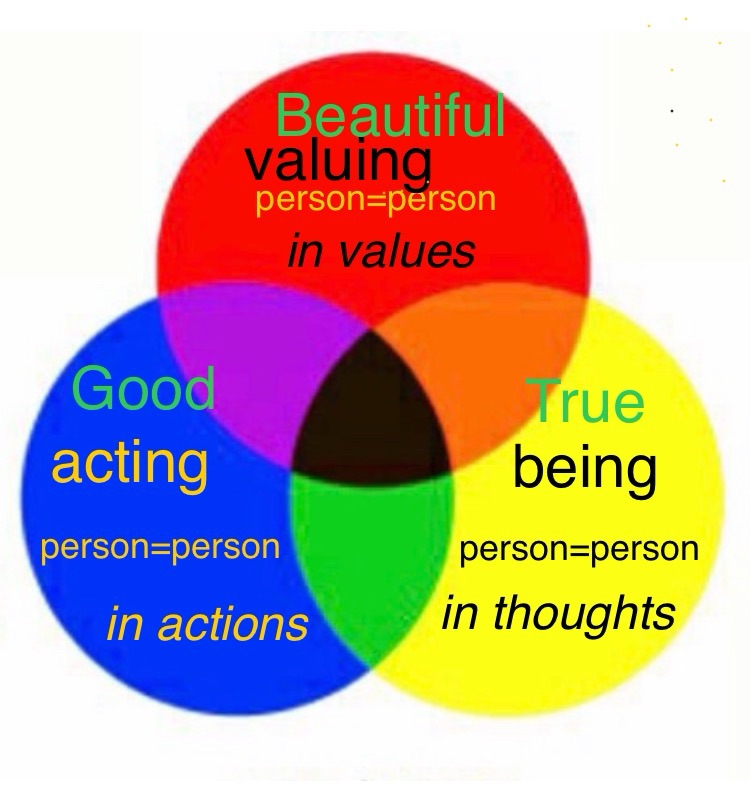
Science is descriptive – it cannot a) prescribe anything, or b) have a purpose behind it. It’s about the way we actually/evidently are and what we actually/evidently do.

Ethics is prescriptive – it cannot a) describe anything, or b) have a purpose behind it. It’s about the way we should be (and actually/evidently aren’t) and what we should do (and actually/evidently don’t).

Art is purposive – it cannot describe or prescribe anything. It’s about what we want to become, and how we want to behave, whether or not we already are like that or behave that way, and whether or not we should be like that or behave like that.

Venn generated by Copilot

Prescriptive rules are rules that imperfect people don’t always follow, but should. Legislation that prescribes imperfect behavior or character is no legislation at all.

Descriptive rules describe how we always behave (only a perfect person is ALWAYS described as behaving how they SHOULD behave).

Sometimes we fall back on the way we always behave, but if we don’t always behave that way, it’s because we can choose to behave a different way (which is not necessarily how we SHOULD behave).

Purposive rules (art) neither prescribe nor describe… they aren’t necessarily how we DO behave, nor how we SHOULD behave… they are what we WANT to be/have, what we WANT to do, or WHY we want it… whether or not things are already that way (descriptive science) or should be that way (prescriptive ethics).

If you’re doing ethics, you’re not (just) doing science or art (you are also prescribing a method, which is not itself a description or purpose/why).

If you’re not prescribing, you may still be doing ethics, but you’re not (just) doing ethics (you may also be describing the perfect…describing is science).

And if you are saying “I want this” you’re using a purposive rule, not (just) a description or a prescription. You’re not saying it is or isn’t that way (maybe it is, maybe it isn’t…yet)… you’re not saying it’s good or bad (maybe it is… maybe it isn’t). You’re just saying you want it. For better or worse.

Art (purposing) does more than merely describe or prescribe, and it may do neither. But the highest art does all three, omnipresently—as it is in the highest (immanent transcendence) kingdom.

The Good (prescriptive), the Loved (purposive), and the True (descriptive) are One/Whole (distinct and together).

Posted in Apologetics, Ethics & Metaethics, Euthyphro Dilemma, Harmonic Triads, Is-Ought Fallacy | Leave a comment

Two quotes compressed & distilled into a concentrated compact of… curiosity… :D

Divine impassibility is not a lack of passion, but an eternally unshakeable, rational passion.

—Anonymous (okay, it was me)

A counter-obligatory imperative is no imperative at all.

— Augustine of Hippo
(my translation, using deontic logic terms)

Posted in Apologetics, Harmonic Triads | 36 Comments

Harmonic Triads Reference, Current Index

This index is not exhaustive, but current as of October 2025:

The first fallacy: Ought-Value or Action-Quality Conflation

On the impossibility of knowing a true tenseless fact without omnitemporality (read all the comments)

Elaborating on C Theory

Logic Venn (of Opposition/Reconciliation)

C Theory of Time & the Venn of Import

Towards a JTB Ought-Is-Value Litmus

Harmonic Triads

Up next:

Also this and this. See the Harmonic Triads category for blog posts after (and before) October 2025 (the time of posting this particular blog post).

Posted in Epistemology, Ethics & Metaethics, Harmonic Triads, Is-Ought Fallacy, Justified True Belief | 3 Comments

The first fallacy: Ought-Value or Action-Quality Conflation

The first fallacy in philosophy, and not just the philosophy of ethics, is neither just the is-ought fallacy, nor just the failure to respect the fact-value distinction, but the fallacy of confusing the former for the latter: conflating oughts and values. This is relevant across every field, not just ethics, because it boils down and adds up to confusing action and quality. Together with the is/fact (substance) element from the first two mentioned fallacies, these three elements constitute the is-ought-value distinction, or the substance, action, quality triad. All three are required to obtain true, justified belief (knowledge) about anything, in any field of philosophy (including all the sciences). They are required together, but distinctly. One cannot stand in for either of the others.

But let’s begin in the field of ethics… messy work under construction.

Please note: Many of my posts on the blog from prior years DO commit the “first fallacy”.

Posted in Divine Essentialism, Harmonic Triads, Is-Ought Fallacy, Justified True Belief | Tagged , | Leave a comment

Jesus, the Great Philosopher (Bible App reading plan)

Join me for the next 5 days, Friend me for life: bible.com/p/73402169/9b6a021defc94523473032611bbe1b88

Posted in Apologetics | 2 Comments

The Personhood Program

Regardless what species we are materially, persons are all structured to be able to see when there is inconsistency between our thoughts, values, and behaviors. We know that we are persons, and that there are other persons. We know we have a choice to acknowledge what we know, in our thoughts, values, and behaviors. That is the only reason there is ever a difference between our thoughts, values, and behaviors. We aren’t programmed robots without the ability to “game” the program. Imagine if we went with the flow of the program rather than gaming it?

Posted in Apologetics, Ethics & Metaethics | 2 Comments

Who is the point?

Why? Why do we care what is true, or what is true about what is good? What is the meaning of life, or what is the point? If we are always good (if that were possible), can we still miss the point?

Does the majority decide the truly good point because we appreciate culture? Do we appeal to the behavior of other species in nature, or every living being’s instinct to survive? What about those things that we consider worth not only living but dying for? 

Can we point to anyone as a true example of someone who is always good and also always gets the point? If not, does that mean there is no true good, and no true point? Why do we have this feeling that there is more to life than merely surviving or running according to our genetic or cultural programming? 

Can there be an organizing principle … a point … that can only be willfully arrived at … that puts all of our competing values and instincts in proper alignment around it, such that, until we find this point, we hunger for it restlessly, we feel aimless, or like all our aims will eventually disappoint us, and never quite feel free from our genetic or social programming—to be who we are meant to be?

How can a mere principle represent the point of persons? Or could the principle also be personal? Who…? …since we can point to no one who always is, does, and values what is true, good, and meaningful? Or can’t we?

Posted in Apologetics | Leave a comment

On the impossibility of knowing a true tenseless fact without omnitemporality

TIME Q Posted on Equip / Reasonable Faith (also submitted as a question of the week) (Facebook discussion below)

I recently took the equip course on God‘s relationship to time and eternity. It was a great supplement to Dr. Craig’s recent coverage in the defenders course over a number of sessions.A lingering question I have is: How can God know a tenseless 1942 fact that is embedded (timestamped) in time unless that time exists in some sense, and he knows… Read more– ichthus77 (@Ichthus77) March 11, 2025

I recently took the Equip course on God‘s relationship to time and eternity. It was a great supplement to Dr. Craig’s recent coverage in the Defenders course over a number of sessions.

A lingering question I have is: How can God know a tenseless 1492 fact that is embedded (timestamped) in time unless that time exists in some sense, and he knows what time it is in that sense, because not only is he immanent in *that* time, he is omnitemporal (omniimmanent, omnipresent)? Would this be a synthesis of both A and B theories, or would it be a “kind” of (which?) one of those two theories?

***

Jabberwock

God is supposed to know counterfactuals and they do not ‘exist’ in any sense. So it seems that the issue described is just an instance of a greater question, i.e. how can God know anything without a causal chain shaping his knowledge?

***

I can see that some things would be able to be known without experience, or a priori, like the fact that opposites cancel each other out, so in order to have a whole you need more than two individuals of the sort that cancel each other out. So this whole must be always existing. However, something in 1492 is embedded in time even if you have gleaned it tenselessly. so that seems to be a synthetic a priori of a coeternal whole, no? And for the record, I do not think this violates free will, if the whole thing is complete on the spur of every moment/choice(s).

***

On Facebook (Christian Apologetics Alliance)

https://www.facebook.com/groups/caalliance/permalink/4241855109375311

Dave Homiack basically repeated Jabberwock and added in Dr. Craig’s “sin is never vanquished because/and Jesus is still hanging on the cross” critique of B Theory and defense of A Theory.

I reply:

I reply to you at 9:00am Pacific on Sunday, March 16, 2025. Tenselessly true (but actually false) ontologically prior to that moment in time, and only true in a tensed (actual) sense upon the reply’s insantiation within time. It’s like Schrodinger’s cat on Dr. Craig’s view, unless God is omnitemporal… timelessly dead in God’s mind, until finally alive in time. Or????? Do I not have this quite right?

I don’t think it is possible that he knows timestamped facts conceptually sans temporality (for the same reason Dr. Craig doesn’t think God can go back to timelessness), nor perceptually after the fact (he is omniscient—Kant’s original being… intellectual intuition), but rather it is only possible for God to know “in the fact” because (or, “if”) he is omnitemporal. If I am right, God doesn’t need to “fore”know or look ahead (or back)—he is already there (including here). We usually don’t understand this because we don’t understand time. Or God’s presence.

I think the situation is neither A nor B Theory. I am familiar with Dr. Craig’s “sin is never vanquished” argument against B Theory. But, he did point out the absurdity of every time existing at the same time, and it is equally absurd (for the same reason) to say that God forever hangs on the cross. Coeternality (omnitemporality, eternity) is not something we easily grasp, never mind the cross was not a magic trick. It would also be equally absurd to say “sin is never vanquished” or “eternal, unconditional love is never demonstrated” by pointing at every other moment outside the moments of the cross (assuming falsely they are absolutely empty of demonstration) just because a) B Theory fixes them in the timeline, or b) A Theory makes them false outside of now. So I’m thinking C Theory (God’s omnitemporality) resolves this. Plus not framing the cross as a kind of magic trick rather than a Signal from the eternal in language we learned in advance (via the Law & Prophets) so we could decode/understand/receive it when the Message was Sent.

Posted in Apologetics, Harmonic Triads | 17 Comments

Jesus’ “State of the Kingdom” Address

Jesus’ “State of the Kingdom” Address: Good News of the Kingdom: Costly Grace

https://a.co/d/6iE6IbX

Google Doc | Index | Discussion Questions

These are the words of Jesus found in the Gospels (Matthew, Mark, Luke/Acts, and John), and in Paul’s first letter to the Corinthian church, with only slight adaptation, as not much has changed in 2,000+ years. Parallel passages among the Gospels have been combined, and the order, rather than being (say) chronological, is according to the concepts being communicated. Verse references for further study, and discussion questions and commentary for individual or group reflection, are included after the address. Multiple English translations are credited on the copyright page.

Available in Kindle and Print, with discussion questions and Scripture references per section at the end.

PLEASE NOTE: Updates are no longer possible to the Kindle or printed version.

Corrections are noted here for future reference, and you can note them in your copy:

Verses added to the Index:
Unrighteous Steward section: expanded from Luke 16:1-8 to Luke 16:1-10.
Jesus Is Lord of the Sabbath section: added Luke 13:35
The Test of Greatness section: added Luke 13:34
The Hight Priestly Prayer section: added Matthew 26:64, Mark 14:62, Luke 22:69

Epigraph: added Luke 22:69

Posted in Apologetics, Ethics & Metaethics, Faith, Golden Rule, Natural Law and Divine Command, Neighboring, Problem of Evil & Hell, The Gospel | Leave a comment

Elaborating on C Theory

“The end is hypothetical while you are advancing towards or falling away from it. The end is hyperthetical once you have reached it.” (C Theory and the Venn of Import)

That was END. Now let’s talk about NOW, relative to the END (plan) and its realization (our perspective as beings subject to Time). 

(Updated 5/10/26) From the perspective of NOW (for beings subject to time), when a time is not currently happening (the past or future), it is hypothetical, but when it is currently happening (now), it is thetical—the entire plan is hypothetical and its entire fulfillment is hyperthetical. From the perspective of the past (from the perspective of the plan—in form) now is hyperthetical. From the perspective of the future (from the perspective of the plan—in soundness/fulfillment) now is hypothetical. 

[Think of nontensed language like gender neutral language. Instead of saying past and future, you say when, just like instead of saying he or she, you say they.]

From the perspective of realization (not yet whole becoming), what IS already fulfilled (the past), is hyperthetical, but what is not yet fulfilled (the future), is hypothetical. NOW is thetical from both the perspectives of the plan and realization. Relative to the past (from the perspective of realization) now is hypothetical. Relative to the future (from the perspective of realization) now is hyperthetical. 

That being said, we need to balance this part and do for it what we did for B theory in C Theory and the Venn of Import:

“The C Theory of Time is unlike A Theory because A Theory only acknowledges the essential status of the present moment, disregarding the essential status of the past and future as part of the whole Metanarrative of Time that began complete.”

Here’s what we did for B theory that needs to be done equally for A theory:

“C Theory is unlike B Theory because B Theory elevates every moment to the hyperthetical status of the past, disregarding that the changes subsumed by Being who is Time are necessary for beings subject to Time to freely participate with/in “Being in Relation” – a willful demonstration of essence that would not rightly be said to exist (in action or being) without such demonstration. Prior to the demonstration to beings subject to Time, the demonstration has hypothetical (essential) import if ontologically grounded in Being-in-Relation who is Time.”

So B theory sees it from the perspective of realization.

And now we will do the same for A theory, from the perspective of realization:

C Theory is unlike A Theory because A Theory demotes every moment except NOW to the hypothetical status of the future, disregarding that the unchanging essence of Being who is Time requires demonstration for beings subject to Time to freely participate with/in “Being in Relation” – a willful demonstration of essence that would not rightly be said to exist (in action or being) without such demonstration. According to C theory, prior to the demonstration to beings subject to Time, the demonstration has hypothetical (essential) import if ontologically grounded in Being-in-Relation who is Time (the whole plan). A theorists criticize B theorists because evil is never vanquished, and Jesus is *still* hanging on the cross. However, if that was accurate, then A theory ALSO (to be consistent) has evil never vanquished, and Jesus *never* hanging on the cross, because only NOW has essential (thetic) import.

C Theory subsumes realization in the plan—they are mutually productive. In other words, the realization (the fullness of the Godhead bodily) exists co-eternally with the Father (the whole/fulfilled plan in whom we live, move, and have our being). The Holy Spirit from the Father and the Son exists thetically.

In the beginning was the Signal (eternal message, end), and the Signal was the Source (eternal “spiritual material” medium), and the Signal was with the Source, and the Signal became the Sink (efficient means, demonstration, action in time).

In the beginning was the End Quality (Value), and the End Quality (Value) was the Substantial Being (Is), and the End Quality (Value) was with the Substantial Being (Is), and the End Quality (Value) became the Done Action (Ought).

Here is a more simple version of the Venn of Import:

Posted in Apologetics, Divine Essentialism, Epistemology, Euthyphro Dilemma, Gettier Problem, Harmonic Triads, Is-Ought Fallacy, Justified True Belief | Leave a comment