Groothuis’ “Christian Apologetics” ch.22: The Resurrection of Jesus

This chapter of Groothuis’ Christian Apologetics covers the evidence for the resurrection of Jesus (which is evidence that the Father approves of everything he said and did in his ministry on earth).

The significance of the resurrection:  “Of all the world’s religions, Christianity alone purports to be based on the resurrection of its divine founder.” Matthew 16:21, 12:40, John 2:19-22 (p.526)

Whereas in ch.20 John Frame is quoted to dispel rumors that the virgin birth is stolen from other religions or mythologies, in ch.22 Groothuis quotes Bruce Metzger and J.N.D. Anderson on why the resurrection is not likewise stolen. Perhaps I will combine those two sections into a unique post at some point. However, a) those rebirths symbolized spring, vs. b) resurrection on the 3rd day, and c) mystery religions were not yet well-established at that time.


Paul, writing two early for the theft hypothesis: “If Christ has not been raised, our preaching is useless and so is your faith.” (1 Corinthians 15:14)

There are other consequences if you read on to verse 19: 1) Christians are false witnesses, 2) Christians are unforgiven, alive or dead, 3) Christians are supremely pitiable, because their hope ends in this life.

The evidence for general theism, and the evidence for the resurrection, are both strong. One may come to Christianity through the evidence for the resurrection alone, without ever knowing the evidence for general theism. However, one may more readily accept the evidence for the resurrection, if one already accepts the evidence for theism, because if there is a God, miracles like the resurrection are more probable.

Groothuis defines a biblical miracle as “an act of divine agency whereby a supernatural effect is produced for the purpose of manifesting God’s kingdom on earth.” (p.532) (Hume misdefined it as a violation of the laws of nature.)

Groothuis defines a law of nature as describing “the basic properties of physical objects in relationship to one another.” (p. 532)

Hume’s Objection

Hume does not argue that miracles are metaphysically impossible, only that natural explanations are always more probable, and no amount of evidence could ever ground a belief that a miracle occurred (this begs the question). He argues that all miracle claims are based on misunderstandings of  prescientific,”ignorant and barbarous nations” who are not credible (however, the disciples were very skeptical, notably Thomas, and in order to identify a miracle, one needs to be able to identify the laws of nature by which they are contrasted).

However, it is not the general probability that ought to be considered for any event, it is that event’s conditional probability–the evidence that makes it more probable, despite its general improbability. As already mentioned, if God exists, this increases the probability (in this case, general) of miracles. The evidence for the resurrection, specifically, increases its conditional probability.

The “cancellation argument” against miracles: Various miracles of various conflicting religions cancel each other out. Answer: miracles do not directly support the truth claims of all religions, and the case for Jesus’ historical resurrection is far stronger than any other miracle claim made by a non-Christian religion.

Jesus was the “kind of person God might raise from the dead” (p538-539). 1) he was accredited by God through miracles, wonders, and signs (Acts 2:22), 2) he was a master teacher, 3) he was a man of compassion, 4) he was a worker of miracles, 5) his life fulfilled OT prophecies, 6) he claimed to be God, 7) he prophesied his own death and resurrection.

The “Minimal Facts” Approach: 

Using only those facts (“minimal facts“) contained in the NT that are accepted by both liberal and conservative critical NT scholars, the resurrection is shown to best explain them over rival hypotheses.

Four minimal facts:
1. Jesus died by crucifixion.
2. Jesus was buried in a known tomb. 
3. The tomb was found empty. 
4. There were postmortem appearances of Jesus.

Jesus died by crucifixion.

“Even if Jesus somehow survived the intense scourging, as well as the agonies of the cross … this would leave completely unexplained why Jesus’ disciples ended up hailing him the resurrected Lord of life.” (p.543)

Jesus was buried in a known tomb.

-There is no other burial tradition.
-Well-established through multiple, independent attestations (Matthew, Mark, John, 1 Cor.)
-Christians not likely to invent a member of the Jewish court that condemned Jesus (Joseph of Arimathea)

The tomb was found empty.

-It is found in Mark, probably the oldest Gospel, and 1 Corinthians 15.
-The stories are basic and lack fictional embellishments.
-All 4 Gospel accounts mention women witnesses (no cred in that culture) (principle of embarrassment)

There were postmortem appearances of Jesus.

12 (listed in chapter) in a 40-day period. As with discovering the empty tomb, women are the first witnesses of the risen Jesus. Since women had no cred in that culture, the disciples would not have invented their being the first witnesses (principle of embarrassment).

Paul is a very strong witness of the resurrection. In 1 Corinthians 15 he is settling a dispute in the church of Corinth over the resurrection of the dead, so he lists various post-resurrection appearances captured in an early creed (“What I received, I passed on…” probably from Peter and James, whom he mentions–eyewitnesses), dated to within 5 years of Jesus’ death.  In it, he (with the creed) affirms the physical nature of the resurrection. His is authorship is never disputed.

Other Well-Established Evidence

1. The transformation of the disciples from being full of fear (they fled), to being full of boldness (on Pentecost). (Also consider the conversion of skeptic James and persecutor Paul.)
2. The early worship of Jesus. (Philippians 2:5-11, another early Christian creed; Pliny the Younger Letters 10.96-97) –by monotheistic Jews
3. Circumstantial evidence (Acts: baptism, Lord’s supper, Sunday worship) presupposes Rez
4. Spiritual experiences in history and today

Alternative Theories

The Swoon Theory (including The Passover Plot version) was ruled out earlier in the chapter when discussing the minimal fact of the crucifixion.

~Hallucination~

Hallucination is the primary theory used to account for the appearances of Jesus (a minimal fact).

Problems with the Hallucination Theory:

1. They perceived Christ through sight, hearing and touch, and as a group.
2. Intense wish fulfillment was not a factor. A) They gave him up for dead, shocked he was alive. B) Thought resurrection happened to everyone at the end of history. C) Did not understand his repeated predictions of death and resurrection. D) Paul and James were not believers.
3. Christianity thrived and gained in popularity, when at first disciples were depressed.
4. The body could have been produced, the occupied tomb could have been investigated, in order to cure the hallucinations.

Theft Theory

Some claim the disciples stole the body — this is the only alternative theory recorded in the Bible. 

Problems:

1. The disciples had neither the motive, nor the means, to pull off the deception of hiding the body. 
2. They thought the resurrection happened to everyone at the end of history.
3. The theft theory cannot explain the appearances of Jesus.

Do this “Twelve Facts” Resurrection Logic Puzzle

Are there discrepancies in the resurrection accounts?

1. They can still be harmonized (only apparent, not real contradictions).
2. Secular history displays discrepancies as great or greater than.
3. All the accounts still agree on the resurrection.
4. Minor differences indicate authenticity, as upposed to collusion (in the case of uniformity).

Posted in Apologetics, Groothuis' 'Christian Apologetics', Reviews and Interviews | Leave a comment

Groothuis’ “Christian Apologetics” ch.21: Defending the Incarnation

The two major issues covered in this chapter of Groothuis’ Christian Apologetics are: 1) the “God or a bad man” argument for Jesus’ deity, and 2) the logical coherence of a “Godman” (someone who is both God and man).

The “God or a bad man” argument for the deity of Jesus from p. 507:

1. If Jesus claimed to be divine (in addition to being human), but was not divine, he was a bad man and merely human; that is, he was deceived, or a deceiver.

2. Jesus was not a bad man and merely human; that is, he was neither deceived, nor a deceiver.

3. Therefore, Jesus was divine (in addition to being human).


Objections:

A. The objection that it is the stuff of legend that Jesus ever claimed deity fails because 1. “the primary documents concerning Jesus were written only a few decades after his death by eyewitnesses or those who consulted them and other reliable sources” and 2) “we cannot find an original teaching of Jesus in which he is shorn of divine claims, either implicit or explicit.” (p. 509)

B. Jesus as guru. “If Jesus really meant to teach an esoteric message that differs completely from what Christianity has always taken it to mean, he was one of the worst teachers in the history of humanity, since for two thousand years he has been taken by his followers (and his critics) to teach monotheism.” (p. 510)

C. Jesus as a bad man (deceiver).  This fails because claiming deity was a very bad public relations maneuver in ancient Israel, and he got nothing out of it except crucifixion. What was his motive? How does all of that mesh with the rest of what we know about him? Why choose to believe he claimed deity, but trash the rest?

D. Jesus as deceived (either mistaken, but sane, or mad as a hatter). To mistake oneself as God is no small mistake, and “Jesus’ claim to have unique authority and supremacy in and over the universe is central to his beliefs and teachings and actions.” (Matthew 7:21-29; 11:28-30) (p. 513) How could he be such a master teacher about everything except his own deity? How could he be such a genius in the area of Ethics (see “greatest commandment” passages showing works flow from faith), and Matthew 7:24-29, 11:27, John 14:1-6, Acts 4:12), but be so deceived about his own identity? Although some claimed Jesus was insane or possessed, they did not persist in that belief (James, Jesus brother, converted to Christianity after his resurrection), or they only made such claims because they opposed his teaching. The fact that the Gospel authors do not shy away from mentioning this embarrassing detail is a testament to their confidence that he was who he claimed to be.

The statement of the Council of Chalcedon affirms the true humanity and true deity of Jesus in one person.

Hypostatic union is the relationship of Jesus’ divine and human natures as being “one person with two natures”.

Kierkegaard was wrong… (but right about a lot of other things)…

Contradiction vs. paradox. A contradiction involves 2 necessarily incompatible (irresolvable) properties, whereas a paradox appears contradictory, but there may be a resolution.

Contradiction:  Jesus possesses ONLY divine attributes and ONLY human attributes. (That’s not the incarnation.)

Paradox: Jesus possesses BOTH divine attributes AND human attributes. (That’s not contradictory.)

Just vs. fully. We are “just” human (and nothing more), but Jesus is “fully” human (plus divine).

Common vs. essential. Some properties are common to humans (being earth born), that are not essential for being a human (a human could be born in a space ship that has left earth’s atmosphere).  That Jesus does not possess those common properties (like “only possessing human properties” or “not having divine properties”) does not negate his humanity, as he does possess the essential properties of being human.

The Chalcedonian formulation is biblically orthodox and logically possible, therefore the incarnation is not logically incoherent.

The “God or a bad man” argument in my own words:

1. If Jesus wasn’t God, his claims to be God came from his own merely-human self-deception, or an evil motive to deceive.

2. There is too much evidence in favor of Jesus’ genius, confidence, self-composure, and perfect goodness.

3. Therefore he is neither deceived, nor a deceiver–he is God.
Posted in Apologetics, Groothuis' 'Christian Apologetics', Reviews and Interviews | Leave a comment

Groothuis’ “Christian Apologetics” ch.20: The Claims, Credentials and Achievements of Jesus Christ

This chapter of Groothuis’ Christian Apologetics shows how Jesus’ beliefs and actions in themselves are an apologetic for a high Christology. Since I cannot reproduce the whole chapter, here are some highlights:

Matthew tells of Jesus’ virgin birth, which means that he is fully human and fully God (his human origin was supernatural and God-ordained), but he did not inherit a sin nature (one of us, but beyond us). John Frame is quoted (and Acts 17:16-34; 1 Corinthians 1-2 and Colossians 2:8 are referenced) to dispel the rumor that his virgin birth is a copycat of other religions or mythologies. In particular, his birth is dissimilar to Buddha’s, as Buddha’s mother was not a virgin, Buddha was not considered supernatural, and that birth narrative was written 100s of years later.

Jesus is the transliteration of Joshua: Jehovah is salvation/Savior. Matthew and Luke (2:10-11) call him “Messiah, the Lord” — Messiah being a title meaning one is anointed by God.  “The Lord” is not used of any OT priests, prophets or kings.


In the public eye, Jesus was a spiritual liberator from demons and death. Reversing death itself was one of Jesus’ most spectacular displays of authority, as was exorcism and healing (Acts 10:38) a display of his power over Satan. 

“When Jesus makes reference to ‘sitting on his throne’ and rendering final judgment, he is indirectly claiming deity, since these prerogatives belong only to God according to Jewish Scriptures.” (p. 489) You can see his claims to deity in his “I AM” statements in John (6:48, 51; 8:12; 10:7,9, 11; 11:25; 14:6; 15:1, 5) (not sure why Groothuis does not include John 8:58). He displayed his authority in forgiving sins, proclaiming himself Judge, and speaking confidently. 

Jesus was a master teacher. He did not defer to others (as a typical rabbi would), but spoke on his own authority and left many questioners speechless and amazed. The word he used frequently, “Amen” or “Verily” or “Truly” or “Solemnly” or “Believe me” or “I tell you this” or “Remember this” et cetera) points to his sense of authority, sincerity and certainty (p. 490). Pascal described his teaching this way: “Jesus said great things so simply that he seems not to have thought about them, and yet so clearly that it is obvious what he thought about them. Such clarity together with such simplicity is wonderful.” (p.482)  

His basic worldview: God: “There is one God who is personal; knowable; worthy of adoration, worship, and service; separate from the creation ontologically but involved with creation through providence, prophecy, miracle and supremely in the life of Jesus himself.” (482) He had unique knowledge of God (Matthew 11:27, John 14:5-7). Humanity: Humans are God’s creatures, are more valued than animals and are spiritual beings with much to gain/lose spiritually, and are poisoned by sin. Ethics: The greatest commandment is to love God (faith saves, not works), and the second greatest flows from it: love your neighbor (the Other) as self.

And he practiced what he preached, interacting with the lowest class (tax collectors, sinners, women)–who happened to be very attentive to what he had to teach.

Now, this next piece–that Jesus was a miracle-worker–had me stumped, because Groothuis says Jews didn’t expect the Messiah to be a miracle-worker at the time of Jesus (so the disciples wouldn’t have invented that). That made me wonder why Jesus answered John the Baptist the way he did when John was in prison. I asked him and he said, “They were not expecting it, but Jesus showed that they should have been. He gave the proper–and logically defensible–understanding of the Hebrew Bible (Matthew 5-7).” But it just occurred to me, why did everybody keep asking Jesus for a sign, if they didn’t expect one? I just asked him that, and I’ll update this with his answer when I receive it.

Jesus received worship from others at his birth (Matthew 2:11), when he calmed the storm (Matthew 14:33), when he was risen (Matthew 28:1,9), by women (Matthew 28:17, Luke 24:52), and by the eleven.

His most frequent title he used in reference to himself was “Son of Man“, which carried strong divine and messianic connotations. There are several prophetic references in the Hebrew Bible specifically to the deity of the Messiah (Psalm 2:7-12; 110:1-2; Is. 7:14, Matthew 1:23; Is. 9:6-7; Micah 5:2; Jer. 23:5-6; Malachi 3:1).

“He faced his crucifixion not as an accident or a mistake, but as a necessary part of his mission.” (p. 495) “There would be no Christianity without his resurrection, which is central to the entire New Testament.” (p. 498)

John uses the word “Logos” to refer to the personal God of the universe who has taken on human nature to conquer sin.

Jesus is Savior, not a mere sage. He is the incarnation of God, not a mere avatar. And he is the Messiah, not a mere prophet.

All of the above considered, he said the “Law and the Prophets” spoke of him, giving them his stamp of divine approval. He says “Scripture cannot be broken” (John 10:35, 17:17). He did not come to abolish it, but fulfill it (Matthew 5:17-19; Luke 16:7, 24:25-27; John 5:9). He gave its proper interpretation to overcome temptation (Matthew 4:1-11, Luke 4:1-13) and correct the false shepherds (who nullified it through their human tradition, Matthew 15:1-6). “Jesus equated the Hebrew Bible with the very words of God, as when he said that David’s writing in Psalm 110 was through the Holy Spirit (Mark 12:35-36).” (p. 504)

The NT is a good source of knowledge about Jesus: “The apostles were personally commissioned by Jesus (Luke 6:13; Acts 9; Galatians 1:1), had unique historical experience with Jesus (Mark 3:14; John 15:27) and were given special inspiration as specially designated emissaries of Christ (e.g., 1 John 1:1-3; 2:7, 24; 1 Peter 1:22-25; 2 Thess. 3:6-15). This authority was recognized by the ancient church as the basis of their beliefs and practices (see Acts 2:42).” (p. 505)

A word on “inspiration” — “God, who cannot err, directed the writers of the Bible to write what God intended them to write, and to do so without any kind of error–logical, historical, scientific or moral.” (p. 504)

(discussion index)

Posted in Apologetics, Groothuis' 'Christian Apologetics', Reviews and Interviews | Leave a comment

"Objections to Faith" by David Spikes (12 yrs. old)

Sometimes people have objections about Christianity, such as “a loving God would never send people to hell,” or “since evil and suffering exist, a good God cannot,” or “miracles contradict science, so they cannot exist.”

One objection is that a loving God would never send people to Hell. Though Hell exists, it doesn’t mean that God sends people there. People have a choice whether to go to Heaven or Hell. It all depends on whether you accept God or not. If you don’t accept God right off the bat and then all of the sudden die, it doesn’t mean that you’ll be sent to Hell. It says in the Bible, whoever repents God is willing to save. The main consequence of not accepting God into your heart is forever separation from God in Hell.  Though Hell is the worst punishment possible, it is not covered in flames and unimaginably hot.  When it mentions flames in Hell in the bible, it is speaking figuratively. In the Bible it says how Jesus arrived surrounded by flames, with a sword in his mouth. To arrive with a sword in his mouth means that he used very powerful words (and I don’t mean that his words had super powers). Hell is supposed to be a place of darkness anyway. Flames would light things up. Again, God doesn’t send people to Hell; they have the choice to go there. The only sin that could get you into Hell is not accepting God, slamming the door in His face, and mocking Him.

Another commonly suggested objection is that, if evil and suffering exist, a good God cannot. I’m going to start out with an example. If you were to help your child along the way with everything they do, they wouldn’t exactly learn anything. They would end up being 34 and still living with their mother. In another situation, if you come across a bear caught in a bear trap the good thing to do would be to help it get free. You want to help but it tries to kill you every time you get close because it’s afraid. Then you shoot in with a tranquilizer dart and now it really thinks you’re out to get him. You then have to push his leg farther into the trap to release the trap. The bear would be thinking, “Why are you making me suffer?” This is basically what everyone goes through sometime in their life. Everything that God does is for your own good, even when it SEEMS that he could never hate you more. God also gives you the choice to love him or not. If he didn’t give you the choice then it wouldn’t be called real love. It’s just like how if you have a doll that will say “I love you,” every time you pull a string. That’s not real love. That’s forced love.  Even when in suffering, no matter whom you are, killer or Christian, God loves you with all of His heart and more.

My last objection is that miracles contradict science so they cannot exist.  “Suppose an apple falls from a tree. That illustrates the law of gravity. The apple will simply fall to the ground. However, what if I reached out and caught the apple before it hit the ground? Am I overturning the laws of gravity? Am I negating the law of gravity? No, not at all.  All I am doing is intervening. And that’s simply what God does when he performs a miracle. He doesn’t suspend the natural laws that govern the world or over turn them; he simply chooses to intervene. If I can intervene and catch the apple before it hits the ground, then certainly God can intervene in a similar way to accomplish what he wants to accomplish,” J.P. Moreland, philosopher. J.P. Moreland is saying that God doesn’t contradict science; all he is doing is intervening or catching the apple.

Again, many people have objections about the Christian faith, but there is a point where objections will keep coming until the person will realize that God is the correct path to take. A loving God will allow suffering for your own good. He will intervene in your life. He will teach discipline and most of all He will love you, no matter who you are.

See also:
Lee Strobel’s “The Case for Faith for Kids” summary with commentary
Posted in Apologetics Toolbox, Problem of Evil & Hell | Leave a comment

Undesigned Coincidences (resurrected by Dr. Tim McGrew in 2011)

I just updated two previous blog posts written in 2011 on Dr. McGrews (Library of Historical Apologetics) (EPS author) undesigned coincidences (1, 2).  I added some talks he has given since then, and linked to some of his newer resources, like this video (here is the full series of talks at Calvary Bible Church, with powerpoint and notes!), and the Audio Resources by Tim McGrew, including Internal Evidence for the Gospels by Tim McGrew (notes!) on Apologetics315.

The evidence called “undesigned coincidences” was resurrected from the archives of historical apologetics by Dr. Tim McGrew in early 2011, though a few mentions of it can be found earlier than that. You can find some material posted by the Christadelphians (they are Unitarians). I also found three books, one written in 2009, one it refers back to, written originally in the 50s and updated in the 90s, and one written in 1836, but is not among the ones mentioned by Dr. McGrew in one of my previous posts on u.c. (he does, however, refer back to J.J. Blunt and WIlliam Paley, where it all seems to have started, not counting the Bible).

There are undesigned coincidences I did not cover in my blog posts, which are covered in the newest talks to which I linked, so my posts need further updating (or perhaps I’ll just start a new one). I would also like to update the old posts to distinguish between internal and external, and reorder the numbering system accordingly.

I also want in *this* post to give a shout-out to some blog posts that have sprouted since Dr. McGrew’s 2011 resurrection of the “undesigned coincidences”…[there are also forums where u.c.s have been discussed: 1 (answered by Tim in a blog post below), 2, 3, 4, 5, 6, 7, 8 …some of them are deliberately abandoned, but feel free to resuscitate them if you feel it would be fruitful…]…

Berean church blog: Undesigned Coincidences by Dan Porte

CrossExamined: Undesigned Scriptural Coincidences: The Ring of Truth by Jonathan McLatchie

TC Apologetics: Scott Smith’s talk on Undesigned Coincidences

dangerous idea: Tim McGrew responds to Ed Babinski’s critique

Christian Apologetics Alliance: One example is used in The Nativity Defended by Jonathan McLatchie, more examples are given in J.w. Wartick’s Jesus’ Birth: How undesigned coincidences give evidence for the truth of the Gospel accounts, and he also points out that Jim Wallace lists some undesigned coincidences in chapter 12 of Cold Case Christianity (review).

J.w. Wartick: Forgotten Arguments for Christianity: Undesigned Coincidences- The argument stated


Thinking Matters: Tim McGrew on Undesigned Coincidences in the Gospels

Triablogue: Undesigned coincidences

Lydia McGrew’s What’s Wrong with the World (and Extra Talks): A Talk on Undesigned Coincidences in the Gospels and He Is Risen!

Gentle Reformation: Undesigned Coincidences – Tim McGrew

Psephizo: Undesigned Coincidences and historical reliability

The Gospel of Erik: (vid) Undesigned Coincidences: An argument for the veracity of the Gospels

Logos Apologia: Undesigned Coincidences from the Library of Historical Apologetics

MandM: Undesigned Coincidences in the Gospels – Tim McGrew

Wintery Knight: Tim McGrew explains how undesigned coincidences affect textual reliability (more)

theophilos: Undesigned coincidences inspired by the Holy Spirit

Biblo’s Blog: (audio) Undesigned Coincidences in the Gospels

Bible Think: Undesigned Coincidences (see right sidebar for more) (full pdf) (might be Christadelphian)

What had happen’ was…: Undesigned Coincidences in the Gospels by Tim McGrew – Apologetics315

agnus dei: Undesigned Coincidences – Evidence for the historicity of the Gospels (Tim McGrew)

Dead Heroes Don’t Save: Undesigned Coincidences: Feeding the 5000

The World of the Bible: History and the Gospels: Undesigned Coincidences

Cold and Lonely Truth: External Biblical Coincidences (audio)

Lastly, Ben Williamson shares his Discovered Undesigned Coincidences

Hopefully even more bloggers take hold of this and spread the word about undesigned coincidences, and start sharing ones they themselves discover, like Ben! :0)

Posted in Apologetics, Tim McGrew, Undesigned Coincidences | Leave a comment

A "Twelve Facts" resurrection logic puzzle

Reposting with additions in red. Originally posted July 7, 2011.

I am studying “the twelve facts” and want to get down what I’ve got so far. After the facts are displayed, we’re going to turn the whole thing into a logic puzzle. Added: Scroll down to the red lettering to work on this puzzle yourself. Share this thread on Facebook.

WATCH: Craig Hazen: Did Jesus Really Rise from the Dead?

Here are the 12 Facts:

1. Jesus died by Roman crucifixion. [1] [1b]

2. He was buried, most likely in a private tomb.

3. Soon afterwards the disciples were discouraged, bereaved and despondent, having lost hope.

4. Jesus’ tomb was found empty very soon after his interment.

5. The disciples had experiences that they believed were the actual appearances of the risen Christ. [2] [2b] [Note that this belief persisted despite Jews believing the resurrection does not happen to ‘one’ person in the ‘middle’ of history.]
Continue reading

Posted in Apologetics, Apologetics Toolbox | 3 Comments

Biblical faith in the "unseen" does not equal "blind" faith.

2 Corinthians 4:18 “So we fix our eyes not on what is seen, but on what is unseen, since what is seen is temporary, but what is unseen is eternal.” (retweet)

Believing in the unseen eternal is NOT blind faith. All faith verses need to be read in that light. The “New Atheists” and Christian fideists have a very warped, unbiblical definition of faith.

Faith is about trust and loyalty.  You have faith in your spouse that s/he is faithful.  This faith is not blind, and neither is biblical faith. Everyone in the Bible who has faith in the unseen (God’s unfulfilled promises about our eternal relationship with him), bases their faith on the reality that they have seen God fulfill other promises up to that point. The heroes of the faith in Hebrews 11 all based their faith on a God they saw working in their lives. 

Hebrews 11:1 “Now faith is confidence in what we hope for and assurance about what we do not see.” (NIV)

“…about what we do not see…” YET!


Romans 8:24 “For in this hope we were saved. But hope that is seen is no hope at all. Who hopes for what they already have?” (NIV)

So, keep in mind that when you read, “For we live by faith, not by sight” (2 Corinthians 5:7, NIV), you are NOT reading about blind faith! You are reading about placing your hope in the unchanging eternal (it is still in the future from your current perspective), rather than getting discouraged by the vicissitudes of the things you see now.

You may not see God working in your life…yet. But there is evidence of him everywhere, and he is drawing you to it–he’s been here all along.  Check out the theistic arguments from natural theology.  Check out the evidence from history.  Don’t stop with those links–they are not even the tip of the tip of the iceberg for you to explore.  

A.sk, S.eek, K.nock (A.S.K.)
Posted in Faith | 1 Comment

Rejecting grace because the evil don’t pay?

Do you reject grace because you want people to pay for evil? Remember: You are relatively good by comparison to evil, but not by comparison to Perfect. (retweet)

When we stop loving/forgiving, it is because we stopped acknowledging God’s love and forgiveness, which motivates ours of others. (retweet)

James 2:17 “…faith by itself, if it is not accompanied by action, is dead.” (NIV) If we can’t bring ourselves to forgive others, it is because we do not have faith that we are forgiven. (retweet)

Matthew 18:33 “Shouldn’t you have had mercy on your fellow servant just as I had on you?” (NIV) If we have faith that we are forgiven, we have no right to withhold forgiveness of others. (retweet)

Matthew 5:17 “Do not think that I have come to abolish the Law or the Prophets; I have not come to abolish them but to fulfill them.” (NIV) #GoldenRule Forgiveness does not mean the bar is lowered.  The bar is Golden-Rule grace, and we are held to it. We are also forgiven for not measuring up to it, and should extend the same forgiveness. (retweet)

Romans 6:1-2 “Shall we go on sinning so that grace may increase? By no means! We are those who have died to sin; how can we live in it any longer?” (NIV) Withholding forgiveness brings a death that we have died to through God extending his forgiveness, which brings new life, especially when we extend it to others. (retweet)

Besides that, forgiveness is not the same as letting people get away with evil!…

Matthew 18:6 “…it would be better for them to have a large millstone hung around their neck and to be drowned in the depths of the sea.” (NIV) God is not going to let people get away with evil. (retweet)

Hebrews 12:6 “…because the Lord disciplines the one he loves, and he chastens everyone he accepts as his son.” (NIV) God’s love is not weak. (retweet)

Posted in Problem of Evil & Hell | Leave a comment

The difference between atheism, theism, and agnosticism.

The difference between atheism, theism, and agnosticism.

Posted in Apologetics | 2 Comments

The difference between atheism, theism, and agnosticism.

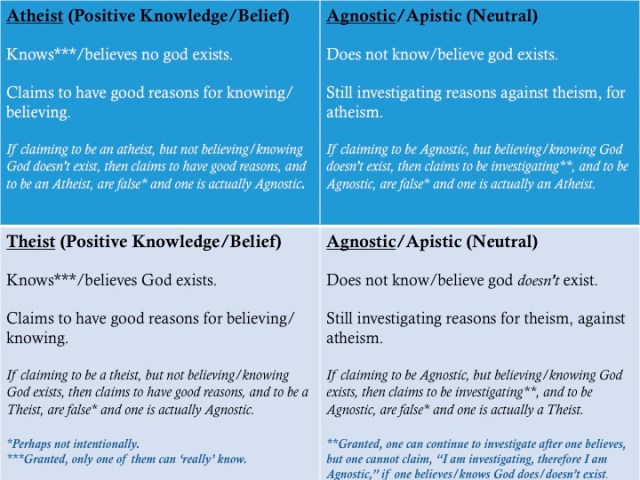
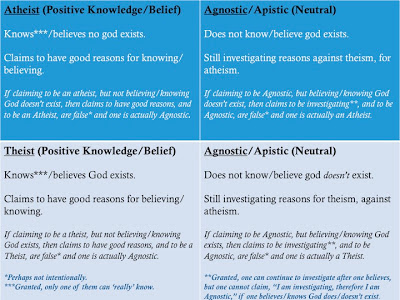
The chart below is made in response to this chart, which was meant to show that atheism is not a belief, and that there can be agnostic atheists and agnostic theists.  
In contrast, my chart shows atheism ‘is’ a belief and that there is no such thing as an agnostic atheist or agnostic theist (only an ‘agnostic’–that’s why there are two boxes for that view, though they could easily be combined into one).  Previous articles on this topic are below the chart and may or may not need some rethinking in light of this chart.


Previous articles:

Jerry Coyne vs. Stephen Meyers
Replace agnosticism with apisticism on every belief scaleNovember 11, 2010

Posted in Apisticism, Faith | Leave a comment